
Clinical Competency Management Software for Healthcare Organizations
Standardise clinical onboarding, validate competence, maintain audit-ready evidence and provide clear visibility into workforce readiness before independent practice across nursing, allied health and other clinical disciplines.
The platform brings together competency requirements, assessments, credentials, clinical authorizations and evidence within a single clinical competency record—providing clinical educators, managers and healthcare leaders with real-time visibility into workforce readiness before independent practice.
Supports: Magnet® • Joint Commission • VA • Nursing • Allied Health • Multi-site Health Systems
Designed for Diverse Clinical Workforces
Healthcare organizations often need to manage competency requirements across multiple professional groups, each with different scopes of practice, assessment methods and regulatory requirements.
Centranum supports configurable competency frameworks for:
☑️ Nursing
☑️ Allied Health
☑️ Pharmacy
☑️ Medical Staff
☑️ Mental Health
☑️ Community Health
☑️ Aged Care
☑️ Technical & Diagnostic Services
☑️ Students, Graduates and Transition-to-Practice programmes
Healthcare organizations can manage all clinical professions within a single workforce capability platform while allowing each profession, specialty and service to maintain its own competency framework, assessment methods, governance requirements and reporting.

SOC 2 Certified • Audit-ready reporting • Trusted in high-compliance healthcare environments for over 20 years
Why Healthcare Organizations Need a More Structured Clinical System
Healthcare organizations manage a constant cycle of onboarding, competency assessment, annual validation, credential renewal and professional development. As staff move between units, new procedures are introduced and accreditation requirements evolve, maintaining an accurate view of clinical competency becomes increasingly difficult.
Many organizations continue to rely on spreadsheets, paper checklists and disconnected systems, making it difficult to answer fundamental questions such as:
- Who is ready for independent practice?
- Which competencies are still outstanding?
- Are mandatory credentials and certifications current?
- Where is the supporting evidence for this assessment?
- Which staff are ready to work in another unit or specialty?

Common challenges include:
- Disconnected onboarding and preceptor sign-offs.
- Competency evidence stored across multiple systems and documents.
- Knowledge testing managed separately from clinical validation.
- Limited visibility of credential expiry and renewal requirements.
- Inconsistent assessment standards across units, specialties and sites.
- Delays in confirming readiness before independent practice.
- Time-consuming preparation for accreditation surveys and clinical audits.
Centranum brings competency requirements, assessments, knowledge verification, credentials and supporting evidence together within a single clinical competency platform—providing clinical educators, managers and healthcare leaders with real-time visibility into workforce readiness, compliance and clinical capability.
When Healthcare Organizations Review Their Clinical Competency Approach
Healthcare organizations typically review their clinical competency processes when existing systems no longer provide the visibility, consistency or governance needed to support safe practice and workforce readiness.
Common triggers include:
- Onboarding and transition-to-practice programmes become difficult to manage consistently across nursing, allied health and other clinical disciplines.
- Competency evidence is spread across spreadsheets, paper records, learning systems and shared drives.
- Clinical educators and managers need clearer visibility into readiness for independent practice.
- Magnet®, Joint Commission, VA or other accreditation activities require stronger evidence and audit trails.
- Competency, credential, certification and licensure records are managed in separate systems.
- Multiple hospitals, units, specialties or professional groups need consistent competency frameworks and assessment processes.
- Workforce shortages increase the need for cross-training, float pool management and flexible deployment.
Clinical educators spend significant time chasing assessments, evidence, credential renewals and overdue validations.
These situations often reveal the same underlying issue: clinical competency information exists, but there is no single, reliable view of workforce readiness across the organization.
What to Look for in Clinical Competency Management Software
Clinical competency management platforms vary considerably in their approach. Some focus primarily on learning management or checklist completion, while others provide a more comprehensive framework for managing clinical competency, credentials and workforce readiness.
When evaluating solutions, consider whether the platform supports:
Clinical Competency Frameworks
Can competency requirements be configured by profession, role, specialty, unit or service? Flexible framework design allows organizations to maintain consistent governance while supporting different clinical disciplines and scopes of practice.
Assessment
Does the platform support structured assessment processes that can be adapted to different clinical roles and competency requirements? Look for assessment workflows that can combine self-assessment with assessment by managers, preceptors, clinical assessors or other authorized roles. The process should be consistent, evidence-based and flexible enough to reflect different clinical responsibilities and levels of practice.
Flexible Competency Verification
Can the method used to verify competency be matched to the competency being assessed? Different competencies require different forms of evidence. Look for the ability to configure verification methods such as direct observation, return demonstration, simulation, document review, evidence of daily work, case studies, peer review, self-assessment, discussion, presentations, tests, surveys or feedback, quality monitors and other organization-defined methods.
Knowledge Verification
Can knowledge testing be linked directly to competency requirements as part of the assessment process? Knowledge assessment can complement practical and observational verification by confirming that employees understand the principles, procedures and clinical knowledge that underpin safe and competent practice.
Evidence & Credential Management
Can competency evidence, professional portfolios, qualifications, certifications and licensure be managed alongside competency records? A single clinical record reduces duplication and improves audit readiness.
Clinical Authorizations & Scope of Practice
Can the platform manage clinical authorizations separately from competency assessments? While demonstrated competence is essential, many healthcare organizations also require formal approval before clinicians can perform specific procedures or practise independently. Look for support for scope of practice, procedural authorizations, approval workflows and renewal requirements.
Workforce Readiness & Clinical Visibility
Can educators, managers and clinical leaders quickly identify who is ready for independent practice, where competency gaps exist and which credentials or validations are due for renewal?
Security, Governance & Compliance
Does the platform provide role-based access, audit trails, structured governance and enterprise-grade security suitable for healthcare environments?
Centranum combines these capabilities within a single clinical competency and workforce readiness platform, helping healthcare organizations manage onboarding, competency validation, credentials, evidence and workforce readiness from one integrated system.

A Unified Clinical Competency Management Platform
Clinical onboarding, ongoing validation and credential tracking require more than spreadsheets, LMS records or isolated competency files. Clinical educators, managers and healthcare leaders need a structured platform that connects requirements, assessments, evidence, credentials and readiness in one place.
Centranum provides a unified clinical competency record for each staff member, showing:
- role, unit, specialty and discipline-specific competency requirements
- current assessment and validation status
- supporting evidence and professional portfolio items
- certifications, credentials, licence and renewal status
- knowledge checks and linked learning resources
- clinical authorizations and scope-of-practice indicators where required
- readiness status at individual, unit and organization level
This gives healthcare organizations a clearer view of who is competent, credentialled, authorised and ready for practice — while reducing reliance on spreadsheets, paper checklists and disconnected systems.
Clinical Onboarding & Tiered Competency Progression
Hospitals require structured onboarding pathways that move clinicians from supervised orientation to independent practice with clearly defined competency milestones. Manual checklists and informal sign-offs create inconsistency, delays and limited visibility of readiness.
Centranum supports structured onboarding and tiered orientation models—including TSAM-style progression—within a governed clinical competency framework that provides clear visibility of competency progression and readiness for independent practice.
Healthcare organizations can:
- Automatically assign onboarding competency requirements by role and unit
- Structure tiered progression levels with defined validation criteria
- Support supervisor or preceptor-based observation, sign-off and documented evidence
- Link knowledge validation to clinical proficiency milestones
- Track readiness status before independent practice
- Record clinical authorizations and approvals required before independent practice where applicable.
- Generate structured, audit-ready records of onboarding progression

Progression is based on validated assessment outcomes, supporting evidence and approval workflows—not checklist completion alone—ensuring onboarding reflects demonstrated competence and readiness for independent practice.
Integrated Clinical Competency & Credential Management
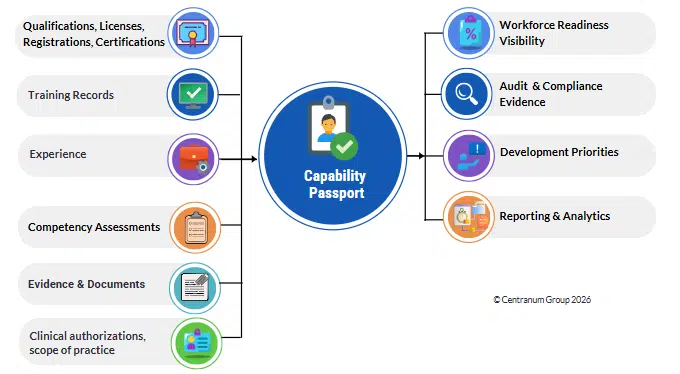
Clinical competency, credentials and clinical authorisations should be managed together. Separating competency validation from licensure, certification, authorizations and renewal tracking creates gaps in workforce readiness and makes it difficult to confirm that clinicians are both competent and authorized to practise.
Centranum integrates:
- Clinical competency frameworks and structured assessments
- Credentials, licensure, certifications and professional registrations
- Clinical authorizations and scope-of-practice approvals
- Expiry monitoring, renewal alerts and revalidation requirements
- Required versus achieved comparisons at role, specialty and unit level
- Consolidated evidence records for both competency and capability
By bringing demonstrated competence, credentials, clinical authorizations and supporting evidence together within a single clinical record, healthcare organizations gain a clear, reliable view of workforce readiness across nursing, allied health and other clinical disciplines.
Ready to replace fragmented competency tracking with a single clinical competency platform?
How Structured Clinical Competency Works
Define
Establish clear clinical standards

Build and maintain clinical competency frameworks aligned to roles, units, specialties and professional disciplines. Define required credentials, competencies, indicators, proficiency expectations and authorizations so validation standards are consistent across nursing, allied health and other clinical teams.
Validate
Assess clinical practice in context

Support multiple validation methods, including direct observation, supervised practice, preceptor or educator sign-off, knowledge testing and evidence review. Capture structured assessment outcomes against defined criteria, with approval workflows where required.
Assure
Maintain readiness, evidence and governance

Consolidate competency validation, credentials, authorizations and historical records into real-time dashboards and reports. Monitor required versus achieved standards, identify gaps and maintain defensible documentation for audits, accreditation and internal review.
Delivered through integrated modules designed specifically for clinical competency, credential management and workforce readiness.
Clinical Competency Framework
Central Clinical Competency Library
Manage clinical competency requirements within a single structured library designed to support nursing, allied health, medical and other clinical disciplines. Competencies can be created, reviewed and updated consistently across units, specialties and professional groups while maintaining version control, governance and audit integrity. Existing competency frameworks can also be imported.
Provide clinicians with clear role expectations, competency standards and access to supporting learning resources in one place. Structured indicators and proficiency criteria help ensure consistent assessment and a shared understanding of competent clinical practice.
Centralised framework management enables organization-wide updates while preserving version history, supporting accreditation, governance and continuous improvement.
Outcome: A single source of truth for clinical competency requirements across the organization.


Clinical Competency Mapping & Career Pathways
Map clinical competency requirements to roles, units, specialties and career pathways across your organization. Profiles can reflect current scope of practice, transition-to-practice programmes, clinical ladder frameworks, specialty requirements and preparation for advanced or expanded roles.
Staff can compare required versus achieved competencies, helping them understand current readiness, identify development priorities and plan their next career step.
Changes to competency frameworks are automatically reflected across all mapped roles and profiles, maintaining structural integrity and ensuring reporting remains accurate as clinical practice evolves.
This supports consistent onboarding, structured clinical career progression and workforce readiness across nursing, allied health and other clinical disciplines.
Outcome: Clear career pathways supported by consistent competency standards and real-time readiness visibility.
Assessment & Validation
Competency Assessments & Clinical Validation
Centranum provides structured clinical competency assessment using multiple validation methods, helping healthcare organizations apply consistent standards across roles, units and specialties while maintaining clear evidence of demonstrated competence.
Clinical competency can be evaluated through:
- Direct observation in clinical practice
- Supervised or preceptor-based assessment
- Practical demonstration of clinical skills
- Competency-linked knowledge testing
- Evidence review and documented clinical practice

Assessors record outcomes against defined competency criteria and indicators, creating structured, role-based assessment records with real-time visibility of required versus achieved standards.
Coordinators benefit from assessor dashboards, automated reminders and streamlined workflows that keep competency reviews on schedule. Assessments can be completed on desktop or mobile devices, supporting validation as part of everyday clinical practice.
Outcome: Consistent, evidence-based clinical competency validation with complete audit trails rather than informal sign-offs or disconnected tracking systems.
Integrated Clinical Assessment Engines
Healthcare organizations often need different assessment approaches depending on the clinical activity, profession or stage of development. Centranum provides three complementary assessment pathways within a single competency framework.
1. Structured Competency Assessment
Role, specialty and unit-specific assessment templates enable clinical performance to be evaluated against defined competency indicators and proficiency expectations. Supporting notes, attachments and evidence are retained within the relevant competency record.
2. Flexible Clinical Skills Forms
Configurable clinical forms support practical skills assessment, behavioural observation and clinical scenarios using consistent evaluation criteria. Forms may be initiated by educators, preceptors or clinicians and are automatically linked to the relevant competency record, creating a consolidated evidence history.
3. Ad-Hoc Competency Assessment
Assess any competency, component or clinical profile at any time. This supports new procedures, remediation, return-to-practice, annual validation and post-training confirmation without creating unnecessary administrative effort.
Outcome: Clinical competence is assessed using the most appropriate method while maintaining consistent standards, complete traceability and structured documentation across the organization.
Knowledge Testing (Competency Linked)
Knowledge alone does not demonstrate clinical competence—but it provides an important foundation for safe clinical practice. Integrating knowledge verification with workplace assessment creates a more complete picture of workforce readiness.
Centranum includes integrated, competency-linked knowledge testing, allowing discipline-specific teams to develop and maintain question banks that support nursing, allied health and other clinical professions.
Knowledge assessments can be automatically assigned and, where configured, results update the relevant competency record in real time alongside workplace assessment outcomes.
Outcome: Clinical educators gain a single view of theoretical knowledge, demonstrated competence and workforce readiness within the same structured clinical record.

Together these assessment pathways provide the evidence required for effective clinical competency assurance, supporting workforce readiness, accreditation and safe deployment decisions.
Evidence, Capability & Documentation
Capability Passport, Scope of Practice & Clinical Authorizations

Clinical workforce readiness depends on both demonstrated competence and verified professional capability. The Capability Passport brings together qualifications, certifications, licensure, clinical authorizations and validated competencies within a single structured clinical record.
The Clinical Capability Passport provides visibility of:
- Qualifications and specialty credentials
- Licensure status and renewal tracking
- Mandatory and role-specific training
- Continuing education (CE/CPD)
- Validated competency outcomes
- Clinical authorizations and scope of practice
Each record is supported by linked evidence and mapped to role requirements, providing educators and managers with a clear view of competency, authorization, scope of practice and workforce readiness.
Clinical Evidence & Professional Portfolio
Clinical competency is strengthened by evidence gathered throughout everyday clinical practice—not solely through formal assessments.
The Professional Portfolio can capture:
- Reflective practice and case notes in their journal
- Practical evaluation outcomes
- Linked competency evidence
- CE/CPD activity
- Supporting documentation
All entries are timestamped and associated with the relevant competency or role requirement.
Each clinician’s Professional Portfolio brings together competency status, credential records and clinical evidence — providing a consolidated view of readiness, progression and compliance when required.

Outcome: A consolidated professional portfolio that supports competency assurance, career development, accreditation and clinical governance.
See how structured assessments, knowledge verification and evidence work together in practice.
Workforce Readiness, Credentials & Analytics
Credential & Licensure Tracking

Credential tracking and competency validation operate within the same structured system, ensuring clinical eligibility and demonstrated competence are visible together.
Organizations can:
- Define credential and licensure requirements by role
- Monitor renewals and expirations with automated alerts
- View upcoming risks through expiry dashboards and heatmaps
- Confirm eligibility before assigning duties, independent practice or specific clinical procedures.
Outcome: Managers have confidence that clinicians are both credentialled and authorised before undertaking clinical duties.
Workforce Readiness Dashboard
Centranum provides readiness views that bring together competency validation, credentials, clinical authorizations and role requirements to show current readiness at individual, team, unit or discipline level.
Clinical educators and managers can quickly see:
- who is ready for independent practice
- outstanding competency or credential requirements
- upcoming licence, certification or authorization renewals
- readiness gaps by role, unit, specialty or professional group
- cross-training and deployment readiness where applicable
These views support day-to-day clinical workforce decisions without relying on separate spreadsheets or manual status checks.
Outcome: Managers and educators gain clear visibility of readiness for current roles, specialty requirements and independent practice.
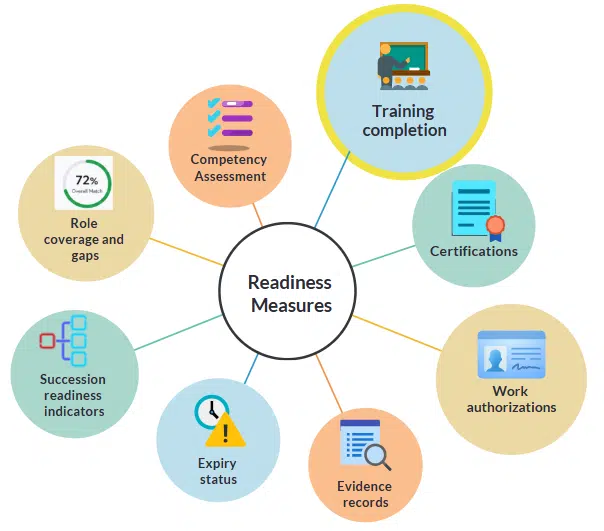
Workforce readiness brings together validated competency, credentials, authorizations, knowledge, training and evidence into a single operational view.
Analytics & Reporting
Centranum provides structured analytics and exportable reports that help healthcare organizations monitor workforce capability, demonstrate compliance and support continuous improvement.
Leaders can analyse:
- Required versus achieved competency levels across units, specialties and professional groups
- Competency validation completion and assessment activity
- Workforce readiness trends over time
- Competency gaps at individual, team and organizational level
- Credential, certification and authorization compliance
- Competency coverage and versatility to support workforce planning and competency-based staffing

Reports draw directly from validated assessments, verified credentials, clinical authorizations and structured role requirements, ensuring consistency and audit defensibility without manual collation.
Exportable reports support accreditation surveys, internal governance, workforce planning, quality improvement and regulatory compliance.
Outcome: Reliable reporting provides the evidence needed to support accreditation, clinical governance and strategic workforce planning.
U.S. Accreditation: Magnet®, Joint Commission & VA
Support competency assurance, workforce readiness and accreditation with structured, audit-ready evidence.
Centranum supports U.S. healthcare organizations in meeting the expectations of major accreditation and quality programmes, including Magnet®, Joint Commission and VA healthcare systems. By bringing competency requirements, assessments, credentials, clinical authorizations and supporting evidence together within one structured platform, organizations can more easily demonstrate workforce readiness, competency assurance and compliance.
Centranum helps organizations to:
- Magnet®: Maintain clear competency expectations, documented development activity and validated workforce capability records
- Joint Commission: Demonstrate clinical competency, workforce readiness, credential status and supporting evidence through structured, audit-ready records.
- VA Facilities: Configure specialty-specific competency requirements and track validation against facility protocols
Outcome: Accreditation evidence is available from a single structured system, reducing manual preparation and improving confidence during surveys and audits.
Survey preparation no longer requires manual collation of evidence across multiple systems.
Enterprise-Grade Security & Compliance
Centranum has supported hospitals, government agencies and other high-compliance organizations for more than two decades. The platform is designed for environments where workforce capability, credential integrity and auditability are critical.
- SOC 2 Type II certified
- Regional hosting options, including U.S. deployment
- Role-based access controls with comprehensive audit logging
- Single-tenant architecture with logical separation of customer data
- Configurable governance supporting multi-site and multi-entity healthcare organizations
Centranum enables healthcare organizations to manage clinical competency, credentials, workforce readiness and supporting evidence within a secure platform designed for enterprise governance, operational assurance and regulatory compliance.
Outcome: Healthcare organizations gain confidence that clinical competency and workforce readiness information is managed securely, consistently and with full auditability.


Frequently asked Questions
What is clinical competency management?
Clinical competency management is the structured process of defining clinical competency requirements, assessing competence, validating evidence and maintaining ongoing visibility of workforce readiness. It provides healthcare organisations with a consistent way to demonstrate that clinicians have the knowledge, skills, credentials and authorisations required for safe clinical practice.
How is clinical competency management different from standard HR or learning systems?
HR systems typically manage employment information, while learning management systems focus on training delivery and completion. Clinical competency management brings together role requirements, competency assessments, knowledge verification, credentials, evidence and workforce readiness within a single structured platform.
What is the difference between clinical competency and workforce readiness?
Clinical competency demonstrates that an individual has met defined competency requirements. Workforce readiness provides a broader operational view by combining validated competencies, credentials, clinical authorizations, mandatory training and supporting evidence to determine whether someone is ready to undertake a specific clinical role or scope of practice.
Can Centranum support Magnet®, Joint Commission and VA healthcare programmes?
Yes. Centranum helps healthcare organizations maintain structured competency frameworks, documented assessments, credentials, evidence and audit trails that support accreditation, clinical governance and workforce readiness. The platform is configurable to align with organizational and regulatory requirements.
How does the platform support onboarding and transition-to-practice?
Structured onboarding pathways allow organizations to assign competency requirements by role, unit and specialty, monitor progression through defined competency milestones, support preceptor validation and provide clear visibility of readiness before independent practice.
What assessment methods are supported?
Centranum supports multiple assessment methods including direct observation, supervised practice, preceptor assessment, practical demonstration, competency-linked knowledge testing, structured assessment forms and evidence review. Assessment workflows can be configured to suit different clinical disciplines and organizational requirements.
Does the platform include competency-linked knowledge testing?
Yes. Integrated knowledge testing enables organisations to verify theoretical understanding alongside workplace assessment. Where configured, knowledge test results can automatically update competency records, contributing to a unified view of workforce readiness.
Can competencies differ by profession, unit or specialty?
Yes. Competency frameworks can be configured for nursing, allied health, medical and other clinical disciplines, with role, unit, specialty and service-specific requirements while maintaining consistent governance across the organization.
Can we import our existing competency framework?
Yes. Most organizations begin by importing existing competency models, checklists and credential requirements.
Centranum supports bulk upload from spreadsheets and templates, after which competencies can be mapped to roles, units and progression levels. Frameworks can be refined over time without losing historical version records.
How does Centranum reduce administrative workload for clinical educators and managers?
Centranum reduces manual administration by centralising competency frameworks, assessments, credentials, knowledge testing and supporting evidence within a single platform. Automated assignment of role requirements, assessment workflows, reminders, renewal tracking and real-time readiness visibility reduce the need for spreadsheets, paper records and manual follow-up. Clinical educators spend less time coordinating competency documentation and more time supporting staff development and clinical practice.
How secure is the platform?
Centranum is SOC 2 Type II certified and provides enterprise-grade security including role-based access controls, comprehensive audit logging, regional hosting options and single-tenant architecture designed for healthcare and other high-compliance environments.
Related Reading
For deeper insights into clinical compliance and audit readiness, explore these resources.
Workforce insights – Why Workforce Capability Data Is Becoming Strategic Infrastructure
Competency Management System Cost & ROI
Clinical Competency Compliance Toolkit
Magnet vs Pathway to Excellence: evidence requirements made practical
Magnet Documentation Factsheet
Also see Capability and Competency Resources for articles on concepts, examples and applications, implementation guides, business case and research.
A-Z Glossary of Competency Management for all terminology and processes
Skills and Competency Management Software – for non- clinical competency management