
Skills Matrix vs Competency Framework
Definition
Skills Matrices and Competency Frameworks are both used to support workforce capability management, but they serve different purposes.
A Skills Matrix provides visibility of the skills held by individuals or teams and is often used to identify skill coverage, training needs and workforce deployment options.
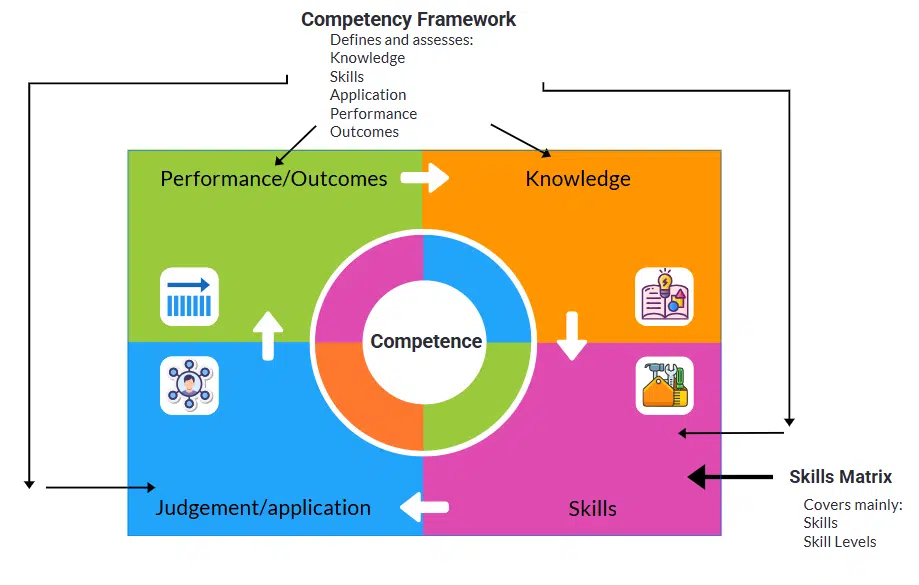
A Competency Framework defines the knowledge, skills and other requirements needed for successful performance in a role or work context. It provides a structure for assessing, developing and managing workforce capability.
Skills and competencies are closely related. Skills often form part of competency, but competency reflects the effective application of knowledge and skills within a workplace context.
Part of the Workforce Capability Knowledge Index: Explore related workforce capability, competency and readiness concepts.
Why the Difference Matters
Many organisations use skills matrices to understand workforce capability and identify skill gaps.
However, organisations often need to answer broader questions such as:
- What knowledge and skills are required for successful performance?
- Have required competencies been demonstrated?
- What evidence supports competency decisions?
- Which capability gaps create operational risk?
- How can workforce readiness be assessed?
- How should workforce development be prioritised?
Understanding the difference between skills matrices and competency frameworks helps organisations select the most appropriate approach for their workforce needs.
What is a skills matrix?
A Skills Matrix is a structured view of skills across individuals, teams or workforce groups.
Skills matrices are commonly used to:
- identify skill coverage,
- monitor skill levels,
- support workforce deployment,
- identify training needs,
- and highlight skill gaps.
Skills matrices focus on the skills required to perform specific tasks, activities or operational responsibilities.
Example
| Employee | Forklift Operation | Welding | Equipment Inspection |
|---|
| Employee A | Level 3 | Level 2 | Level 3 |
| Employee B | Level 2 | Level 0 | Level 3 |
| Employee C | Level 0 | Level 3 | Level 1 |
What is a competency framework?
A Competency Framework defines the knowledge, skills and other requirements needed for successful performance in a role or work context.
Competency frameworks recognise that possessing knowledge or skills alone does not necessarily demonstrate competency. Competency is demonstrated through the effective application of knowledge and skills in the workplace or other relevant work environment.
Competency frameworks may include:
- knowledge requirements,
- skills requirements,
- competency definitions,
- performance indicators,
- behavioural expectations,
- proficiency levels,
- assessment criteria,
- development pathways,
- and workforce capability requirements.
Competency frameworks help organisations define what successful performance looks like and provide a basis for competency assessment, workforce development and workforce readiness.
Key Differences
| Training Matrix | Skills Matrix | Competency Framework |
|---|---|---|
| Tracks training requirements and completion | Tracks skills and skill levels | Defines competency expectations and assessment criteria |
| Learning-focused | Skill-focused | Performance-focused |
| Shows who has completed training | Shows who has specific skills | Defines what successful performance looks like |
| Supports compliance and training administration | Supports workforce deployment and capability visibility | Supports assessment, development and workforce readiness |
| Records learning activities | Records skills status | Defines and assesses competency |
Example
Competency: Equipment Maintenance
Knowledge requirements:
- Equipment operating principles
- Maintenance procedures
- Safety requirements
Skills requirements:
- Fault diagnosis
- Equipment inspection
- Maintenance execution
Performance indicators:
- Diagnoses equipment faults accurately
- Applies maintenance procedures correctly
- Follows safety requirements consistently
- Completes maintenance documentation accurately
The framework defines the knowledge, skills and performance expectations required for competent performance.
Where Do Training Matrices, Skills Matrices and Competency Frameworks Fit?
Skills Matrix
- Focuses on skills
- Tracks specific skills and skill levels
- Answers “Who has this skill?”
- Often used for skills visibility and workforce deployment
- Usually centred on tasks or activities
- May contribute to competency assessment
- Provides skills visibility
Competency Framework
- Focuses on competency
- Defines knowledge, skills and performance expectations
- Answers “What does competent performance look like?”
- Often used for competency assessment and development
- Usually centred on roles or work contexts
- Provides the framework for competency assessment
- Provides broader workforce capability visibility
How Skills Matrices and Competency Frameworks Work Together
Skills matrices and competency frameworks are not competing approaches.
Skills are often an important component of competency, and many competency frameworks include skills requirements.
A skills matrix provides visibility of skills, while a competency framework provides a broader structure for defining, assessing and developing competency through the effective application of knowledge and skills in the workplace.
Many organisations use both approaches together to support workforce capability management and workforce readiness.
Relationship to Competency Assessment
Skills matrices may record skills status or skill levels.
Competency frameworks provide the structure used to assess whether knowledge and skills can be applied effectively within a defined work context.
Relationship to Workforce Readiness
Skills contribute to workforce readiness, but readiness typically requires more than the possession of skills alone.
Competency frameworks help organisations assess whether knowledge and skills have been successfully applied and whether workforce requirements have been met.
Relationship to Workforce Capability Infrastructure
Skills matrices and competency frameworks can both form part of workforce capability infrastructure.
Competency frameworks often provide the foundation for competency assessment, capability management and workforce readiness processes.
What Skills Matrices and Competency Frameworks Are Not
A Skills Matrix Is Not a Competency Framework
Skills matrices focus on skill visibility. Competency frameworks define and assess the effective application of knowledge and skills within a work context.
A Competency Framework Is Not Just a Skills Inventory
Competency frameworks incorporate knowledge requirements, skills requirements and performance expectations to support competency assessment and development.
Neither Automatically Determines Workforce Readiness
Skills and competency information may contribute to readiness decisions, but workforce readiness often requires additional information such as qualifications, certifications, authorisations and assessment outcomes.
Related Concepts
FAQs
What is the difference between a Skills Matrix and a Competency Framework?
A Skills Matrix provides visibility of skills across individuals or teams. A Competency Framework defines the knowledge, skills and performance expectations required for successful performance and provides a structure for competency assessment and development.
Can a Skills Matrix be used for competency management?
Skills matrices can support competency management by providing visibility of skills, but they typically do not define competency requirements, assessment criteria or performance expectations.
Which is better, a Skills Matrix or a Competency Framework?
Neither is inherently better. Skills matrices and competency frameworks serve different purposes and are often used together to support workforce capability management.
Can organisations use both a Skills Matrix and a Competency Framework?
Yes. Many organisations use competency frameworks to define expectations and skills matrices to provide visibility of specific skills and capability coverage.
How do Competency Frameworks support workforce readiness?
Competency frameworks define the knowledge, skills and performance expectations required for successful performance and provide a basis for competency assessment, workforce development and workforce readiness decisions.