
Capability Requirements
Definition
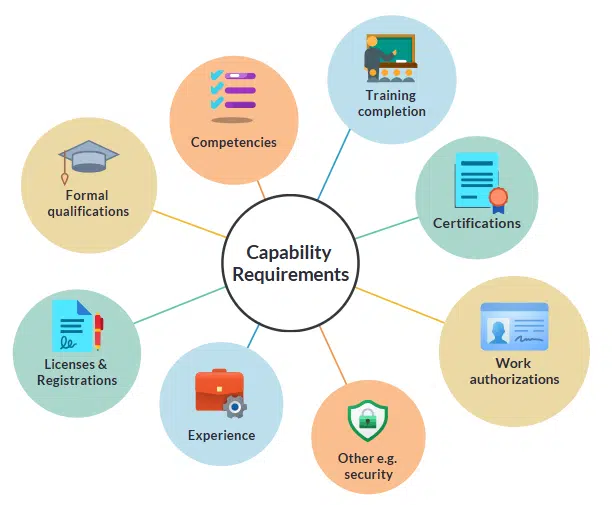
Capability requirements define the qualifications, certifications, experience, competencies, licences, authorisations, training and other requirements needed to perform a role, responsibility, activity or scope of practice.
Capability requirements establish what an organisation expects an individual to possess, maintain or demonstrate in order to perform work safely and effectively.
They provide the reference point against which workforce capability, competency and readiness can be assessed.
Part of the Workforce Capability Knowledge Index: Explore related workforce capability, competency and readiness concepts.
Why Capability Requirements Matter
Organisations cannot assess workforce capability or readiness without first defining what is required.
Capability requirements provide a structured way to communicate workforce expectations and answer questions such as:
- What is required for this role?
- Which competencies must be demonstrated?
- What qualifications or certifications are mandatory?
- What experience is expected?
- Which licences or registrations are required?
- What training must be completed?
- What authorisations are needed?
By defining these requirements clearly, organisations can support workforce consistency, capability visibility and operational assurance.
Common Types of Capability Requirements
Qualifications
Formal qualifications, degrees, diplomas or certifications required for a role.
Experience
Previous work experience, operational exposure or demonstrated practical experience needed to perform effectively.
Competencies
The knowledge, skills and behaviours required to perform successfully within a particular role or context.
Training Requirements
Mandatory learning activities, induction programmes, refresher training or compliance-based learning requirements.
Licenses and Registrations
Professional licences, registrations, permits or regulatory approvals required to undertake specific responsibilities.
Certifications
Industry-recognised certifications that support role capability and compliance requirements.
Authorizations
Formal approvals that permit individuals to undertake specific activities, procedures or responsibilities independently.
Other Organisational Requirements
Additional requirements may include security clearances, memberships, medical clearances, language requirements or organisation-specific expectations.
Relationship to Workforce Capability Infrastructure
Capability requirements are a foundational component of workforce capability infrastructure.
They provide the baseline against which competency assessments, capability passports, workforce readiness indicators and workforce assurance activities are measured.
Without clearly defined requirements, organisations cannot reliably determine whether individuals or teams meet workforce expectations.
Relationship to Competency Assessment
Competency assessments evaluate whether individuals can demonstrate the competencies defined within capability requirements.
The capability requirement defines what is expected. The assessment helps determine whether that expectation has been met.
Relationship to Capability Passports
Capability passports often provide a consolidated view of an individual’s capability requirements and current status against those requirements.
This may include competency assessments, qualifications, certifications, licences, experience and other supporting information.
Relationship to Workforce Readiness
Capability requirements help establish the criteria used to determine workforce readiness.
Readiness cannot be measured unless there is a clear understanding of what capabilities, competencies, credentials and authorisations are required.
What Capability Requirements Are Not
A Job Description
Job descriptions typically describe responsibilities and accountabilities. Capability requirements define what a person needs in order to perform those responsibilities effectively.
A Competency Framework
Competency frameworks define expected competencies. Capability requirements may include competencies but also incorporate qualifications, experience, certifications, licences and other workforce requirements.
Training Records
Training records provide evidence of completed learning activities. Capability requirements define what is required, regardless of whether training has been completed.
Workforce Readiness
Capability requirements define expectations. Workforce readiness reflects the extent to which those expectations are currently being met.
Related Concepts
FAQs
What are capability requirements?
Capability requirements are the qualifications, certifications, experience, competencies, licences, authorisations, training and other requirements needed to perform a role, responsibility or activity.
Why are capability requirements important?
Capability requirements provide a clear definition of workforce expectations and establish the baseline used to assess capability, competency and readiness.
How do capability requirements differ from competencies?
Competencies are one component of capability requirements. Capability requirements may also include qualifications, certifications, experience, licences, training and authorisations.
How do capability requirements support workforce readiness?
Capability requirements establish the criteria against which readiness is assessed. They define what individuals or teams must possess, maintain or demonstrate to be considered ready.
Are capability requirements only used for regulated roles?
No. While common in regulated, clinical and operational environments, capability requirements can be used in any organisation to define workforce expectations and support workforce capability management.