
Job Redesign Software for Workforce Transformation
Analyse work, redesign roles, define requirements, assess readiness, and support workforce capability development
Move beyond static job descriptions by connecting redesigned roles to capability requirements, assessment, gap analysis, and development.

Why Job Redesign Needs Structure

Work is changing faster than traditional role definitions.
Many organisations still rely on spreadsheets, PDFs, workshops, or disconnected frameworks to redesign jobs. While these may support planning discussions, they often make it difficult to:
- compare current roles with proposed future-state work
- identify how responsibilities shift across jobs
- manage multiple draft versions
- involve stakeholders in structured review
- connect redesigned roles to capability requirements
- assess workforce readiness after redesign
- support learning and development following change
Job redesign becomes more sustainable when supported by a structured platform rather than static documentation.
Common Job Redesign Use Cases
Operational Redesign
Redefine responsibilities, remove duplication, and clarify ownership.
AI and Automation Impact
Understand how technology changes tasks, roles, and capability needs.
Workforce Transformation
Redesign jobs to support changing business models or structures.
SkillsFuture Workforce Development
Support consultant-led redesign aligned to Singapore frameworks.
Capability Framework Refresh
Support consultant-led redesign aligned to Singapore frameworks.
Role Standardisation Across Teams
Create consistent expectations across business units or locations.
The Job Redesign Lifecycle
Centranum supports a structured lifecycle for redesigning roles and connecting them to workforce capability outcomes.

1. Set Up the Structure
Create the framework needed to support redesign.
Supports:
- job families
- organisational groupings
- departments
- accountability categories
- role grouping within the job directory
- optional framework-aligned structures
This creates a consistent structure before role capture begins.
2. Capture Current roles
Start from Current Role Data
- existing job descriptions, uploaded role information, framework reference roles, newly created roles
- analysis of current work activities
For larger projects, role information can be uploaded using structured templates.
This allows organisations to move quickly from unstructured role documentation into a structured redesign environment.
Identifying Where Work Sits Across Roles

A key challenge in job redesign is understanding:
- where activities are currently performed
- which roles are involved
- where gaps or overlaps exist
Centranum’s structured role and task data enables organisations to:
- search for activities across roles (e.g. by keyword in responsibilities or tasks)
- identify which roles currently perform those activities
- highlight gaps where activities are not clearly assigned
- identify tasks that may no longer be required
- determine which roles are impacted by operational or technology change
This provides a practical way to analyse the impact of redesign decisions before redefining roles.
3. Compare and Redesign Roles
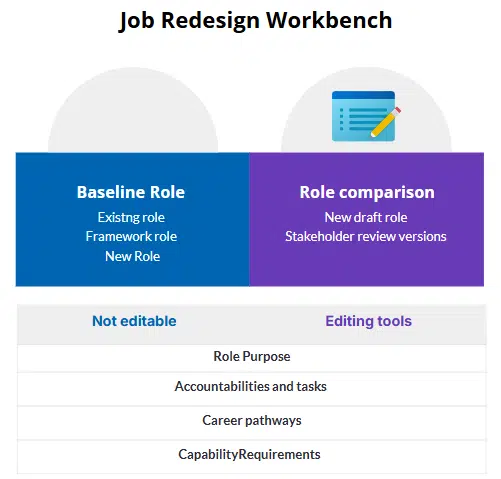
Role Redesign Workbench
The workbench provides a controlled environment for reviewing and redesigning roles.
Supports:
- side-by-side comparison of current, framework, and draft roles
- copy-based redesign workflow
- preservation of source versions during redesign
- selective refinement of accountabilities and tasks
- AI assisted search across role libraries
- optional admin-assisted AI drafting for new roles
- iterative process of draft creation
- stakeholder review and validation
Users can compare role versions while building a future-state design.
Supports Iterative Role Design
Redesign work can move through multiple draft and review cycles while maintaining governance and visibility of change.
4. Stakeholder Review and Validation
Detailed draft review
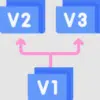
Stakeholders can create their own draft copies for review.
Supports:
- manager review
- SME feedback
- highlighted changes
- draft comparison
- controlled governance
Broader validation with survey forms

Dynamic forms can pull accountabilities directly from the role being reviewed. Enables;
- structured validation
- workload review
- missing responsibility identification
- broader stakeholder feedback
- future-state alignment
This helps ensure that redesigned roles are practical, accurate, and aligned with how work is performed , now and as change is implemented.
5. Define Role Requirements
Once redesigned roles are agreed, organisations can formalise the requirements attached to each role. This may include both capability requirements — such as qualifications, certifications, training, experience, which indicate preparedness for the role — and competency requirements, which describe the observable knowledge, skills, and behaviours expected on the job. Defining these requirements creates a clear foundation for workforce alignment, assessment, and development.
6. Assessment Against Redesigned Roles
Redesigning a role is only part of the process — organisations also need to understand whether people meet both the formal requirements and the demonstrated competencies attached to the role.
Capability Assessment

Assess whether individuals meet the formal requirements attached to the role.
- education and qualifications
- certifications and licences
- training completion
- work experience
- work authorisations
- memberships or registrations
- compliance requirements
This helps confirm whether employees meet the baseline requirements to perform the role.
Competency Assessment

Assess how effectively individuals demonstrate the required competencies within the role.
- behavioural, core and technical competencies
- proficiency levels
- self, manager, expert, or multi-rater assessment
- evidence-based evaluation
- observable performance indicators
- readiness against future-state expectations
This helps organisations understand capability beyond qualifications alone.
Complete Workforce View
Capability and competency assessment are viewed together to provide a more complete picture of workforce readiness.
- qualification + performance alignment
- readiness for redesigned roles
- workforce planning visibility
- development prioritisation
Redesign → Requirements → Assessment → Gap → Development Plans → Learning Delivery
7. Gap Analysis
Identify workforce capability gaps following redesign.
Supports:
- individual gap analysis
- team-level gap analysis
- workforce readiness reporting
- comparison between required and current capability
- prioritisation of development needs
Gap analysis provides visibility into where development is required.
8. Development Plans and Learning
Once redesigned roles, requirements, and gaps are identified, organisations can support targeted workforce development. Centranum connects redesigned roles to development pathways aligned with capability and competency requirements.
Training Identification and Recommendations
- development recommendations linked to identified gaps
- role-based learning priorities
- capability and competency development plans
- framework linked learning options where relevant
- links to internal learning resources and those of subscribed learning providers
Learning Delivery Options
LMS integration
For organisations with an existing LMS, Centranum can integrate learning resources to enable training recommendations including;
- Course catalogue synchronization
- Links of learning resources to competency framework
- Display of relevant resources to meet capability or competency gaps
- Alignment between redesigned roles and learning pathways
Training Administration and Resource Delivery
For organisations without an LMS, Centranum can support learning administration directly with;
- training catalogue and calendar
- enrolments and approvals
- e-learning and hybrid course delivery
- integration with subscribed on lien learning providers
- completion monitoring and reporting
This allows organisations to move beyond redesign into structured workforce capability development, helping to achieve;
- readiness for redesigned roles
- targeted development investment
- workforce transition planning
- ongoing role-based learning management
Modules Supporting Job Redesign
Centranum supports job redesign through a combination of role definition, analysis, capability mapping, and stakeholder input.
Job Role & Description Management
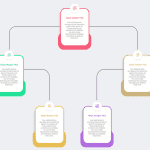
Define and manage structured role profiles, including responsibilities, tasks, and capability requirements. This provides the core foundation for analysing and redefining roles during job redesign.
Competency Library & Mapping

Define and maintain structured competency frameworks to support evolving role requirements. This enables organisations to reflect changing capability requirements as roles are redesigned.
Survey & Feedback
Collect structured input from stakeholders to support job redesign and validate proposed changes. This supports both detailed role-level input and broader validation across the organisation.
Assessment & Analytics
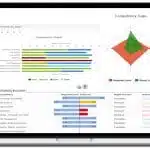
Manage capture of capability information and competency assessments, enabling a clear view of gaps and trends by individual, team and across the organization. The foundation for development planning and targeted learning investment.
Development Planning

Define and maintain targeted development objectives, learning pathways and programmes to fill gaps and develop new competencies for the future. Enables organisations to track develop initiatives and progress.
Leaning delivery & tracking
Learning and development can be linked directly to capability and competency frameworks, so organisations can recommend training based on identified gaps, evolving role requirements, and future workforce needs. Centranum synchronises with existing LMS catalogues and completion data, or can provide training administration and resource delivery directly for organisations without an LMS, supporting real-time visibility of workforce capability.
Related Reading
Job & Capability Architecture – Structuring roles, responsibilities, and capability requirements.
Competency Management – Defining and maintaining competency frameworks linked to roles.
Operational Skills Management – Managing task-based roles and responsibilities in operational environments.
Assessment & Analytics – Managing assessments and reports on capability/competency levels, gaps and trends.
Workforce Development Planning – creating managing and tracking individual and team development initiatives.
Competency Based Learning & Development – manage, deliver and track capability and competency linked learning.
AI and Job Redesign – How AI is changing tasks, roles, and capability requirements.
FAQ
At what stage in a job redesign programme is Centranum typically used?
Centranum can support multiple stages of a job redesign programme — from analysing current roles and capturing work activities through to stakeholder review, finalised role requirements, assessment, and workforce development.
Can this be used before redesign decisions are finalised?
Yes. Centranum can be used during the analysis phase to understand where work currently sits, which roles are affected, and how responsibilities may change before redesign decisions are confirmed.
How detailed does role information need to be?
The level of detail can vary. Organisations can start with high-level responsibilities and expand into more detailed accountabilities and tasks over time. More detailed information provides stronger visibility into workload, overlaps, and redesign impact.
Can redesigned roles include capability and competency requirements?
Yes. Once redesigned roles are agreed, capability requirements such as qualifications, certifications, training, and experience can be defined alongside competency expectations, proficiency levels, and behavioural or technical requirements.
How does assessment support job redesign?
Assessment helps organisations understand whether employees are aligned to redesigned roles. Capability and competency assessments can be used to evaluate readiness, identify gaps, and support workforce transition planning.
Can job redesign be linked to skills gap analysis?
Yes. Redesigned roles can be linked to capability and competency requirements, allowing organisations to compare current workforce readiness against future-state expectations and identify development priorities.
How are training needs identified after job redesign?
Training recommendations can be linked to identified capability or competency gaps, helping organisations target development activity to support redesigned roles and changing work requirements.
Can Centranum integrate with an LMS or HR system?
Yes. Centranum can complement existing HRIS and LMS platforms by linking redesigned roles to capability requirements, assessment, learning recommendations, and completion tracking.
What if we do not have an LMS?
For organisations without an LMS, Centranum can support training administration, learning resource delivery, and completion tracking within the platform.
Can this support iterative redesign over time?
Yes. Roles can be refined over time as work evolves, allowing organisations to manage redesign as an ongoing process rather than a one-off project.