
Performance Review Software
Supports: Where Are We Now? – Evaluates performance against agreed expectations through structured, evidence-based review processes.
Create structured, configurable performance reviews for annual, probation and other review processes. Centranum automates review creation, brings together the required performance components, and guides employees, managers and authorized administrators through assessment, moderation, confirmation and sign-off.
Configurable policies, workflows, moderation and calibration tools help organizations deliver fair, consistent and evidence-based performance reviews.

Why Organizations Are Rethinking Performance Reviews
For many organizations, traditional annual performance reviews have become unpopular. Employees often view them as retrospective, time-consuming and disconnected from day-to-day work, while managers can find them administratively burdensome. As a result, some organizations have reduced the frequency of formal reviews or removed them altogether in favor of more continuous performance conversations.
However, eliminating formal reviews entirely can create different challenges.
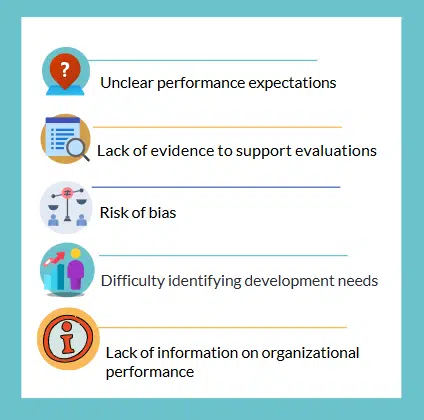
Without a structured review process, organizations may experience:
- Inconsistent performance expectations across teams.
- Limited documented evidence to support promotion, remuneration or disciplinary decisions.
- Greater risk of unconscious bias and inconsistent evaluations.
- Difficulty identifying development needs and recognizing achievement.
- Reduced visibility into organizational performance trends.
- Limited governance for probation, compliance or regulated workforce requirements.
- Less reliable information to support talent reviews, career progression and succession planning.
The challenge is not whether organizations should conduct performance reviews, but how they conduct them.
The most effective organizations combine continuous feedback and development conversations with structured, evidence-based performance reviews that provide consistency, transparency and organizational oversight.
Centranum supports this balanced approach through configurable review workflows, integrated evidence, flexible review types and governance controls that allow organizations to design review processes aligned with their own policies and culture.
Connect Performance Reviews to What Employees Actually Do
Performance Reviews Built Around the Employee’s Role.
Many performance review systems rely on generic appraisal forms that are completed independently of the employee’s actual job. This can make reviews feel disconnected from day-to-day responsibilities and difficult to support with objective evidence.
Centranum takes a different approach.
Performance reviews can be built around the employee’s own Job Description, allowing managers and employees to evaluate performance against the responsibilities and accountabilities that define the role. Where required, reviews can also assess performance at the individual task level.
Throughout the review period, Journal entries linked to specific accountabilities, goals or competencies can be displayed automatically within the review, providing relevant evidence without requiring managers to search through separate records. Optional 360-degree feedback can also be presented alongside competency evaluations to provide additional perspectives where appropriate.
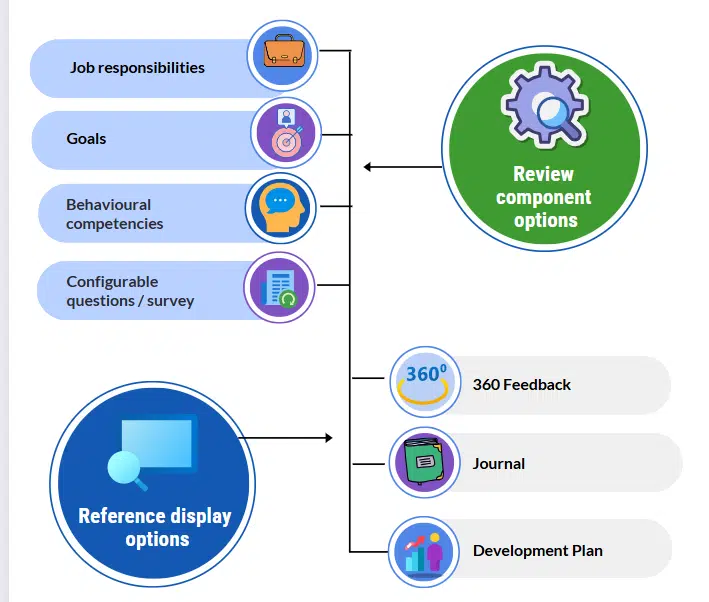
By bringing role expectations, performance evidence and review activities together, organizations can create more meaningful, transparent and evidence-based performance reviews.
Organizations can also display the employee’s current Development Plan alongside the performance review. Rather than capturing development actions within the review itself, managers and employees can review existing development objectives, update plans where appropriate and continue managing development as an ongoing process after the review has been completed.
How Performance Reviews Work
1. Configure Review Types
Different review processes often require different workflows, participants and policies. Centranum allows organizations to configure multiple review types, each with its own process and governance requirements.
Review types may include:
- Annual performance reviews
- Probation reviews
- Development reviews
- Organization-specific review processes
Each review type can have its own workflow, review components, evaluation methods and approval process.
2. Configure Review Components & Policies
Each review type can be configured to include the components that reflect the organization’s performance management framework.
Review components may include:
- Job responsibilities and accountabilities
- Individual tasks, where operational performance is reviewed at task level
- Goals and goal achievement
- Performance competencies, such as organizational values, leadership behaviours, core competencies or other behavioural expectations, using configurable performance competency profiles
- Configurable question-and-answer sections for organization-specific requirements such as manager feedback, career interests or other structured review questions.
In addition, administrators can configure:
- Evaluation and scoring methods
- Descriptive or achievement-based scoring
- Visibility rules
- Review workflow
- Validation rules
- Moderation requirements
- Employee confirmation
- Final sign-off
Optional reference information can also be displayed within the review, including:
- Journal entries linked to the relevant accountability, goal or competency
- 360-degree feedback associated with competency evaluations
- The employee’s current Development Plan to support development discussions during the review
3. Create Review Cycles Automatically
Performance reviews can be created automatically when a new employee joins the organization or generated as part of a recurring review cycle.
Automatic review creation helps ensure employees enter the appropriate review process at the right time while reducing manual administration.
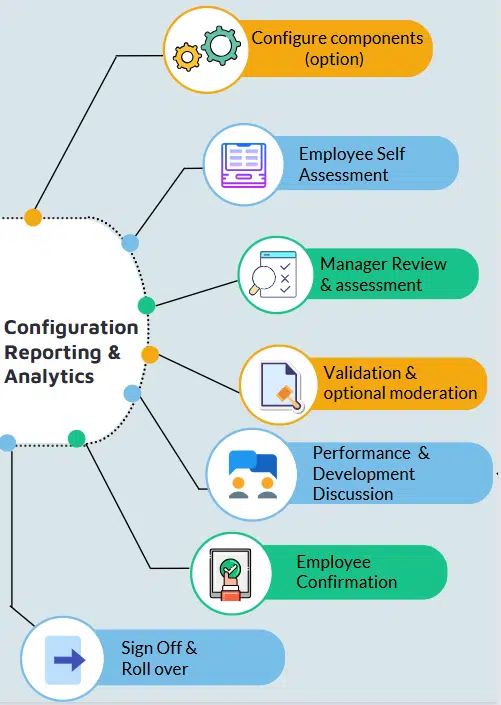
4. Complete the Review Workflow
Organizations can configure review workflows to reflect their own governance requirements.
A review may include:
- Employee self-assessment
- Manager assessment
- Moderation
- Performance review meeting
- Employee acknowledgement or confirmation
- Final sign-off
Different review types can follow different workflows, allowing organizations to balance flexibility with consistent governance.
5. Support Fair and Consistent Evaluations - Validation, Moderation & Calibration
Centranum combines automated validation, configurable moderation and organizational calibration to help improve the quality and consistency of performance reviews.
Automated Review Validation
Before a review is finalized, the system can identify potential inconsistencies such as:
- Component summary ratings that do not align with individual item ratings.
- Overall review ratings that are inconsistent with component results.
These alerts help reviewers and moderators identify reviews that may require further consideration before sign-off.
Configurable Moderation
Where additional governance is required, reviews can be routed to a moderator before completion.
Depending on organizational policy, moderation may be completed by:
- The next level manager
- HR
- Other designated reviewers
Moderators can review assessments, request changes where appropriate and help ensure organizational standards are applied consistently before reviews are finalized.
Organizational Calibration
Calibration analytics help organizations evaluate whether performance ratings are being applied consistently across the workforce.
Reports can compare rating distributions across:
- Managers, Teams
- Departments, Business units and the whole organization
These insights support calibration discussions. Calibration supports fairer performance evaluations by helping identify unusually high or low rating patterns and encouraging greater consistency in the application of performance standards.
6. Manage Reviews Efficiently
Authorized administrators can oversee review cycles using bulk administration tools.
Administrative actions include:
- Waive reviews
- Mark reviews as moderated
- Mark unfinished reviews as complete and automatic rollover
- Complete final sign-off and automatic rollover
These capabilities reduce administrative effort while maintaining appropriate governance controls.
7. Track Progress & Analyze Results
Real-time reporting provides visibility into both review progress and performance outcomes.
Analytics can include:
- Review stage and completion status
- Outstanding actions
- Results by review component
- Performance trends
- Moderation outcomes
- Review challenges and exceptions
Automated notifications help employees, managers and reviewers complete required actions on time, while dashboards provide HR and leadership with oversight of review progress across the organization.
Who it helps

For Employees
- Understand how performance is evaluated.
- Review performance against actual job responsibilities.
- Capture achievements throughout the review period.
- Participate in self-assessments and performance discussions.
- View goals, competencies and supporting evidence in one place.

For Managers
- Conduct structured, evidence-based performance reviews.
- Evaluate employees against role responsibilities, goals and performance competencies.
- Access relevant Journal entries and supporting information during reviews.
- Complete reviews consistently using configurable workflows.
- Reduce administration through automated review processes.
For HR & Performance Teams
- Configure review types, components, workflows and evaluation policies.
- Support different review processes for business units, departments or workforce groups where required.
- Delegate administration to designated administrators for organizational entities or defined user groups.
- Manage review cycles, moderation, validation and calibration activities.
- Monitor review completion, governance and performance trends through real-time analytics.

For Senior Leaders
- Gain visibility into review completion and organizational performance.
- Monitor consistency across managers and business units.
- Support fair, evidence-based talent and remuneration decisions.
- Identify organizational performance trends through review analytics.
Why Organisations Choose Centranum
Built for Real-World Performance Management
Unlike generic appraisal systems, Centranum enables organizations to configure performance reviews that reflect their own governance, culture and performance philosophy.
Key differentiators include:
- Performance reviews built around the employee’s actual job responsibilities.
- Connected development planning – Review outcomes can be discussed alongside the employee’s Development Plan, helping managers turn performance conversations into ongoing development rather than creating disconnected action plans.
- Multiple configurable review types, including annual, probation and organization-specific reviews.
- Flexible review components aligned with your performance framework.
- Integrated goals, performance competencies and supporting evidence.
- Automated workflows, notifications and review creation.
- Validation, moderation and calibration tools that promote fair and consistent evaluations.
- Enterprise reporting, analytics.
- Flexible governance – Configure different review policies, workflows and evaluation methods for departments, business units or workforce groups while maintaining enterprise oversight.
- Delegated administration – Assign dedicated administrators to organizational entities or defined groups, such as senior managers, while maintaining role-based permissions and governance.
- One connected platform linking performance reviews with goals, development planning, career development and workforce readiness.
Enterprise Ready
- Configurable for organizations of all sizes, from a single business unit to global enterprises.
- Role-based security and delegated administration.
- Comprehensive audit history and governance controls.
- Enterprise reporting and analytics.
- SOC 2 Type II audited platform.
- Integrates with HRIS, LMS and identity management systems.
- Regional hosting options for enterprise and regulated environments.
Related Reading
Performance Management Software – Discover how continuous performance management connects goals, feedback, reviews and development.
Goal Management Software – Align organizational objectives with individual and team goals.
Journal – Capture achievements, feedback and evidence throughout the review period.
360 Feedback – Gather multi-source feedback to support development and performance conversations.
Development Planning – Turn performance review outcomes into structured development plans.
The 3 Key Workforce Questions – Learn how role expectations, performance evaluation and development connect within one workforce capability framework.
FAQs
What is performance review software?
Performance review software helps organizations plan, manage and complete structured employee performance reviews. It supports configurable review workflows, performance evaluations, approvals, reporting and governance while reducing manual administration.
What is the difference between a performance review and a performance appraisal?
The terms are often used interchangeably. Performance appraisal traditionally refers to the formal evaluation of an employee, while performance review may describe the broader process, including self-assessment, manager evaluation, moderation, employee discussions and development planning. Centranum supports the complete performance review process.
Can performance reviews be built around an employee’s job responsibilities?
Yes. Centranum can automatically build performance reviews around an employee’s Job Description, including role accountabilities and, where required, individual tasks. This helps managers evaluate performance against the employee’s actual responsibilities rather than using a generic appraisal form.
What review components can be included?
Organizations can configure different review types with different components. Reviews may include job responsibilities, goals, performance competencies, configurable question-and-answer sections and supporting reference information such as Journal entries and optional 360-degree feedback.
How does Centranum support moderation and calibration?
Centranum supports automated review validation, configurable moderation workflows and calibration analytics. Reviews can be moderated by next-level managers, HR or other designated reviewers, while calibration reports help organizations compare rating patterns across managers, teams and departments to promote fair and consistent performance evaluations.
Can different departments use different performance review processes?
Yes. Organizations can configure different review types, workflows, scoring methods and policies for different business units, departments or workforce groups while maintaining enterprise governance and reporting.
Does the platform support probation and other review types?
Yes. In addition to annual performance reviews, organizations can configure probation reviews, development reviews and other organization-specific review processes, each with its own workflow, components and governance requirements.