

Job Role & Capability Architecture Software
Supports: What’s Expected? – Defines roles, responsibilities and required capabilities.
A clear job role and capability architecture provides the foundation for workforce capability and workforce readiness.
It defines how work is structured across the organization, the responsibilities associated with each role, and the capability requirements needed to perform effectively. By creating consistent role expectations, organizations can better align development, workforce planning and readiness initiatives.
Centranum’s Job Role & Capability Architecture software helps organizations define role structures, capability requirements and career pathways within a single framework. It provides the foundation for capability management, competency assessment, workforce readiness and talent decisions while improving role clarity for employees, managers and leaders.
Trusted across industries
For more than 20 years, organizations in healthcare, manufacturing, engineering, technology, utilities and government have used Centranum to improve workforce capability, competency and readiness visibility.
Start Where You Are
Whether you need to define roles, manage capability requirements, assess competency or improve workforce readiness visibility, Centranum supports your current priorities while providing a foundation for future growth.
Solving the Workforce Capability Challenge
Many organizations struggle to maintain consistent role definitions, capability requirements and career pathways across the workforce. As organizations grow, role information often becomes fragmented across documents, spreadsheets, HR systems and business units.
Without a structured job role and capability architecture, organizations can experience:
- Inconsistent role expectations across teams and locations
- Difficulty identifying capability requirements and workforce gaps
- Misaligned training and development activities
- Limited visibility of career pathways and internal mobility opportunities
- Challenges supporting workforce readiness and workforce planning
Centranum provides a structured framework for defining roles, capability requirements and career pathways, creating a foundation for workforce capability, competency assessment and workforce readiness.

When Organizations Review Their Job Architecture
Organizations often review their job architecture when:
- Job descriptions have become inconsistent across teams
- Capability requirements are difficult to maintain
- Managers lack clarity about role expectations
- Career pathways are poorly defined
- Workforce planning is based on incomplete role information
- Skills, competency and capability requirements are managed separately
Building a Workforce Capability Architecture
1. Define Roles & Responsibilities
Create structured role profiles that define responsibilities, accountabilities, key activities, expected outcomes and career pathways.
Establish clear role expectations and progression opportunities across the organization.


2. Define Capability Requirements
Identify the capabilities required for successful role performance, including qualifications, training, certifications, experience, authorizations and competencies.
Create clear workforce capability requirements for each role.
3. Maintain Workforce Capability Records
Track and maintain workforce capability information through training records, integrations, qualifications, certifications and the Capability Passport.
Provide a single source of truth for workforce capability information.

4. Support Workforce Development
Use identified gaps and role requirements to guide development planning, learning activities and capability growth.
Connect workforce capability requirements to targeted development actions.
Platform Modules Included
Centranum’s Job Role & Capability Architecture solution provides the foundation for defining role expectations, capability requirements, competency requirements and workforce readiness information.
Core modules
Job Role Manager
Define role profiles, responsibilities, outcomes, career pathways and role relationships.
Capability Requirement Mapping
Map qualifications, certifications, training, experience, authorizations and other workforce capability requirements to each role.
Competency Framework & Mapping
Define competency requirements and proficiency expectations, then map them directly to job roles.
Capability Passport
Maintain workforce capability records and compare current capability and competency status against role requirements.
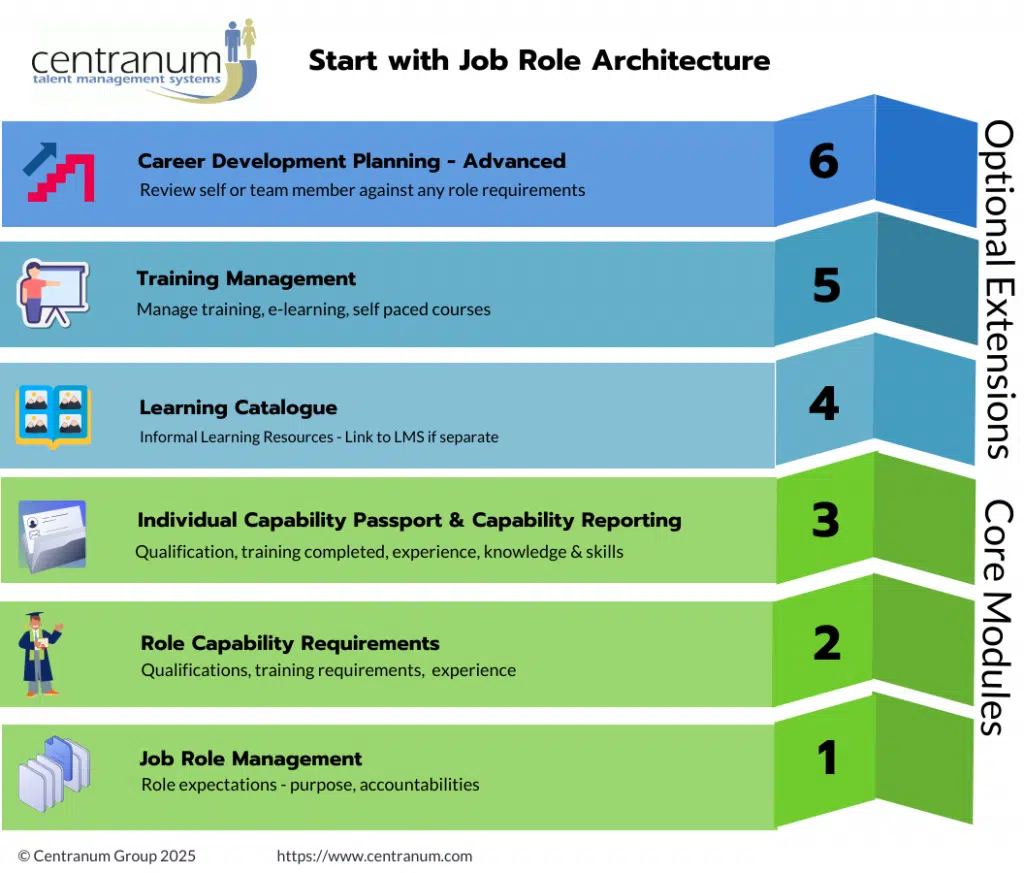
Optional Extensions
Learning Resources –Link learning content, documents and development resources to capability and competency requirements.
Training Management – Manage training activities and completion records where a separate LMS is not used.
Development Plans – Create targeted development actions linked to identified capability and competency gaps.
Career Development – Support career pathways, role matching and workforce mobility.
Who it helps
Staff

- Clear expectations
- Career path visibility
- Access relevant learning resources & training
- Personal development planning & tracking
Managers

- Clear role accountabilities
- Visibility of Capability and Skills Gaps
- Training oversight
- Tracking career interest
- Individual & Team development planning and tracking
Admins/L&D

- Single source of truth for role definitions and capability requirements
- Tracking of training completions
- Skills Gap analysis for Learning Needs
- Tools for managing development programmes
- Oversight of career interest & personal development progress
Why choose Centranum?
Based on research in Organizational Psychology

Over 20 Years of Experience in Centralising and Optimizing Job Role Clarity and Capability Alignment. SOC 2 certified
Enterprise-grade security. Independently audited.
FAQs
What is a job role and capability architecture?
A job role and capability architecture is a structured way to define work across your organization. It outlines what each role is accountable for, the capabilities required to perform that work, and how roles relate to each other across functions or career levels. It provides the foundation for skills development, performance, and succession planning.
Do we need to define every role in detail before we start?
No. A good platform lets you start with core or common roles and expand incrementally. You can import existing job data or create tailored role profiles aligned with responsibilities, capabilities, and pathways — without needing to redesign your org chart.
Can we manage job families in the system?
Yes. Our platform supports job family tagging and filtering in reports. You can also link job families to roles and capabilities to enhance planning, analytics, and development frameworks. This helps you visualize pathways, track capability across functions, and identify bench strength by job type.
How are capabilities different from competencies?
Capabilities refer to qualifications, training, and experience that suggest someone could perform a task. Competencies are demonstrated behaviors and skills observed in action. A good platform manages both — and links them directly to each role to ensure relevance.
How does this help with workforce planning?
With a clear job and capability structure, you can see where critical skills exist, where gaps are emerging, and what development is needed — by team, function, or region. It also supports onboarding, succession, and internal mobility, all from a single source of truth.
Can we align roles with organizational values or strategy?
Absolutely. You can include strategic priorities, values, and behaviors in your role definitions or competency models — ensuring everyone is aligned with the direction of the organization, not just their task list.
What industries use this approach?
This approach is used across healthcare, manufacturing, engineering, public sector, and technology organizations — anywhere there’s a need to manage capability, compliance, and career development at scale.
How does job role architecture support skills matrices?
Role architecture provides the structured capability framework behind skills matrices, ensuring consistency across teams and supporting workforce planning and audits.