
Knowledge Testing & Assessment Software
Verify Knowledge Requirements as Part of Workforce Readiness
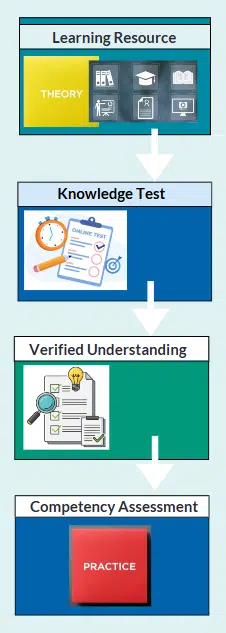
Training completion does not necessarily demonstrate understanding.
Many organisations need a structured way to verify knowledge requirements, assess understanding and provide evidence that individuals have achieved required standards before performing responsibilities, applying new procedures or progressing to competency assessment.
Centranum Knowledge Testing & Assessment Software helps organisations validate knowledge requirements through configurable assessments linked directly to job roles, capability requirements, competencies, learning activities and workforce readiness processes.
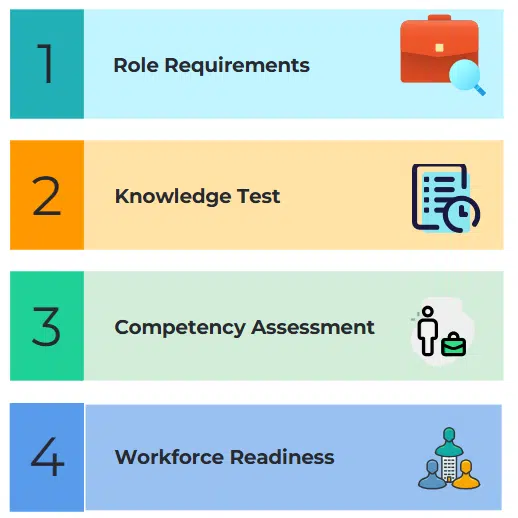
As part of the broader Workforce Readiness Framework, knowledge testing provides objective evidence that supports competency assessment, workforce readiness and compliance decisions.
Supports: Where Are We Now? – Measures knowledge and understanding as part of competency assessment and workforce readiness.
Why Knowledge Testing Matters
Many workforce activities require individuals to demonstrate knowledge before they can safely perform responsibilities or maintain compliance requirements.
Examples include:
- Regulatory and compliance requirements
- Clinical procedures and protocols
- Operational safety requirements
- Equipment operation and maintenance
- Technical procedures
- Product knowledge
- Information security requirements
- Privacy and data protection requirements
- New policies and procedures
- Insurance and underwriting policies
- Professional development requirements
Without structured validation, organisations often rely on training attendance records, acknowledgements or declarations rather than evidence of understanding.
Knowledge testing helps organisations verify understanding and maintain audit-ready evidence of workforce capability.
When Organizations Consider Knowledge Testing
Organizations often look for knowledge testing software when:
- Training completion does not prove understanding
- Knowledge checks are managed manually or inconsistently
- Procedures, compliance requirements or standards change
- Managers need evidence before signing off competency
- Test results need to link to roles, learning, competency or readiness records
Two approaches to knowledge testing
Centranum supports two primary approaches to knowledge testing depending on how assessment outcomes will be used.
Competency-Linked Knowledge Testing
Knowledge assessments can be linked directly to competencies, competency indicators and capability requirements.
Assessment results can contribute directly to competency assessment outcomes, providing additional evidence to support workforce readiness decisions. Results may update competency assessments at an overall competency level or at a more granular indicator level depending on assessment design.
This approach is particularly useful where knowledge validation forms part of a broader competency assessment process.
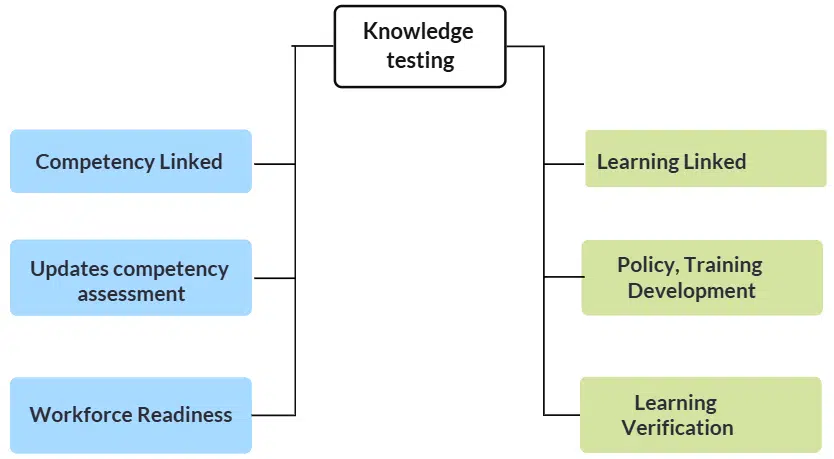
Learning-Linked Knowledge Testing
Knowledge assessments can also be linked to learning resources, training programmes and development objectives.
For organisations using Centranum Training Management, assessments may form part of course completion requirements. They can also be used independently to verify understanding of policies, procedures, regulatory updates or professional development activities.
Examples include:
- New policy implementation
- Compliance requirements
- Information security awareness
- Clinical protocol updates
- Operational procedure changes
- Professional development activities
- Continuing professional development (CPD)
This approach helps organisations verify understanding rather than simply recording attendance or acknowledgement.
Flexible Assessment Design
Knowledge assessments can be configured using a range of question types and scoring approaches.
Question Types
Support organisation-defined assessment formats including:
- Multiple choice questions
- Multiple response questions
- True/false questions
- Matching questions
- Rating Scale
- Short & Long answer questions – evaluator-reviewed responses
Automated and Evaluator Scoring
Questions with predefined answers can be scored automatically, while other question types can be reviewed and scored by designated assessors.
This flexibility allows organisations to combine objective testing with professional judgement where required.
Question Pools and Randomisation
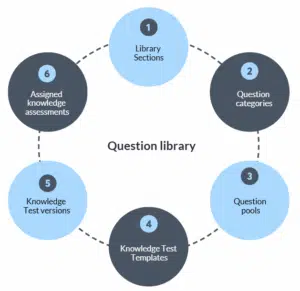
Organise questions within reusable libraries and categories. Assessment templates can draw from fixed questions or randomly selected questions from defined pools.
Question pools help organisations create reusable assessment content while reducing memorisation and increasing assessment variation.
Assessment structure
Assessment Templates – Create reusable assessment templates containing sections, question pools, scoring rules and competency mappings.
Version Management – Generate multiple versions of assessments from the same template, supporting annual reviews, recertification programmes and ongoing knowledge validation.
Attempts and Reassessment Rules – Configure permitted attempts, reassessment intervals, pass requirements and retesting rules to support organisational policies and compliance requirements.
Assignment and Delivery
Automated Assignment
Competency-linked assessments can be assigned automatically based on role requirements, competency requirements or workforce readiness rules.
Learning and Development Integration
Learning-linked assessments can be associated with learning resources, development objectives, policy documents and training programmes.
Multiple Access Points
Employees can access assessments through:
- Home page dashboards
- Development plans
- Training programmes and course materials
Assessment Outcomes
Competency Assessment Integration -‘Assessment outcomes can update competency assessments automatically, including competency-level or indicator-level ratings where configured.
Workforce Readiness Evidence – Assessment results become part of the individual’s workforce readiness record and can contribute to workforce readiness reporting and compliance evidence.
Reporting and Analytics – Monitor completion rates, pass rates, assessment outcomes and workforce readiness indicators across individuals, teams and the organisation.
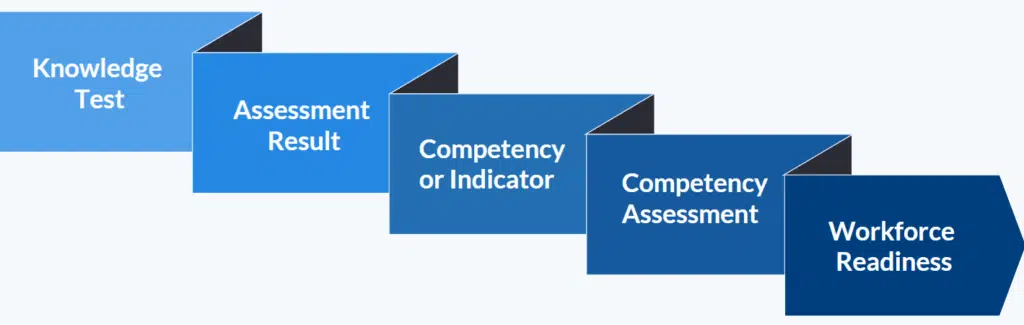
Knowledge Testing and Competency Assessment
Knowledge testing and competency assessment serve different but complementary purposes.
Knowledge Testing
Measures understanding of information, procedures, standards, policies, regulations or concepts.
Competency Assessment
Measures demonstrated performance in the workplace against defined competency standards and role requirements.
Together they provide stronger evidence of workforce readiness than either approach alone.
For example, an employee may successfully complete a knowledge assessment before progressing to observation, practical demonstration or competency validation activities.
Supporting Workforce Readiness Across Industries

Validate clinical knowledge, protocols, mandatory education and continuing professional development requirements.

Verify safety knowledge, equipment operation requirements, operational procedures and task readiness.

Engineering and Technical Services –
Assess technical knowledge, regulatory requirements and operational standards.

Insurance and Financial Services
Verify understanding of policies, underwriting requirements, regulatory obligations and organisational procedures.

Government and Regulated Environments
Support compliance, policy implementation and mandatory knowledge requirements.
.
Part of an Integrated Workforce Readiness Framework
Knowledge Testing & Assessment works alongside:
- Job Roles and Capability Requirements
- Capability Passport
- Competency Library and Mapping
- Competency Assessment and Analytics
- Development Planning
- Career Development and Succession Planning
Together these capabilities help organisations verify knowledge, assess competence and improve workforce readiness.
FAQs
What is knowledge testing software?
Knowledge testing software helps organizations create, deliver and report on assessments that verify whether employees understand required knowledge for their role, training, compliance or competency requirements.
How is knowledge testing different from training completion?
Training completion shows that a person has completed a learning activity. Knowledge testing provides evidence that they understood key concepts, procedures, standards or requirements.
How does knowledge testing support competency assessment?
Knowledge testing can provide objective evidence for competency assessment by validating the knowledge required before observation, sign-off or workplace demonstration.
Can knowledge tests be linked to competencies or role requirements?
Yes. Knowledge tests can be linked to job roles, capability requirements, competencies, training activities, documents and policies , and workforce readiness processes.
What types of questions can be used?
Organizations can use configurable question types, question pools and randomized assessments to test knowledge consistently across individuals, teams or role groups.
Can employees retake knowledge assessments?
Yes. Retakes, pass marks, renewal periods and reassessment rules can be configured according to organizational requirements.
How are knowledge test results reported?
Results can be reported at individual, team, role or organizational level to identify knowledge gaps, completion status, pass rates and readiness risks.
Can knowledge testing be used in regulated industries?
Yes. Knowledge testing is commonly used in healthcare, manufacturing, engineering, utilities, government and other regulated environments where organizations need evidence that employees understand critical procedures, standards and compliance requirements.
Is there an audit trail for knowledge assessments?
Yes. The system records assessment activity, including assignment, completion dates, scores and results, providing a transparent audit trail to support compliance and reporting requirements.