
Competency Assessment Software & Analytics
Supports: Where Are We Now? – Assesses demonstrated competency against defined expectations.
Evidence-based insights to build, manage, and optimize workforce capability
Assess Competence. Identify Gaps. Drive Workforce Readiness.

Centranum’s Workforce Competency Assessment & Analytics module enables organizations to evaluate workforce capability with precision and depth. Go beyond performance reviews and skills matrices with real-time competency assessment and analytics. Drive evidence-based development at scale.
Why Competency Assessment & Analytics Matters
It transforms data into actionable insights for workforce capability and competency management
Without integrated assessment and analytics, your workforce data is fragmented — and decisions are made on guesswork. Centranum brings it all together:
Benefits: role alignment, risk reduction, compliance evidence, accurate skills gaps analysis, targeted development
-
Aligns roles, skills, learning, and career planning
-
Reduces risk of human error and compliance failure
-
Improves talent mobility and leadership readiness
When Organizations Review Competency Assessment Processes
- Competency assessments are inconsistent across teams or locations
- Assessment evidence is difficult to capture and maintain
- Managers lack visibility of competency gaps
- Audit and compliance requirements are increasing
- Development decisions are not based on reliable assessment data
How It Works — From Framework to Insight
Assessment doesn’t exist in isolation. Centranum connects expectations, evaluation, and development into one continuous loop:
Define – establish clear role and competency requirements in the Library.
Assess – capture real evidence of performance and capability.
Analyze – visualize workforce strengths, gaps, and risks.
Act – from assessment gaps to development actions. Gather rich information for succession.
Define
Ground Every Assessment in Role Expectations
- Competencies drawn from your central Library, validated and version-controlled.
- One source of truth for all competency data
- Profiles mapped by role, project, or function (core, leadership, technical, clinical, regulatory).
- Clear indicators and proficiency levels set the standard for “what good looks like.”
Assess - Flexible competency assessment methods
Observation -based
- Manager, mentor, or SME observation

Peer/Expert Validation
- Structured or open peer/expert validation
- Validation notes and scoring standards
Knowledge Testing
- MCQs linked directly to competencies
- Auto-scored and update assessment records in real time
- Used for compliance, onboarding, reskilling
Self-Assessment & Reflection
- Employees reflect on strengths and gaps
- Supports growth conversations
- Flexible proficiency and behavior scales

360 Feedback
- Core, leadership, or role-specific
- Configurable anonymity
- Graphical developmental reports with AI sentiment/thematic analysis
Evidence Uploads
- Documents, logs, photos linked to indicators
- Preserved with version control
- Accepted as audit-ready proof

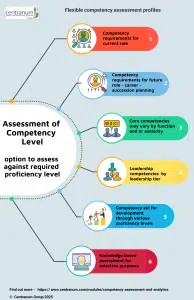
Assessment Profiles & Options
- Profiles tailored to role, career stage, or project
- Assess against current or future role requirements
- Support for succession and talent pool assessments
- Knowledge-based assessments for internal/external selection
Automations and Integrations
Part of Centranum’s secure Competency Management Software functionality includes;
- Expired competency re-assessments created automatically
- Wizards and templates streamline administration
- Gaps flow directly into individual Development Plans
- Competency-linked learning resources suggested in reports
- Role Definition, Library, Mapping, and Assessment connect seamlessly
- Outputs feed into Learning, Career and Succession Planning
- Staff and managers see progress directly in dashboards


Analytics & Reporting
- Real-time dashboards: competency levels, skills gaps, progress
- Real-time skills matrices (team, department or function)
- Visual display of gaps and readiness linked to development planning
- Drill down to individuals or indicators
- Compare competency levels over time for workforce planning & audit readiness
Integrated capability and credential reporting provides strategic insight across all role requirements
Act – Close Gaps and Drive Growth
Compliance, Quality & Risk Management
- Track mandatory competencies and certifications
- Time-stamped, role-specific assessments with audit trails
- Automated alerts for expiring certifications
- Prove regulatory compliance with one-click reports
- Reduce risk of error through ongoing visibility of gaps
Compare best competency tracking tools in 2026
Use in Any Sector
🏥 Healthcare: Clinical verification, bedside assessment, mandatory training
and other high stakes sectors
🏭 Manufacturing: Operator capability, safety, ISO/QMS tracking
💼 Engineering & Technology: Skill benchmarking, project team matching
🏛 Government/NGOs: Capability frameworks, regulatory assurance
with independent security certification
The Competency Assessment & Analytics module forms the evidence base for your capability assurance and workforce development insights.
FAQs
What is competency assessment software?
Competency assessment software helps organizations evaluate employee competence against defined role requirements, competency frameworks and proficiency standards. It provides a structured way to assess knowledge, skills and behaviours, capture evidence, identify gaps and track competency development over time.
What is the difference between skills assessment and competency assessment?
A skills assessment measures an individual’s ability to perform specific tasks or activities. Competency assessment takes a broader view by evaluating the knowledge, skills, behaviours and application required to perform successfully in a role.
While skills assessments focus on specific capabilities, competency assessments evaluate whether a person can consistently apply those capabilities in the workplace. Many organizations use competency assessment to support workforce readiness, compliance, development and performance decisions.
How are competencies assessed in the system?
Centranum supports multi-method assessment including manager or mentor observation, peer/expert input, self-assessment, panel interviews, knowledge testing with MCQs, and evidence uploads. Forms can be customized to assess specific tasks and procedures. Each method can be used alone or in combination, depending on the competency and role.
Can we define our own assessment criteria?
Yes. You can define specific indicators for each competency, set proficiency levels, and configure validation methods (e.g., demonstration, documentation, peer review) for each role or job family.
Can we use automated knowledge testing for specific competencies?
Yes. Competency-linked multiple choice questions (MCQs) can be used to validate knowledge. Results automatically update competency assessments – levels and gap reports.
Does the platform track who completed each assessment and when?
Yes. Full audit trails are recorded including assessor name, method used, and date. When there are multiple assessments for one person an algorithm is used to determine the definitive assesment in reports – but all are recorded.
How can managers use the analytics?
Managers get real-time dashboards showing team competency levels, gaps, and readiness. They can view individual profiles or team-wide matrices, and download reports for planning, audits, or compliance.
Can the system help with external compliance or certification reporting?
Yes. Assessment records can serve as evidence of demonstrated competency. Reports support internal audits, certification renewals, or regulatory inspections.
Can competency assessment data be reported at team or organizational level?
Yes. Competency assessment data can be aggregated and analyzed across individuals, teams, departments, locations or the entire organization. Reporting and analytics help managers and leaders identify competency gaps, monitor readiness, track progress over time and support workforce planning decisions.
How does competency assessment support workforce readiness?
Competency assessments provide visibility of demonstrated competence against role requirements. By identifying strengths, gaps and development priorities, organizations can make more informed decisions about workforce readiness, capability development, compliance and role suitability.