
Competency Evidence
Definition
Competency Evidence refers to the information, records, observations and supporting materials used to demonstrate or verify that an individual has met defined competency requirements.
Competency evidence provides the foundation for competency assessment decisions and helps organisations establish confidence that competency has been demonstrated in a consistent and defensible manner.
Evidence may be collected from multiple sources and through multiple assessment methods depending on organisational, professional or regulatory requirements.
Part of the Workforce Capability Knowledge Index: Explore related workforce capability, competency and readiness concepts.
Why Competency Evidence Matters
Competency assessments often require more than a simple declaration that an individual is competent.
Organisations may need to demonstrate how competency decisions were reached and what information was used to support those decisions.
Competency evidence helps answer questions such as:
- What evidence supports this competency decision?
- How was competency demonstrated?
- Who validated the competency?
- When was competency assessed?
- Is the evidence current and relevant?
- Does the evidence support workforce readiness requirements?
- Can the competency decision be justified during an audit or review?
Competency evidence supports workforce assurance, consistency, transparency and defensible decision-making.
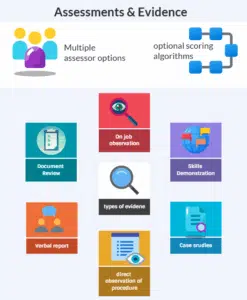
Common Types of Competency Evidence
Assessment Records
Completed assessment forms, competency ratings, assessment outcomes and evaluation records used to support competency decisions.
Observation Records
Documented observations of workplace performance, including assessor observations, workplace evaluations and practical performance reviews.
Documentation Records
Records of practical demonstrations, procedures, activities or task-based assessments completed against defined competency requirements.
Knowledge Assessment Results
Results from knowledge tests, examinations, quizzes, verbal reviews, scenario-based evaluations and other knowledge assessment activities.
Logbooks and Activity Records
Records of completed procedures, tasks, cases, projects, operational activities or workplace experience used to demonstrate competency development and application.
Work Samples and Outputs
Reports, case studies, project deliverables, documentation, work products or other outputs that demonstrate competency in practice.
Portfolios
Collections of supporting records, evidence documents, work samples and assessment information assembled to demonstrate competency achievement.
Third party validation
Feedback, endorsements or validation provided by supervisors, mentors, preceptors, subject matter experts, review panels or other recognised assessors.
Competency Certifications and Sign-Offs
Formal approval records confirming that defined competencies, competency groups, scopes of practice or operational authorisations have been successfully demonstrated and approved.
Characteristics of Good Competency Evidence
- Relevant – Evidence should relate directly to the competency being assessed.
- Valid – Evidence should provide a reliable indication of competency performance.
- Current – Evidence should reflect current capability and competence rather than outdated achievements.
- Sufficient – Enough evidence should be available to support a competency decision with confidence.
- Verifiable – Evidence should be capable of being reviewed, validated or confirmed if required.
Relationship to Competency Assessment
Competency evidence supports competency assessment decisions.
Evidence provides the information used to evaluate competency, while the assessment process uses that information to determine whether competency requirements have been met.
Evidence supports the decision. Assessment produces the decision.
Relationship to Capability Requirements
Capability requirements define the competencies and other requirements expected for a role or responsibility.
Competency evidence helps demonstrate whether competency-related requirements have been achieved.
Relationship to Capability Passports
Competency evidence may contribute to information displayed within a Capability Passport.
Assessment outcomes, certifications, qualifications and supporting records may all form part of the capability information available within the passport.
Relationship to Workforce Readiness
Competency evidence contributes to workforce readiness by supporting confidence in competency assessment outcomes.
Reliable evidence helps organisations make informed readiness decisions and maintain workforce assurance.
Relationship to Workforce Capability Infrastructure
Competency evidence is a core component of workforce capability infrastructure.
It provides the supporting information needed to validate competency decisions, readiness status and workforce capability records.
What Competency Evidence Is Not
A Competency Assessment
Competency evidence provides supporting information. Competency assessment evaluates that information and produces a competency decision.
Training Completion
Training completion may contribute evidence, but completion alone does not necessarily demonstrate competency.
A Qualification
Qualifications indicate preparation but they do not always translate to competent on job performance
Workforce Readiness
Competency evidence contributes to readiness decisions but does not by itself indicate workforce readiness.
FAQs
What is competency evidence?
Competency evidence refers to the information, records, observations and supporting materials used to demonstrate or verify that an individual has met defined competency requirements.
Why is competency evidence important?
Competency evidence provides the foundation for competency assessment decisions and helps organisations support workforce assurance, consistency and defensible decision-making.
What types of evidence can support competency assessment?
Competency evidence may include assessment records, workplace observations, demonstration records, knowledge assessment results, logbooks, activity records, work samples, portfolios, third-party validation and competency sign-offs. These records provide the information used to support competency assessment decisions and workforce readiness determinations.
How does competency evidence differ from competency assessment?
Competency evidence provides supporting information. Competency assessment evaluates that information and determines whether competency requirements have been met.
How does competency evidence support workforce readiness?
Competency evidence helps validate competency decisions and provides confidence that workforce readiness assessments are supported by reliable and relevant information.