
Competency Assessment (Concept)
Definition
Competency Assessment (concept) is the process of evaluating whether an individual can demonstrate the knowledge, skills, behaviours and judgement required to perform effectively within a defined role, responsibility or work context.
Competency assessments help organisations determine whether workforce capability expectations have been met and provide evidence to support competency, capability and workforce readiness decisions.
Assessment may be conducted using a range of methods including observation, demonstration, knowledge testing, document review, peer feedback, supervisor evaluation and other assessment approaches.
Part of the Workforce Capability Knowledge Index: Explore related workforce capability, competency and readiness concepts.
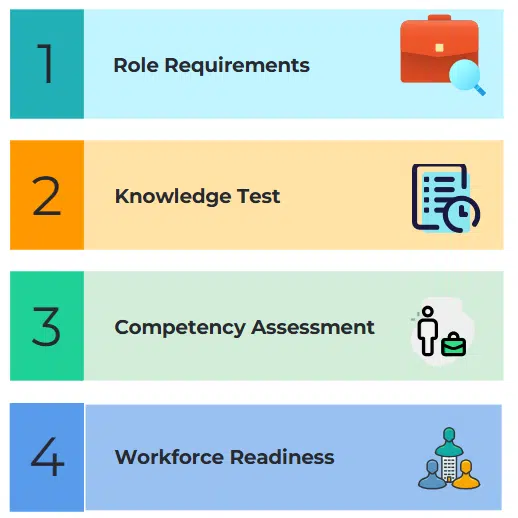
Why Competency Assessment Matters
Defining competencies and capability requirements is only one part of workforce capability management.
Organisations also need a reliable way to determine whether individuals can demonstrate the required competencies in practice.
Competency assessments help answer questions such as:
- Can the individual perform the required activity?
- Has the required competency been demonstrated?
- What evidence supports the assessment decision?
- Which competency gaps have been identified?
- Where is development required?
- Is reassessment required?
- Does the individual meet workforce readiness requirements?
Competency assessments support workforce visibility, development planning, operational assurance and workforce readiness.
Common Assessment Methods
These are how evidence is gathered.
- Observation
- Demonstration
- Knowledge Assessment
- Document Review
- Verbal Review
- Scenario-Based Evaluation
- Workplace Simulation
- Multi-Method Assessment
Common Assessor Types
These are who provides the assessment.
- Self Assessment
- Supervisor Assessment
- Expert Assessment
- Mentor or Preceptor Assessment
- Peer Assessment
- Multi-Rater Assessment
- Panel Assessment
Relationship to Capability Requirements
Capability requirements define the competencies, qualifications, certifications and other requirements expected for a role or responsibility.
Competency assessments help determine whether competency-related requirements have been demonstrated and achieved.
Capability requirements define expectations. Competency assessments evaluate performance against those expectations.
Relationship to Competency Evidence
Competency assessments should be supported by appropriate evidence.
Evidence may include observations, demonstrations, assessment records, knowledge test results, certifications, portfolios, supervisor feedback or other supporting information.
Assessment provides the decision. Evidence supports the decision.
Relationship to Capability Passports
Competency assessment outcomes often contribute to information displayed within a Capability Passport.
Assessment results provide visibility of demonstrated competency status and help support workforce capability and readiness decisions.
Relationship to Workforce Readiness
Competency assessments are one of the key contributors to workforce readiness.
Readiness decisions may incorporate assessment outcomes alongside capability requirements, qualifications, certifications, authorisations and other workforce capability information.
Relationship to Workforce Capability Infrastructure
Competency assessment is a core component of workforce capability infrastructure.
It provides the evaluation process used to determine whether workforce capability expectations have been met and supports workforce visibility, assurance and readiness management.
What Competency Assessment Is Not
Training Completion
Completion of training does not necessarily demonstrate competency. Competency assessment evaluates whether knowledge and skills can be applied effectively in practice.
A Knowledge Test
Knowledge testing may contribute to competency assessment, but competency assessment often incorporates multiple assessment methods and sources of evidence.
A Performance Review
Performance reviews evaluate broader performance outcomes, behaviours and objectives. Competency assessments focus on demonstrated competency against defined requirements.
Workforce Readiness
Competency assessment contributes to workforce readiness but is only one component of the broader readiness picture.
Related Concepts
FAQs
What is competency assessment?
Competency assessment is the process of evaluating whether an individual can demonstrate the knowledge, skills, behaviours and judgement required to perform effectively within a defined role or work context.
Why is competency assessment important?
Competency assessments help organisations determine whether workforce capability expectations have been met and provide evidence to support capability and workforce readiness decisions.
What evidence can be used in competency assessment?
Evidence may include observations, demonstrations, knowledge tests, certifications, supervisor assessments, peer feedback, portfolios and other supporting records.
How does competency assessment differ from training completion?
Training completion confirms participation in learning activities. Competency assessment evaluates whether the required competency can be demonstrated in practice.
How does competency assessment support workforce readiness?
Competency assessments provide evidence of demonstrated capability and contribute to readiness decisions alongside qualifications, certifications, authorisations and other workforce requirements