
Workforce Intelligence: Can You Trust Your Workforce Data?
Workforce intelligence promises better decisions about capability, performance, and organizational readiness. But how reliable is the information behind those decisions?
What Can Workforce Intelligence Tell Us?
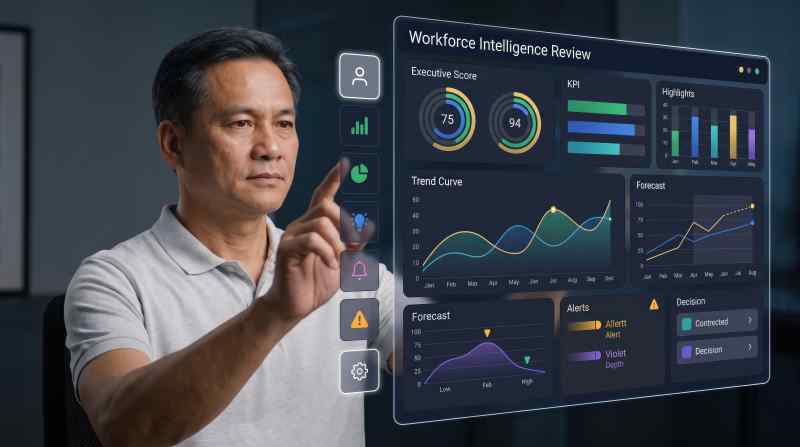
Workforce intelligence brings together information about people, their capabilities, performance, and organizational requirements to support operational and strategic decisions.
Ideally it helps organizations understand not only the workforce they have today, workforce readiness, but also whether they have the capabilities needed to meet current demands and prepare for the future.
Consider three examples:
- In healthcare, workforce intelligence can help answer whether clinicians have the competencies required to perform particular procedures independently, where gaps exist, and what development or reassessment is needed.
- In manufacturing and utilities, it can help establish whether sufficient competent and authorized personnel are available to undertake critical work, maintain safe operations, and respond to changing operational demands.
- In workforce planning, it can reveal capability gaps across roles and departments, identify potential successors, and inform decisions about development, recruitment, and future workforce requirements.
These are important questions, with consequences for safety, performance, productivity, and organizational resilience.
But the usefulness of workforce intelligence depends on the reliability of the information behind it.
More Workforce Data Doesn’t Mean Better Intelligence
Organizations already have plenty of workforce data.
HR systems have employment histories, qualifications, and job information. Learning management systems track training and certifications. Skills inventories record employee capabilities. Performance management systems capture goals, feedback, and ratings. Competency assessment systems document demonstrated performance.
Each contributes something valuable, but they don’t measure the same things.
A completed training course does not automatically establish practical competence. A self-reported skill is not equivalent to an independently verified assessment. A performance rating may reflect achievement of business objectives without establishing proficiency in particular tasks.
Even when the records themselves are accurate, the conclusions drawn from them may not be.

Bringing this information together into dashboards and reports can improve visibility. But combining data collected for different purposes, using different standards and methods, can also create a false impression of certainty.
Workforce Intelligence You Can Act On
Workforce intelligence becomes valuable when organizations can use it to make informed decisions with an appropriate degree of confidence. That requires more than accurate records or sophisticated analytics. Decision-makers need reliable underlying information, visibility into the strength and limitations of the evidence, and an understanding of whether that evidence is suitable for the decision being made.
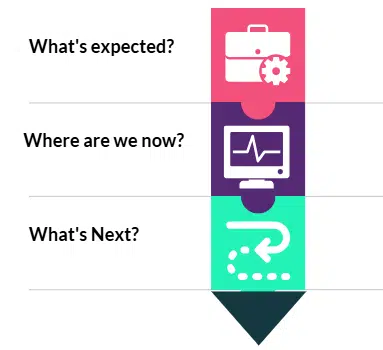
Workforce intelligence should help organizations answer three fundamental questions:
- What is expected? What capabilities and standards are required for particular roles and work?
- Where are we now? What capabilities are available, what has been demonstrated, and how reliable is the supporting evidence?
- What’s next? Where are the gaps, what actions are needed, and how should the organization prepare for future workforce requirements?

The challenge is not just having access to workforce data. It is understanding what the data actually tells us, and what it doesn’t.
That brings us to the question of TRUST.
Can AI Be Trusted to Interpret Workforce Intelligence?
AI is increasingly being used to identify and infer workforce skills and competencies from language – including CVs, job descriptions, employee profiles, performance reviews, and descriptions of work experience.
Using natural language processing and semantic matching, AI can identify capability-related terms and associate them with skills taxonomies or competency frameworks. Some systems match information to established competency definitions, while others generate inferred skills or capabilities from patterns in the text.
This can be valuable for identifying potential capabilities, suggesting competency matches, and helping organizations organize large volumes of workforce information.
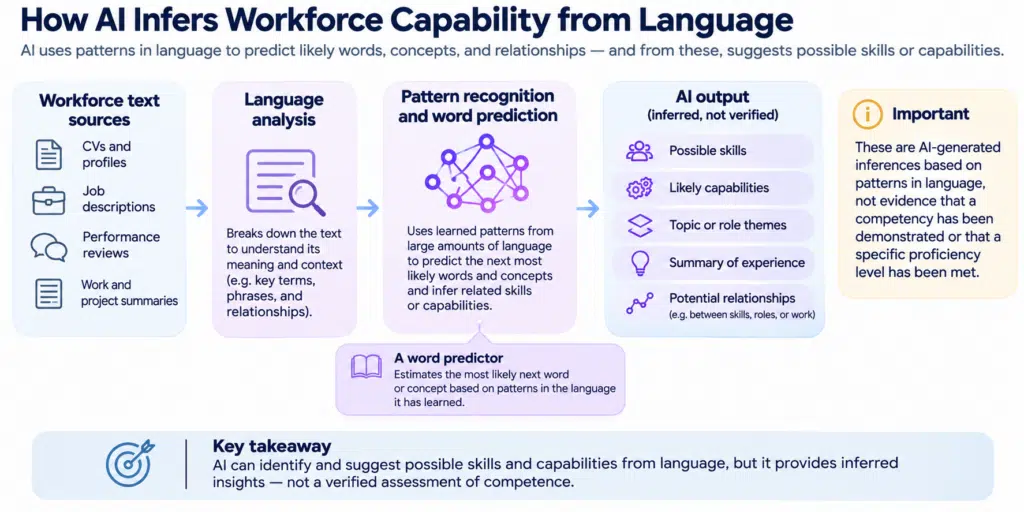
But recognizing language associated with a competency is not the same as establishing that the competency has been demonstrated.
An employee’s description of leading a project may suggest leadership, planning, and risk management capabilities. It does not establish the level of proficiency demonstrated, the quality of performance, or whether the employee meets specific competency requirements.
Even when AI maps information to an established framework, semantic similarity does not provide evidence that the person meets its assessment criteria.
There is also a risk that inferred capabilities are presented alongside verified competencies without a clear distinction between them. When these records are aggregated into workforce analytics, the resulting picture of capability may appear more certain than the evidence warrants.
For AI-supported workforce intelligence to be trustworthy, organizations need to know what information was used, how capabilities were inferred or matched, which competency definitions were applied, and whether the resulting judgments have been independently verified.
The protection of workforce information is another important consideration. CVs, performance records, assessments, and employee profiles may contain personal or commercially sensitive information. Organizations need to understand what information is shared with AI services, how it is processed and retained, and whether it may be used for other purposes.
AI can be a powerful tool for identifying possible capabilities and supporting workforce analysis. But inferred capability should remain distinguishable from assessed competency, and decisions should reflect the strength of the underlying evidence.
What Makes Workforce Intelligence Trustworthy?
Trusted is a word frequently used in relation to data, analytics, and increasingly, artificial intelligence.
But what does it mean when we are making decisions about workforce capability?
Trustworthy workforce intelligence is information that is sufficiently reliable, relevant, and transparent to support the decisions for which it is being used.
Six dimensions are particularly important:
| Dimension | Key question |
|---|---|
| Accuracy | Does the information correctly represent the capability or performance being described? |
| Currency | Is the information still valid and relevant today? |
| Evidence | What supports the recorded capability or proficiency? |
| Context | Under what conditions was the capability demonstrated, and does that match the intended use? |
| Consistency | Have comparable standards and assessment criteria been applied? |
| Traceability | Can we establish where the information came from and how it was verified? |
These dimensions are interdependent.
– An assessment may be accurate when conducted but become outdated.
– A proficiency rating may be current but based on poorly defined criteria.
– Evidence may be credible but relate to a different operating environment.
Trust is therefore not simply a property of a database, a dashboard, or the technology used to analyze information.
It depends on the quality of the underlying information and our ability to establish what that information reliably represents.
Trust Starts With the Evidence, Not the Dashboard

Reliable workforce intelligence begins well before information reaches a report or analytics dashboard.
It begins with defining what is expected and establishing credible evidence of what employees can actually do.

What Is Expected?
Define Capability Before Measuring It
Before an organization can determine whether employees meet its requirements, those requirements must be clearly defined.
Job descriptions, competency frameworks, skills matrices, professional standards, and operating procedures all contribute to establishing expectations.
The quality of those definitions matters.
Consider a competency described as “demonstrates effective communication.”
This does not provide any guidance on
- What effective communication looks like
- In which situations
- At what level of proficiency
- How an assessor should determine whether the requirement had been met
Specific, observable assessment criteria provide a more consistent and defensible basis for determining whether competence has been demonstrated.
Instead of ‘ effective communication’ , specific criteria might require an employee to explain a procedure clearly, check understanding, and respond appropriately to questions about the procedure.
Similarly, a manufacturing employee might be expected, for a particular process – to identify hazards, apply the specified controls, and follow established isolation procedures.
These behaviors can be observed and evaluated. They also make expectations clearer to employees and reduce ambiguity between assessors.
However, criteria must do more than describe observable actions. They must reflect the knowledge, skills, judgment, and level of performance genuinely required for the work.
A well-designed competency framework is the essential foundation for meaningful assessment – and therefore meaningful workforce intelligence.
Where Are We Now?
Establish What Has Actually Been Demonstrated

Once expectations are defined, the next question is whether employees meet them.
Workforce capability information can come from many sources:
- Qualifications, licenses, and certifications.
- Training records and knowledge tests.
- Employee self-assessments.
- Manager and expert evaluations.
- Direct observation of work.
- Demonstrated competency assessments.
- Performance reviews and work outcomes.
These sources provide different types and strengths of evidence.
For example, a qualification may establish that someone has completed a recognized program of study. Training completion confirms participation in learning, potentially including successful knowledge assessment. Direct observation can establish whether someone performs a task to the required standard under particular conditions.
No single method is appropriate for every capability.
Knowledge testing may be suitable for assessing understanding of regulations or procedures. Direct observation may be needed to establish practical competence. More complex competencies involving professional judgment may require multiple observations, case discussions, or evidence gathered over time.
The choice of assessment method should reflect the nature of the competency and the consequences of an incorrect judgment.
A competency rating is only as reliable as the criteria, assessment process, and evidence behind it.
From Evidence to Intelligence: Making Reliability Visible
Establishing reliable competency information is only part of the challenge.
Decision-makers also need to understand how that information was established and whether it is suitable for the decisions they are making. Three connected elements are essential.
Reliable Information

Capability judgments should be based on clearly defined requirements, appropriate assessment methods, and credible supporting evidence.
An assessment should establish what the employee has demonstrated, against which criteria, and under what conditions.
Visible Reliability

The basis for those judgments should be accessible.
Depending on the purpose, this may include the assessment criteria, method, assessor, date, context, supporting evidence, and any relevant limitations or reassessment requirements.
This information helps users distinguish between reported capability, inferred capability, and demonstrated competence.
It also allows them to recognize when an assessment may no longer be sufficiently current or relevant.
Suitability for the Decision

The same information may be adequate for one decision but insufficient for another.
Self-assessed skills may be useful for identifying development interests. They would not normally provide sufficient assurance to authorize an employee to perform safety-critical work independently.
A competency assessment completed several years ago may provide useful historical information, but may need to be revisited if equipment, procedures, or role requirements have changed.
The level of assurance required should reflect the nature and consequences of the decision.
Connecting Information Without Losing Its Meaning
Workforce intelligence depends on connecting information from different sources while preserving its meaning and context.
Consider a workforce readiness dashboard showing that 85% of employees meet a particular competency requirement.
What does that figure mean if some ratings are based on self-assessment, others on training completion, and others on observed performance?
The percentage may be mathematically correct, but it could conceal important differences in the strength of the supporting evidence.
This is why workforce intelligence needs to connect requirements, capability records, assessments, and development information without treating every record as equivalent.
Users should be able to move from a workforce-level view to the underlying information that supports it.
Aggregation does not automatically create trustworthy intelligence. The reliability of workforce-level conclusions depends on the reliability, relevance and comparability of the information being combined.
From Workforce Intelligence to Better Decisions
The purpose of workforce intelligence is not simply to describe the workforce. It is to inform action.
Reliable information about current capability, interpreted against clearly defined requirements, can support decisions across several areas.
- Operational readiness: Identifying employees who meet competency and authorization requirements for particular work, and where additional verification is needed.
- Targeted development: Distinguishing genuine competency gaps from missing or outdated evidence, so development and reassessment can be directed appropriately.
- Workforce planning: Understanding capability distribution across teams and departments, identifying shortages, and anticipating the effects of changing operational requirements.
- Career development and succession: Evaluating potential and readiness against future role requirements, rather than relying primarily on job titles, tenure, or subjective judgments.
The decisions vary, and so do the evidence requirements.
An organization may reasonably use indicative skills information for broad development planning while requiring independently verified competency assessments for high-risk operational decisions.
Trusted workforce intelligence does not mean that every workforce record must meet the same standard.
It means knowing what the evidence supports and whether it provides sufficient assurance for the decision at hand.
How Can Organizations Build Trusted Workforce Intelligence?
Start With the Decisions

Identify the operational and strategic questions the organization needs to answer.
What evidence is required to authorize employees for particular tasks? How should competency gaps be identified? What information is needed to support succession or workforce planning?
The answers determine the information and level of assurance required.
Define Expectations Clearly

Establish role and task requirements, competency standards, and proficiency levels that reflect the actual work.
Use specific, observable assessment criteria wherever demonstrated performance needs to be evaluated.
Match Assessment Methods to Purpose

Choose assessment methods appropriate to the capability being assessed.
Knowledge testing, direct observation, expert evaluation, work samples, and other methods each have a place. Their suitability depends on what must be demonstrated.
Preserve the Basis for Capability Judgments
Retain the criteria, methods, dates, context, and supporting evidence needed to understand how competency conclusions were reached.
Make this information accessible to those responsible for interpreting and acting on it.
.
Connect Information Without Losing Context
Bring together job requirements, capability records, competency assessments, performance information, and development activities.
Maintain the distinctions between different forms of evidence and enable users to examine the basis for workforce-level conclusions.
Keep Information Current
Capability requirements and individual circumstances change.
Establish processes for reviewing information, updating requirements, and triggering reassessment when necessary.
The objective is not simply to maintain complete records, but to maintain information that remains useful and reliable for its intended purpose.
Trustworthy workforce intelligence doesn’t require perfect information or the elimination of uncertainty. It requires clearly defined expectations, credible evidence, transparency about reliability, and the ability to interpret information appropriately for the decisions being made.
The real value of workforce intelligence is not how much information an organization holds, but how confidently it can use that information to make better decisions.
How Centranum Supports Trusted Workforce Intelligence
Centranum’s configurable workforce capability platform connects job and capability requirements with employee capability records, competency assessments, supporting evidence, performance information, and development activities.
Organizations can define competencies and proficiency standards, establish specific, observable assessment criteria, apply different assessment methods, and retain the information needed to understand how capability judgments were reached.
Connected workforce readiness views help organizations examine current capability against requirements, identify gaps, and plan appropriate actions.
FAQs
What is workforce intelligence?
Workforce intelligence combines information about employees, capabilities, performance, and organizational requirements to support decisions about workforce readiness, development, and future needs.
What is the difference between workforce analytics and workforce intelligence?
Workforce analytics identifies patterns and trends in workforce data. Workforce intelligence interprets that information against organizational requirements to support decisions and actions.
What makes workforce intelligence trusted?
Six factors: accuracy, currency, evidence, context, consistency, and traceability. Together, they help establish whether workforce information is sufficiently reliable for a particular decision.
How can organizations verify employee skills and competencies?
Through assessments against specific, observable criteria, using appropriate methods such as knowledge testing, direct observation, work samples, and expert evaluation.
Can AI accurately identify employee skills and competencies?
AI can infer possible skills and capabilities from language based and experience records, but these inferences do not establish demonstrated competency or verified proficiency.
How does workforce intelligence support workforce planning?
It helps organizations identify capability gaps, assess workforce readiness, anticipate future requirements, and make informed decisions about development, recruitment, and succession.
Can training records be used as evidence of competency?
Yes, if training includes appropriate assessment against defined competency criteria. Completion records alone establish participation, not necessarily demonstrated competence.