
Skills Matrix vs Competency Framework: What’s the Difference?
A skills matrix provides visibility into workforce capability, while a competency framework defines the knowledge, skills and behaviours required for effective performance. Together they help organisations assess, develop and improve workforce readiness.
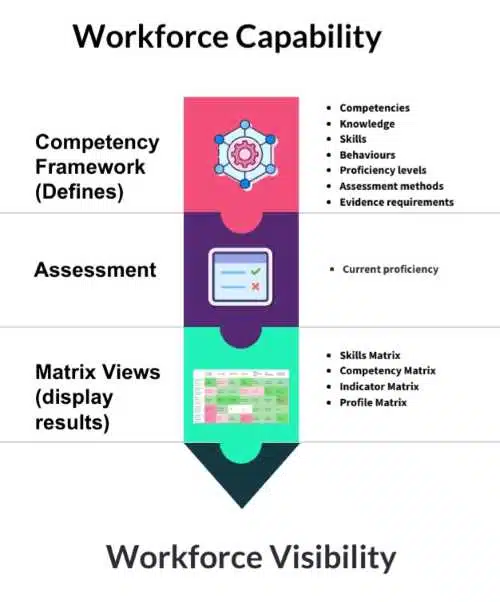
See gaps, coverage, readiness, development priorities
Understanding the Difference
A skills matrix and a competency framework are often discussed as though they are competing approaches. In reality, they serve different purposes and are most effective when used together.
A competency framework defines what people need to know, do and demonstrate to perform successfully in a role.
A skills matrix provides a visual summary of the current capability of individuals or teams.
One defines expectations.
The other displays assessment results.
Understanding this distinction helps organisations build more structured approaches to workforce capability, development and workforce readiness.
Skills and Competencies Are Not the Same
The difference begins with the distinction between a skill and a competency.
A skill
A skill is the ability to perform a specific task or activity.
Examples include operating equipment, performing a clinical procedure, using software or completing a manufacturing process.
Skills are generally task-focused and can often be observed directly.
A competency
A competency is broader.
It combines the knowledge, skills and their effective application in the workplace, together with judgement, behaviours and other attributes required for successful performance.
Competencies describe how capability is applied in real work situations, not simply whether someone can perform an isolated task.
This distinction is important because competency frameworks are designed to assess more than individual skills.
What Is a Competency Framework
A competency framework defines the capabilities required for successful performance within a role, profession or organisation.
Depending on the organisation, it may include:
- technical competencies
- behavioural competencies
- leadership competencies
- role-specific competencies
- core organisational competencies
Each competency typically defines:
- required knowledge
- required skills
- expected behaviours
- proficiency levels
- assessment criteria
- evidence requirements
This creates a consistent standard for assessing capability across individuals, teams and locations.
Rather than relying on personal opinion, managers assess employees against clearly defined expectations.
What Is a Skills Matrix
A skills matrix is a visual representation of assessed capability.
Typically displayed as a table, it shows people on one axis and skills (or other capability requirements) on the other, allowing managers to quickly see current capability across a team.
A skills matrix helps answer questions such as:
- Who can perform this task?
- Where are our skills gaps?
- Who can provide cover?
- Where should training be prioritised?
- Which teams are at risk?
Its strength is providing visibility.
It summarises workforce capability in a format that is easy to understand and use for planning.
Quick Comparison
| If you need to… | Skills Matrix | Competency Framework |
|---|---|---|
| View who can perform a task | ✓ | ✓ |
| Compare capability across a team | ✓ | ✓ |
| Define role expectations | Limited | ✓ |
| Assess capability consistently | Limited | ✓ |
| Capture assessment evidence | No | ✓ |
| Link learning to capability | Limited | ✓ |
| Support compliance and audits | Limited | ✓ |
| Measure workforce readiness | Limited | ✓ |
For many organisations, the best solution is not choosing one or the other—it is using both together.
How They Work Together
Rather than choosing between a skills matrix and a competency framework, many organisations use both
The competency framework provides the structure by defining:
- what capability is required
- how capability should be assessed
- expected proficiency levels
- what evidence demonstrates competence
Assessment results can then be presented in a skills matrix, giving managers a clear view of current workforce capability.
In other words:
- The competency framework defines capability.
- The skills matrix displays capability.
Together they provide both consistency and visibility.
Beyond Skills: Supporting Workforce Readiness
Modern organisations need more than a list of skills. They need confidence that employees are ready to perform their roles safely and effectively.
Workforce readiness may depend on a combination of:
- competencies
- skills
- qualifications
- certifications
- licences
- mandatory training
- workplace assessments
- practical evidence
- experience
- authorisations
A competency framework provides the structure for managing these requirements, while matrix views help managers understand capability across teams and identify gaps that require attention.

When Is a Skills Matrix Enough?
A competency framework becomes increasingly valuable when organisations need to:
- define consistent role expectations
- assess competence objectively
- capture assessment evidence
- support compliance and accreditation
- manage workforce readiness
- align learning with capability requirements
- support career development and succession planning
As organisational complexity increases, structured competency management becomes increasingly important.
When Do You Need a Competency Framework?
A skills matrix may be sufficient when an organisation wants to:
- gain a quick overview of workforce capability
- identify basic skills gaps
- support cross-training
- plan routine development activities
For relatively simple operational environments, this may provide adequate visibility.
Common Misconceptions

Skills and competencies are the same.
Skills are part of competency, but competency also includes knowledge, judgement, behaviours and the effective application of skills in the workplace.
Training completion proves competence
Completing training is only one part of demonstrating workforce capability. Practical assessment and evidence are often equally important.
A skills matrix replaces a competency framework
A skills matrix provides visibility into capability but does not define capability requirements or assessment standards.
FAQs
Can a competency framework include skills?
Yes. Skills are often one component of a competency, alongside knowledge, behaviours, judgement and proficiency expectations.
Is a skills matrix the same as a competency matrix?
Not necessarily. A skills matrix typically focuses on individual skills or tasks, while a competency matrix may present broader competency assessment results. Both are visual ways of presenting workforce capability.
Which is better for compliance?
A competency framework generally provides stronger support because it defines assessment criteria, proficiency requirements and evidence needed to demonstrate competence.
Can organisations use both together?
Yes. Many organisations define capability using a competency framework and present assessment results through skills or competency matrices to provide managers with clear visibility.