
Who Is Authorized to Perform the Work?
Closing the Gap Between Training, Competency, and Authorisation
Understanding who is authorised to perform work is critical in industries where safety, compliance, competency, and operational readiness must be validated before activities can be assigned.
Most organisations can tell you who has completed training.
Far fewer can clearly demonstrate who is authorised to perform critical tasks — and under what conditions.
This gap sits between training records, competency assessments, and operational control.
It is also where compliance risk, safety exposure, and audit challenges most often occur.
Workforce readiness is rarely based on one factor alone.
Training, competency, and authorisation each play a different role in determining whether someone is permitted to perform work.
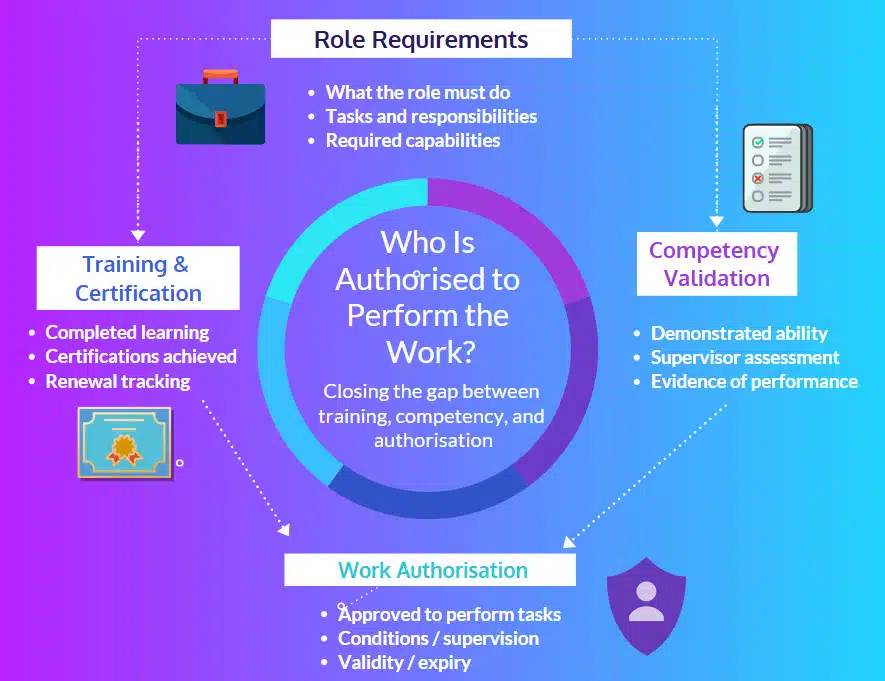
Role requirements define what is needed. Training and competency provide evidence of readiness. Authorisation determines whether work can be performed.
Training, Competency, and Authorisation Are Not the Same
These concepts are often treated as interchangeable, but they serve different purposes within workforce readiness.
Training — records that learning, instruction, or certification has been completed.
Competency — demonstrates that an individual can perform a task or role to the required standard, typically through assessment, observation, or validation.
Authorisation — confirms that an individual is approved to perform specific work within defined scope, conditions, or timeframes.
While many systems capture training records, and some support competency assessment, far fewer provide a structured way to manage workforce authorisation — particularly where approval depends on multiple conditions being met.
Why Authorisation Matters More Than Organisations Realise
In many organisations, work is assigned based on role title, training completion, or assumed experience. However, these indicators do not always confirm whether someone is formally authorised to perform a specific activity.
Authorisation becomes important when work carries operational, safety, regulatory, or clinical risk. In these environments, organisations may need to confirm not only that an individual has completed training or demonstrated competency, but also that additional conditions have been met.
These conditions may include: 
- current licences, permits, or certifications
- role-specific approvals or sign-off
- demonstrated competency within a defined timeframe
- supervisor or assessor validation
- site, equipment, or activity-specific restrictions
- reassessment or renewal requirements
Without a clear authorisation framework, organisations may struggle to answer a simple but critical question:
Who is approved to perform this work today — and on what basis?
This gap often becomes visible during audits, incidents, workforce transitions, or when responsibilities change across teams or locations.
What Authorisation Means in Practice
Authorisation defines the conditions under which an individual is permitted to perform work.
Unlike role title or training completion alone, authorisation provides operational clarity around who can perform specific activities and within what limits.
In practice, authorisation may define:
- which tasks or activities an individual can perform
- the level of responsibility permitted
- whether supervision or sign-off is required
- equipment, location, or environment restrictions
- validity periods, expiry dates, or reassessment requirements
- role-specific or regulatory approval conditions
This creates a clear connection between workforce capability and operational control, helping organisations ensure that work is assigned to appropriately approved individuals.
Common Gaps in Current Approaches
Many organisations manage training, competency, and authorisation across disconnected systems, spreadsheets, or local processes.
As a result, it can become difficult to clearly understand:
- who is currently authorised to perform specific work
- which tasks or activities that authorisation applies to
- whether approvals are still valid or require renewal
- what evidence supports an authorisation decision
- how authorisation changes when roles or responsibilities evolve
Training completion is often used as a proxy for readiness, even when additional validation, experience, or approval may be required.
Without a structured approach, organisations may rely on assumption rather than verifiable data — making it harder to answer operational, compliance, or audit questions with confidence.
A Structured Approach to Capability and Authorisation
A more effective approach connects workforce requirements, assessment, and authorisation within a clear, traceable process.

In this structure:
- Role definitions establish what work needs to be performed
- Capability requirements define qualifications, training, licences, or experience
- Competency assessments confirm demonstrated ability in practice
- Authorisations formalise approval to perform specific work
- Evidence and audit trails provide traceability and ongoing validation
Rather than treating training, competency, and authorisation as separate activities, this creates a connected view of workforce readiness — helping organisations understand not only what people have completed, but what they are approved to do.
Utilities, Technical Roles, and Permit-Based Work
In industries such as utilities, infrastructure, engineering, manufacturing, and field services, authorisation often goes beyond role title or training completion. Individuals may need to meet multiple conditions before they are permitted to perform specific work.
These conditions may include permits, licences, certifications, operational approvals, permission to operate specific machinery or equipment, or demonstrated competency linked to particular tasks or environments.
Examples may include:
- electrical or switching authorisations
- confined space permits
- high-risk work licences
- isolation or lockout approvals
- plant or equipment operation certification
- safety-critical role approval
- contractor or site-specific inductions
- regulatory or industry compliance requirements

In these environments, authorisation is often task-specific rather than role-based. A person may be approved to perform some activities, but not others, depending on training, competency, experience, supervision requirements, or permit status.
A structured approach helps organisations ensure that work is assigned only to individuals who meet both formal requirements and operational readiness criteria.
Healthcare and Clinical Competency

In healthcare environments, the distinction between training, competency, and authorisation is particularly important.
Training may be completed through an LMS, while competency is often validated through observation, sign-off, or clinical assessment. However, organisations may still struggle to maintain a clear, centralised view of who is authorised to perform specific procedures or work within defined scope of practice.
This can make it difficult to consistently track:
- which clinicians are authorised to perform specific procedures
- the level of supervision or delegation required
- expiry, reassessment, or revalidation requirements
- evidence supporting each authorisation decision
- differences in authorisation across departments, locations, or clinical settings
Without a structured approach, audit preparation becomes more manual, verification relies heavily on local records, and visibility of workforce readiness can be fragmented across teams.
Why Training Completion Is Not Enough
Training completion is often treated as evidence of readiness, but it does not always confirm that an individual is authorised to perform work.
In many environments, additional conditions may need to be met before approval can be granted.
Organisations may also need to confirm:
- required qualifications, licences, or certifications are current
- mandatory experience thresholds have been achieved
- competency has been demonstrated in practice
- supervisor approval or sign-off has occurred
- permits, access rights, or equipment approvals remain valid
- reassessment, renewal, or recertification requirements are tracked
This becomes particularly important where work carries operational, safety, regulatory, or clinical risk. Authorisation depends not only on what someone has completed, but whether all required conditions remain valid at the time work is performed.
Supporting Permit and Authorisation Tracking

A structured approach allows organisations to manage authorisation as an active workforce control rather than a collection of disconnected records.
By linking authorisation to roles, tasks, permits, and evidence, organisations can maintain a clearer view of who is approved to perform specific work and under what conditions.
This can support:
- role- or task-based authorisation visibility
- permit, licence, and approval tracking
- expiry and renewal management
- alignment between requirements and workforce readiness
- prevention of unauthorised work allocation
- traceable records for audit and compliance
Rather than relying on spreadsheets or local ownership, organisations gain a consistent view of workforce authorisation across operational and safety-critical roles.
Authorisation as Part of Workforce Readiness
Authorisation should not be viewed as a standalone compliance activity. It forms part of a broader picture of workforce readiness — helping organisations understand whether individuals are not only trained or assessed, but appropriately approved to perform work.
As roles evolve, responsibilities shift, and regulatory expectations increase, organisations need greater visibility into how capability, competency, and authorisation align across the workforce.
A structured approach can help organisations:
- understand readiness at an individual, team, or operational level
- respond more effectively to workforce change
- support safer task allocation and supervision decisions
- maintain continuity as roles or requirements evolve
- strengthen auditability and governance across operational work
 Rather than asking only “Who has completed training?”, organisations can begin to answer a more meaningful question:
“Who is currently ready and authorised to perform this work?”
This creates a more complete view of workforce capability — linking role requirements, demonstrated competency, and operational approval within a single framework.
FAQ
What is workforce authorisation?
Workforce authorisation is the formal approval for an individual to perform specific work or tasks. It may depend on training, competency, licences, permits, supervision requirements, or organisational approval.
What is the difference between competency and authorisation?
Competency confirms that an individual can perform work to a required standard. Authorisation determines whether that individual is approved to perform specific work within defined conditions or scope.
Does training completion mean someone is authorised to perform work?
Not always. Training may support readiness, but authorisation often depends on additional factors such as competency validation, permits, licences, experience, or supervisor approval.
Why is workforce authorisation important?
Authorisation helps organisations ensure that work is assigned to appropriately approved individuals, reducing compliance risk, improving safety, and supporting audit readiness.
How is authorisation managed in technical or permit-based environments?
Authorisation may depend on role requirements, permits, licences, competency validation, expiry dates, and operational approvals linked to specific tasks or equipment.
Can authorisation requirements vary by role or task?
Yes. Authorisation may apply differently depending on the activity, environment, equipment, supervision requirements, or level of responsibility involved.