

Best Competency Management Software (2026): Compare 14 Top Tools for Capability Growth
Vendors reviewed: Kahuna, Dossier, StaffGarden, TalentGuard, Fuel50, CABEM, HRSG, SkillDirector, Skills-Base, AG5, CloudAssess, ThinkEleven, Acorn Works — plus our editor’s take on Centranum.
This guide compares 14 leading competency management software platforms in 2026. It is designed for HR, Learning & Development, compliance, and operational leaders evaluating structured systems to define, assess, and develop workforce capability.
With vendors offering overlapping feature sets and AI-driven claims, selecting the right platform requires looking beyond marketing language. The real differences lie in architecture, governance, assessment design, and how well the system supports compliance, operational readiness, and career growth.
Different Types of Competency Management Software
Choosing the right competency management system isn’t just about ticking boxes. The best platform depends on how deeply you need to track competence, prove compliance, and support workforce growth. Here are the key factors to evaluate:
| Platform Type | Best For |
|---|---|
| Healthcare competency | Clinical assessment & evidence |
| Talent suites | Career & succession |
| Compliance platforms | Regulated industries |
| Competency libraries | Framework design |
| Skills matrices | Operational visibility |
| Integrated capability platforms | End-to-end workforce capability |
Explore a Structured Approach to Competency Management
See how Centranum supports competency frameworks, structured assessments, competency evidence and workforce readiness within one configurable platform.
How We Chose the Top Competency Management Platforms
Our evaluation is based on eight key capability dimensions used by leading HR and compliance organizations:
- Framework Depth – Level design, indicators, and behavioral definitions
- Assessment & Evidence Capture – Self, manager, and validation tools
- Audit & Assurance – Traceability and version control for regulated contexts
- Analytics & Reporting – Skills gap analysis, dashboards, and workforce insights
- L&D Integration – Direct linkage between competencies and learning
- Career & Succession Mapping – Capability pathways and readiness tracking
- System Integrations – HRIS, LMS, and performance systems
- Pricing Transparency – Visibility and scalability for enterprise rollout
Best Healthcare-Focused Platforms (3 reviewed) – Dossier, StaffGarden, Kahuna
Kahuna Workforce
 Kahuna is a US-based platform that specializes in skills and competency management for large technical and industrial workforces. It positions itself as a tool for operational readiness, particularly in high-consequence industries like energy, healthcare, and heavy manufacturing.
Key Features: Workforce skills assessment, role-based requirements mapping, readiness dashboards, integrations with HR and learning systems.
Strengths: Strong focus on industries where safety and compliance are critical; detailed role-to-skill alignment; good visibility for operational leaders.
Limitations: Implementation can be complex; audit and compliance reporting is not as robust as some competitors; less flexible outside technical/industrial contexts.
Best For: Large technical organizations in sectors such as oil & gas, utilities, or healthcare that need to monitor readiness and workforce skills at scale. Enterprise pricing, generally positioned at the mid-to-high end of the market given its industrial focus and implementation requirements.
Dossier
Dossier is a US-based platform focused exclusively on clinical competency management. It is widely used by hospitals and healthcare organizations to manage nursing and allied health competencies, compliance, and Magnet accreditation requirements.
Key Features: Clinical competency tracking, mobile-friendly assessments, skills validation checklists, reporting for Magnet readiness.
Strengths: Purpose-built for healthcare; strong adoption in US hospitals; tailored workflows for nursing and allied health roles.
Limitations: Limited applicability outside clinical settings; weaker support for broader talent management or career development; heavy healthcare terminology may not translate well for other sectors.
Best For: Hospitals and healthcare providers seeking a system focused on clinical competency, regulatory compliance, and Magnet accreditation support. Mid-range enterprise pricing, aligned with healthcare sector budgets. Competitively priced for hospitals but less transparent publicly.
StaffGarden
StaffGarden (acquired by Ascend Learning) is a platform originally built for nursing portfolio management and clinical credential tracking. It provides hospitals with digital tools for managing nursing education, certification, and competency records.
Key Features: Digital nursing portfolios, education and credential tracking, compliance documentation, clinical career ladders.
Strengths: Focused on nursing workforce needs; strong portfolio and credential management; ties into professional development pathways.
Limitations: Limited support beyond nursing; not a full competency management solution across roles; long-term roadmap uncertain under Ascend Learning ownership.
Best For: Nursing and hospital education teams looking for portfolio and credential tools. Pricing details are not widely published. Historically sold on a per-hospital basis, now part of Ascend Learning with bundled offerings.
(See our clinical competency management for more detail on healthcare-focused platforms.)
Comparison
Healthcare-focused systems highlight credential tracking, portfolios, and Magnet readiness. While effective in hospitals and allied health, most are limited to healthcare use cases and do not extend easily into broader workforce or career applications.
Healthcare (Kahuna, Dossier, StaffGarden)
| Vendor | Focus | Strengths | Limitations |
|---|---|---|---|
| Kahuna | Industrial + healthcare | Ops-focused assessments; competency assurance in clinical and industrial contexts | Complex implementation; broad but not granular in clinical detail |
| Dossier | Healthcare | Magnet readiness, audit support, compliance tracking | Narrow scope (healthcare only); less suited to non-clinical workforce |
| StaffGarden | Nursing portfolios | Credential management, nurse portfolios | Nursing-only; roadmap unclear after acquisition |
| Centranum | Healthcare + general | Full clinical competency workflows, integrated knowledge testing, audit-ready portfolio exports aligned to Magnet requirements | — |
Best Talent Marketplaces & Career Suites (2 reviewed) – Fuel50, TalentGuard
TalentGuard
 TalentGuard is a US-based talent management platform that emphasizes skills intelligence and career pathing. While it includes competency management capabilities, its positioning is broader — spanning performance, career development, and succession planning.
Key Features: Skills and competency libraries, career pathing tools, role profiles, succession planning, performance management, analytics dashboards.
Strengths: Strong positioning as an integrated skills intelligence platform; attractive for HR leaders seeking a career development focus; broad coverage across talent processes.
Limitations: Competency management is only one part of the suite; implementation can be complex; pricing can be higher than niche providers.
Best For: Mid-sized to large organizations that want a skills and career development platform with competency management included, rather than a competency-first solution. Premium enterprise pricing, reflecting its broader positioning as a career and succession platform rather than competency-only.
Fuel50
Fuel50 is a New Zealand–founded, US-headquartered platform best known for its talent marketplace and employee engagement focus. While it offers skills and competency management features, its primary strength is in internal mobility, employee experience, and career development.
Key Features: AI-driven talent marketplace, career pathing, skills and competency frameworks, gig and project matching, employee engagement analytics.
Strengths: Strong focus on employee experience and internal mobility; well-recognized in global enterprise markets; extensive use of AI for matching and recommendations.
Limitations: Designed more for engagement and career mobility than compliance or audit; complex implementation; premium pricing compared to niche competency solutions.
Best For: Large enterprises seeking a talent marketplace and internal mobility solution, with competency and skills as part of a broader engagement strategy. Premium enterprise pricing, often significantly higher than niche competency solutions, reflecting its positioning as a talent marketplace and engagement platform.
Comparison
Broad HR and talent marketplaces offer mobility, career pathing, and engagement features. These platforms work well for employee experience, but their competency management is limited – only one small piece of larger, more complex systems.
Broad HR/Talent Suites (Fuel50, TalentGuard)
| Vendor | Focus | Strengths | Limitations |
|---|---|---|---|
| Fuel50 | Talent marketplace | Internal mobility, engagement | Not competency-first |
| TalentGuard | Career/succession | Skills + career pathing | Complex, premium pricing |
| Centranum | Competency-first suite | Full cycle: frameworks, assessment, development, careers, succession |
Best Compliance-Led Platforms (1 reviewed) – CABEM
CABEM
 CABEM Technologies is a US-based software provider offering a competency management system with a strong compliance and audit focus. It is designed to help organizations document and track employee competencies, particularly in regulated industries.
Key Features: Competency frameworks, assessments, document management, role-based requirements, audit reporting, configurable workflows.
Strengths: Emphasis on compliance and audit trails; customizable to organizational requirements; US-based vendor with experience in regulated environments.
Limitations: User interface is less modern than newer platforms; limited focus on broader talent processes such as career development or succession; can require configuration effort.
Best For: Organizations in regulated sectors (manufacturing, government, healthcare) that prioritize compliance and auditability in their competency management approach. Pricing typically customized per implementation, with focus on compliance-heavy organizations. Not publicly transparent.
Comparison
Compliance-driven platforms emphasize audit trails and risk management, often in regulated industries. While strong in documentation, they may lack support for ongoing development, succession, or career growth.
Compliance Led – CABEM
| Vendor | Focus | Strengths | Limitations |
|---|---|---|---|
| CABEM | Compliance | Strong audit trails | Weaker UX, limited dev pathways |
| Centranum | Compliance + growth | Full audit trails plus development, career, succession support | — |
Best Library-First Platforms (2 reviewed) – HRSG, SkillDirector
HRSG (CompetencyCore)
 HRSG (CompetencyCore) is a Canada-based provider best known for its extensive library of prebuilt competencies and job profiles. It helps organizations quickly assemble competency frameworks and integrate them into HR processes like job descriptions and performance reviews.
Key Features: 3,000+ competencies, 500+ job descriptions, profiling and job role builder, integration with HR tools.
Strengths: Large content library accelerates framework building; useful for organizations starting from scratch; strong reputation in competency modeling.
Limitations: Content-first approach can lack depth in assessments and evidence tracking; may not support the detailed gap analysis or compliance reporting required in regulated sectors; broader workflows (development, succession) are limited.
Best For: Organizations seeking quick access to competency libraries and job profiles, especially if their priority is content over full assessment and assurance workflows. Pricing depends on library size and modules selected. Positioned mid-market, with costs linked to access to its extensive content library.
SkillDirector
SkillDirector positions itself around a “Self-Directed Learning Engine,” using prebuilt competency models to help employees identify gaps and take ownership of their development. It’s marketed heavily for organizations looking to accelerate upskilling initiatives.
Key Features: Predefined competency models, self-directed learning pathways, links to learning resources, progress tracking.
Strengths: Quick to launch with prebuilt content; empowers employees to take ownership of development; strong for learning-focused HR teams.
Limitations: Content-first approach; less emphasis on audit or compliance evidence; limited support for role frameworks and succession planning; depth of gap analysis depends on model fit.
Best For: Organizations that want fast-start competency models tied directly to self-directed learning, rather than a full audit and assurance platform.
Comparison
Competency library providers focus on speed: prebuilt content and models to help organizations get started quickly. While these libraries can accelerate setup, they often stop short of providing detailed assessment workflows, evidence tracking, or audit-ready outputs.
Library-first (HRSG, SkillDirector)
| Vendor | Focus | Strengths | Limitations |
|---|---|---|---|
| HRSG | Competency libraries | Large prebuilt content | Light on workflows |
| SkillDirector | Self-directed learning | Fast start with models | Limited compliance depth |
| Centranum | Library + workflows | 4000+ competencies, 1800+ roles plus assessment, gap analysis, and audit-ready evidence | — |
Best Skills-First Dashboards (2 reviewed) – Skills-Base, AG5
Skills-Base
 Skills-Base is an Australia-based platform for skills tracking and workforce dashboards. It provides a flexible skills hierarchy that can be built to any depth and displays workforce capability through visual heatmaps.
Key Features: Hierarchical skills library, dashboards and heatmaps, self-assessment tools, inferred skills from training data.
Strengths: Straightforward to configure; flexible hierarchy design; effective at simple skills visualization.
Limitations: Reporting is limited, lacks specific behavioral indicators, evidence capture, and compliance audit trail; interface is dated compared to modern platforms.
Best For: Organizations wanting a lightweight tool for skills tracking and visualization. Enterprises that require reliable reporting, assurance evidence, or targeted development planning may find the skills-only approach insufficient. Marketed as an affordable option for skills tracking. Exact pricing not transparent, but often perceived as lower-cost compared to enterprise solutions.
AG5
AG5 is a Netherlands-based skills management platform that emphasizes real-time dashboards for workforce planning. It is often used in operational environments to map and track employee skills across shifts, teams, and production lines.
Key Features: Skills matrices, visual dashboards, training and certification tracking, integrations with HR and ERP systems.
Strengths: Strong at frontline workforce planning; intuitive dashboards for operational leaders; good fit for manufacturing and technical environments.
Limitations: Skills-first approach provides less depth in defined competency indicators; limited support for compliance evidence or career development workflows; more suited to operational line management than enterprise-wide talent strategy.
Best For: Manufacturing and industrial organizations that want real-time visibility of workforce skills at the operational level. Mid-range pricing, typically sold as SaaS subscriptions per user. Competitive in manufacturing/operations use cases.
Comparison
Skills-first tools emphasize dashboards and heatmaps for workforce visibility. These can be useful snapshots, but without defined indicators, context, or evidence, the outputs may not be reliable for compliance or targeted development.
Skills-first (Skills-Base, AG5)
| Vendor | Focus | Strengths | Limitations |
|---|---|---|---|
| Skills-Base | Skills dashboards | Flexible hierarchies, visual heatmaps | Clunky UI, reporting gaps |
| AG5 | Skills matrices | Real-time ops dashboards | Shallow indicators |
| Centranum | Skills + competencies | Real-time tracking with context & evidence | — |
Best LMS-First Hybrids (3 reviewed) – CloudAssess, ThinkEleven, Acorn Works
CloudAssess
 CloudAssess is an Australia-based learning and assessment platform that has expanded its positioning into competency management. Its roots are in vocational training and compliance assessment, and it markets heavily to training providers, RTOs, and organizations with strong learning compliance requirements.
Key Features: Assessment creation and delivery, digital evidence collection, compliance reporting, learning content hosting, integrations with LMS/HR systems.
Strengths: Strong in assessment workflows; good fit for regulated training contexts; flexible for education and compliance-heavy industries.
Limitations: Primarily an assessment platform rather than a full competency management solution; limited support for role frameworks or enterprise workforce planning; more focused on training providers than corporate HR.
Best For: Training providers, RTOs, and organizations seeking digital assessment and compliance tracking with some competency management capabilities. Pricing is usually quoted per user, mid-range, with emphasis on assessment and training provider contexts.
ThinkEleven (SkillStation)
ThinkEleven, based in the UK, offers SkillStation, a modular platform for skills and competency management. It provides a blend of training, assessment, and reporting tools, with flexibility to configure for different organizational contexts.
Key Features: Competency and skills frameworks, dashboards, gap analysis, training records, optional LMS and e-learning modules.
Strengths: Flexible modular design; useful dashboards and gap analysis reporting; good fit for organizations wanting both training and competency tools in one platform.
Limitations: User experience less polished than some competitors; not as strong in audit-ready reporting; primarily focused on small-to-mid sized organizations.
Best For: Organizations seeking a configurable, all-in-one system that combines training records, skills management, and competency tracking. Pricing positioned for small-to-mid sized organizations, generally lower than enterprise systems but scalable with modules.
Acorn Works
 Acorn Works (also known as Acorn LMS) is an Australia-based platform that combines learning management with competency tracking. Its competency management functionality is positioned as part of a broader learning ecosystem, making it more of an LMS-first solution with competency features included.
Key Features: Learning content delivery, competency frameworks, skills tracking, reporting, integrations with HR and learning tools.
Strengths: Affordable compared to enterprise platforms; integrated LMS and competency tracking in a single system; good fit for training-focused organizations.
Limitations: Competency management is secondary to LMS functionality; less sophisticated for audit, compliance, or role framework management; limited adoption in large enterprise HR contexts.
Best For: Training-focused organizations or smaller businesses that want an affordable LMS with added competency tracking, rather than a dedicated enterprise-grade competency platform. Low-to-mid range pricing, typically competitive in the LMS/competency hybrid space. More affordable than most enterprise competitors.
Comparison
Some platforms grow from a learning management base, adding skills or competency features on top. These can deliver training effectively but are usually LMS-first by design, with competency management as a secondary layer.
LMS-first (CloudAssess, ThinkEleven, Acorn Works)
| Vendor | Focus | Strengths | Limitations |
|---|---|---|---|
| CloudAssess | Training/assessment | Strong for RTOs and training providers | LMS-first, not enterprise competency |
| ThinkEleven | Modular LMS/skills | Configurable modules, adds LMS | SME-focused, weaker audit |
| Acorn Works | LMS with competency features | Affordable, integrated training + skills | Competency features secondary; LMS-first design |
| Centranum | Competency-first with LMS | Optional full LMS directly linked to competencies & development | — |
| — |
Centranum

Centranum is a competency and capability management platform designed for structured workforce governance. It places role-based frameworks at the core of the system, providing a unified capability profile that combines competencies, skills, qualifications, certifications, training, experience and evidence within a single architecture.
Key Features: Role-based competency frameworks; configurable proficiency scales and assessment workflows; competency-linked knowledge testing; structured capability, credential and evidence capture; staff profiles showing role expectations, current status and next steps; skills, competency and profile matrix reporting; analytics and readiness dashboards; AI-assisted drafting tools.
Strengths: Provides a consolidated view of workforce capability beyond competencies alone; supports onboarding, competency assurance, compliance monitoring and workforce readiness; enables structured career development and workforce planning; well suited to regulated and operational environments.
Limitations: More structured and configurable than lightweight skills trackers; may require clearer upfront framework design than plug-and-play skills inventory or LMS hybrid tools.
Best For: Healthcare systems, regulated industries, and organisations seeking a dedicated capability architecture supporting onboarding, compliance, workforce readiness and career development rather than a simple skills inventory dashboard. Mid-range pricing aligned with structured capability platforms, scalable by organisation size and configuration.
Finished Comparing Platforms?
Every organization has different requirements. If you’d like to see how Centranum supports your specific competency framework, assessment process and workforce readiness requirements, we’d be happy to demonstrate it.
📄 Download Platform Overview 🎥 Book a Skills & Competency Demo
Not All Competency Platforms Are Architecturally Equal
Across the platforms reviewed, differences are not only in feature sets but in how competency architecture is structured.
Some systems position competency as an extension of learning management. Others function primarily as skills dashboards or libraries with assessment overlays. Fewer platforms place role criteria, evidence capture, and governance controls at the core of their design.
For organizations operating in regulated, operationally critical, or growth-focused environments, structural design often matters more than interface features. The way criteria are defined, assessed, verified, and reported determines whether a system supports compliance, onboarding, and workforce development — or simply tracks skills.
Evaluate Your Requirements Before You Compare
Choosing a platform is easier when your structural requirements are clear.
Use our structured Competency System Evaluation Framework and downloadable comparison spreadsheet to assess vendors against your specific use case — onboarding, compliance assurance, career development, or workforce planning.
View Evaluation Framework
Download Evaluation Toolkit Spreadsheet
What to Look for in Competency Management Software
Framework Design & Flexibility
Framework flexibility
Can you import, adapt, or build frameworks that fit your organization — or are you limited to a fixed library?
Granularity of competencies
Does the system provide detailed knowledge, skills, and behavioral indicators — or only headings and ratings? Granularity drives accurate gap analysis and targeted development.
Competency mapping
Can competency requirements be mapped to job roles, teams, locations, professions or career pathways? Flexible mapping reduces duplication and makes frameworks easier to maintain as organisational structures evolve.
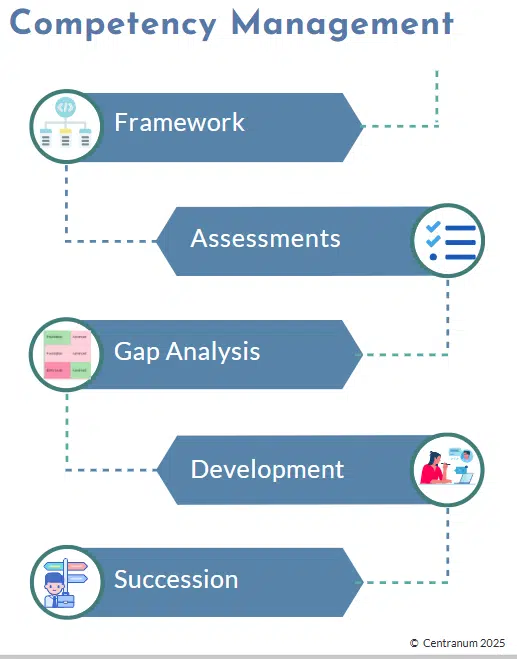
Assessment, Evidence & Competency Assurance
Assessment Methods
Does the platform support multiple assessment methods such as self-assessment, manager assessment, observation, practical demonstration, peer review, document review and competency sign-off? Flexible assessment methods help ensure competency can be evaluated appropriately across different roles.
Knowledge Verification
Can knowledge tests be linked directly to competency requirements? For many organisations, structured knowledge assessment provides an efficient way to verify understanding before practical assessment or demonstration of competence, particularly for safety, compliance and technical procedures.
Competency Assurance
Does the platform support evidence collection, verification, reassessment and approval workflows to provide confidence that competence has been demonstrated rather than simply recorded?
Evidence Integrity
Are assessments, uploaded evidence, assessor decisions and approvals securely recorded with a complete audit trail that supports regulatory, accreditation and quality requirements?
Assessment Consistency
Does the platform support structured scoring, standardised rating scales and clear assessment criteria so competency decisions remain consistent across managers, assessors and locations?
Workforce Visibility & Development
Gap Analysis
Can managers easily identify skills and competency gaps at individual, team and organisational levels? Effective gap analysis should highlight development priorities and provide meaningful insight rather than simply displaying assessment scores.
Development Planning
Can identified gaps be linked directly to learning resources, development plans and reassessment activities? The most effective platforms support continuous capability development rather than treating assessment as a one-off event.
Growth & Succession
Does competency information support career development, internal mobility and succession planning? Connecting competency data with future role requirements helps organisations develop capability from within and prepare employees for changing workforce needs.
Operational Readiness
Can managers quickly determine whether employees have demonstrated the required capability for their current role or a specific task? For organisations operating in regulated, technical or safety-critical environments, visibility into workforce readiness helps support deployment decisions, operational assurance and compliance.
Integration & Ecosystem
Integration Options
Can the system integrate with your HRIS, LMS and other workforce systems? Secure APIs, scheduled synchronisation and file-based integration may all be appropriate depending on your environment.
Learning Integration
If you use a separate LMS, can learning completions, knowledge testing and development activities be linked to competency requirements? If you don’t have an LMS, does the platform provide integrated learning capability?
Career & Workforce Planning
Does competency information support career pathways, succession planning, internal mobility and workforce planning? Connecting competency data to broader talent processes helps maximise the long-term value of competency management.
Scalability
Can the platform grow as your organisation evolves? Consider support for multiple business units, locations, frameworks, languages and governance structures without creating unnecessary complexity.
Governance & Structural Controls
Structural questions to ask vendors
- How are role criteria defined, maintained and version-controlled?
- Can rating scales be separated from decision criteria?
- How is assessment evidence recorded, reviewed and audited?
- How is governance managed across multiple entities, divisions, locations or frameworks?
- What AI features are used, and how are they bounded, reviewed and explained?
AI in competency management
If vendors promote AI-driven recommendations, ensure that criteria are clearly defined, measurement methods are structured, evidence requirements are explicit and outputs are explainable.
AI can assist with drafting, analysis and pattern identification, but it should not replace governance, professional judgement or clearly defined competency standards.
User Experience & Total Cost of Ownership
User Experience
The success of a competency management system depends on whether employees, managers and administrators can use it efficiently as part of their everyday work.
Consider whether the platform provides each user with a clear view of:
- What’s expected – the skills, competencies and qualifications required for their role.
- How they are doing – current competency status, evidence, qualifications and assessment results.
- Where to next – development priorities, learning activities, reassessments and career opportunities.
Managers should be able to quickly identify team capability, workforce gaps and pending actions, while administrators need intuitive tools for maintaining frameworks, managing assessments and producing reports.
Total Cost of Ownership
Look beyond subscription pricing and consider the overall cost of implementing and maintaining the system.
Evaluate factors such as:
- implementation and configuration effort
- administration and ongoing maintenance
- scalability as frameworks and users grow
- availability of training and vendor support
- licensing transparency and optional modules
A platform that requires less administration, is easier to maintain and supports future organisational growth may deliver a lower total cost of ownership over time, even if its initial subscription cost is higher.
Find the Right Competency Management Approach
Whether you’re replacing spreadsheets, implementing structured competency management or improving workforce readiness, explore how Centranum can support your competency frameworks, assessment processes, governance requirements and workforce reporting.
FAQs
What is competency management software?
Competency management software helps organisations define role requirements, assess workforce capability, capture evidence of competence, identify development needs and monitor workforce readiness. Unlike spreadsheets or standalone training records, it provides a structured system for managing competency frameworks, assessments, qualifications, certifications and reporting across the organisation.
How is competency management different from skills tracking?
Skills tracking typically records whether an employee possesses a particular skill or has completed training. Competency management takes a broader approach by defining the knowledge, skills and behaviours required for each role, measuring demonstrated competence through structured assessment and evidence, and linking competency information to development, performance and workforce planning.
How does competency management software improve compliance and workforce readiness?
Competency management software provides a structured record of role requirements, assessments, qualifications, certifications and supporting evidence. This helps organisations demonstrate compliance, prepare for audits, identify capability gaps earlier and give managers greater confidence that employees have demonstrated the required capability before undertaking critical work.
How are competencies assessed and verified?
Most competency management systems support multiple assessment methods, including self-assessment, manager assessment, observation, practical demonstration, document review and peer assessment. Some platforms also incorporate competency-linked knowledge testing to verify understanding before practical assessment. Supporting evidence, assessor decisions and reassessments provide confidence that competence has been demonstrated rather than simply recorded.
Can competency management software support frontline and technical workforces?
Yes. Modern competency management platforms are increasingly used in healthcare, manufacturing, engineering, utilities, mining and other operational environments where demonstrated capability directly affects safety, quality and compliance. Features such as evidence capture, competency assurance, certification management and workforce readiness reporting are particularly valuable in these industries.
What should I look for when choosing a competency management platform?
Look beyond feature lists and evaluate how well the platform supports your competency framework, assessment methods, evidence requirements, reporting, workforce visibility, integration with existing systems and long-term governance. The most suitable platform is one that aligns with your organisational structure, workforce requirements and future capability strategy.
Does competency management software replace an LMS?
Not necessarily. A Learning Management System (LMS) primarily delivers and tracks learning activities, while competency management software measures whether employees have demonstrated the required capability to perform their roles. Many organisations integrate the two so that learning activities, knowledge testing and competency assessments work together.
Can competency management software integrate with HRIS and LMS systems?
Most enterprise competency management platforms support integration with HR information systems, Learning Management Systems and other workforce applications through APIs, scheduled synchronisation or secure file exchange. This helps maintain consistent employee records while reducing manual administration.
How much does competency management software cost?
Pricing varies depending on the number of users, modules, implementation requirements and level of configuration. When comparing platforms, consider the total cost of ownership, including implementation, administration, maintenance, scalability and ongoing support, rather than subscription pricing alone.
Still Evaluating Competency Management Platforms?
Every organization has different requirements. Whether you’re comparing solutions, defining your framework or planning your next steps, we’re happy to help.
Download the Centranum Platform Overview
Book a personalized demonstration
Discuss your requirements with our team