
From Role Requirements to Workforce Readiness: A Connected Capability Architecture
Roles, competencies, performance, development, career and succession are often managed as separate processes. Connecting them through shared role requirements and evidence creates a more coherent, and more useful, picture of workforce capability.

The problem is not a lack of workforce data
Most organizations already have a substantial amount of information about their workforce.
Role descriptions describe responsibilities. Learning systems record training. Competency frameworks define expected knowledge, skills and behaviors. Performance systems hold goals, feedback and review outcomes. Employees maintain qualifications and experience records. Career and succession processes add aspirations, potential ratings and readiness labels.
The problem is that these processes often create separate versions and views of the workforce.
The role description may not match the competency profile. Training completion may be treated as evidence of competence. Performance information may sit outside development planning. Career suggestions may be based on role-title similarity rather than role requirements. Succession decisions often depend on managerial opinion without a clear definition of what “ready” means.
Each system may work as designed while the organization still cannot answer fundamental questions such as:
- Do people currently meet the requirements of their roles?
- Which gaps present the greatest operational risk?
- What development would address a specific gap?
- Who could move into another role, and what would they still need?
- Are nominated successors genuinely ready?
- Does the workforce have the capability required for future work?
Answering these questions requires more than integrating systems or bringing data into one dashboard. The information needs a shared structure.
That structure begins with the work, connects requirements to evidence about people and then uses that evidence to support different workforce decisions.
Are your role requirements, workforce evidence and talent decisions held in separate systems?
See how Centranum connects competency, performance, development, career and succession information in one workforce capability platform.
Explore the Centranum platform
What a connected capability architecture means
A connected capability architecture links three layers that organizations often manage separately.
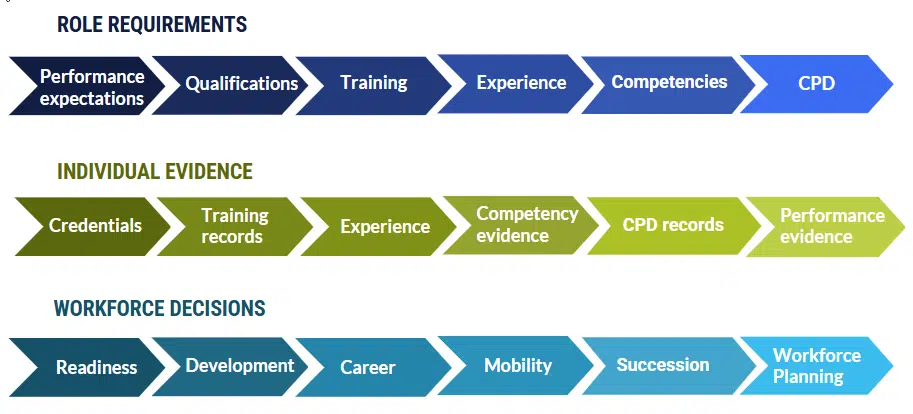
1. Work requirements

This layer defines what the work requires:
- The purpose and accountabilities of the role
- Expected outcomes and standards
- Qualifications, licenses and certifications
- Required training and experience
- Knowledge, skills and competencies
- Authorizations and other conditions for particular work
Requirements may come from the role, profession, location, business unit, regulatory environment or a specific assignment. They need to be combined without creating a separate profile for every possible variation.
2. Evidence about people

This layer records what is known about the individual:
- Current qualifications and certifications
- Training completed
- Authorizations
- Relevant experience
- Competency assessment results
- Work observations and other supporting evidence
- Performance outcomes and feedback
- Development activity
- Career interests and mobility preferences
Different evidence supports different conclusions. A completed course confirms participation in learning. It does not necessarily demonstrate competent application. A competency assessment provides evidence against defined requirements. It does not, by itself, explain overall performance or future potential.
3. Workforce decisions

The first two layers support decisions about:
- Current role readiness
- Compliance and operational deployment
- Development priorities
- Performance support
- Career pathways and role mobility
- Succession readiness
- Workforce coverage and risk
- Future capability requirements
The architecture is connected because the same governed role requirements and relevant evidence can support several decisions. It is not collapsed into a single score or label.
A person may be competent in the technical requirements of the current role but performing below expectations because of unclear priorities or inadequate resources. Another person may perform strongly in the current role but still need particular qualifications or experience before moving into a target role.
Connection makes these distinctions visible. It does not remove them.
Begin with the work and its requirements
A connected architecture needs a common reference point. That reference point is the work – not the learning catalogue, performance review, existing or inferred list of employee skills.
Role descriptions provide a starting point, but are rarely sufficient alone. They often describes responsibilities broadly without defining the specific capability requirements, and the expected standards or evidence needed to determine whether someone is ready to perform the work.
For each priority role, organizations need to establish:
- Why the role exists
- Its principal accountabilities and expected outcomes
- The standards, measures or conditions that apply
- The qualifications, certifications and authorizations required
- The knowledge, skills and competencies needed
- The experience or exposure important to effective performance
- Any requirements that must remain current or be periodically reassessed
These requirements should be derived from the work rather than assembled as a generic list.
Build and maintain a competency library
Competencies that are used across multiple roles should be defined and maintained in a central library rather than recreated within each role profile. A competency definition should make clear:
- What the competency covers
- The knowledge and skills involved
- How it is applied in the work
- The observable indicators or criteria used for assessment
- Proficiency levels used to distinguish different standards of application
The same competency can then be included in several role profiles. This improves consistency and makes it possible to compare evidence across roles without assuming that every role requires the competency to the same degree.
Set proficiency requirements for the role
Competencies that are used across multiple roles should be defined and maintained in a central library rather than recreated within each role profile. A competency definition should make clear:
- What the competency covers
- The knowledge and skills involved
- How it is applied in the work
- The observable indicators or criteria used for assessment
- Proficiency levels used to distinguish different standards of application
The same competency can then be included in several role profiles. This improves consistency and makes it possible to compare evidence across roles without assuming that every role requires the competency to the same degree.
Build role-specific profiles from shared requirements
Not every requirement belongs exclusively to one role.
Qualifications, certifications, training, competencies and other requirement items can be held as central records and reused across the organization.
The role profile itself must still reflect the particular work. It brings together the specific requirements that apply to that role, including the required level, standard or conditions where relevant.
So a role may need more than one capability requirement profile. Different versions to reflect variations such as:
- Specialty or area of practice
- Location or business unit
- Regulatory requirements
- Equipment, process or product responsibilities
- Level of authority
- Particular assignments or operating environments
These are genuine differences in what the work requires, not unnecessary duplication.
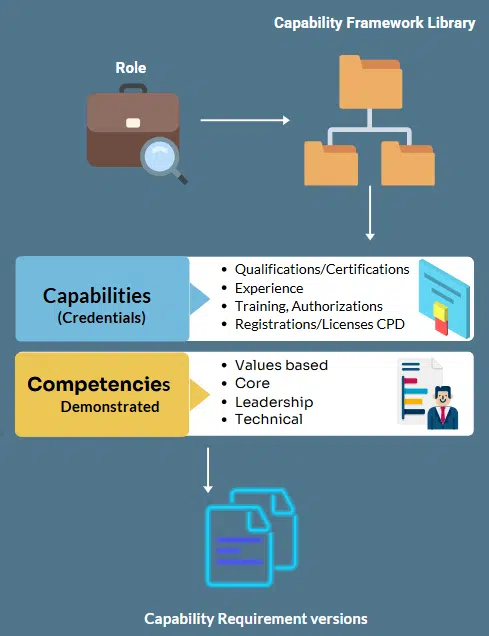
The important distinction is between the shared content item and the role-specific profile. A competency or certification can be defined and maintained centrally, then included in several profiles. Each profile retains the combination and level of requirements appropriate to that version of the role.
This allows organizations to maintain consistency in how requirements are defined while still representing meaningful variations in the work.
Keep role requirements current
Work changes. Technology, regulation, operating models and customer expectations can all alter what a role requires. Someone therefore needs to be responsible for reviewing and updating role requirements when the work changes.
Role and capability information needs ownership, review and version control. Organizations should be able to identify:
- Who is responsible for each requirement
- Where it applies
- When it was approved or changed
- Whether the change affects current employees
- What new evidence or reassessment may be required
This does not mean rewriting every role at once. A practical implementation can begin with roles that are operationally critical, difficult to staff, affected by change or associated with significant risk.
Once the work and its requirements are defined, the organization has a stable basis for comparing what the role needs with the evidence available for each person.
Build a current evidence profile for each person
Once role requirements are clear, the organization needs a current picture of what each person brings to the work.
This should extend beyond a training history or self-reported list of skills. Relevant evidence may include:
- Qualifications, licenses and certifications
- Completed training
- Continuing professional development records and progress against CPD requirements
- Authorizations
- Relevant work experience
- Competency assessment results
- Direct observations and practical demonstrations
- Knowledge assessments
- Work samples and supporting documents
- Manager, peer or specialist validation
- Performance outcomes and feedback
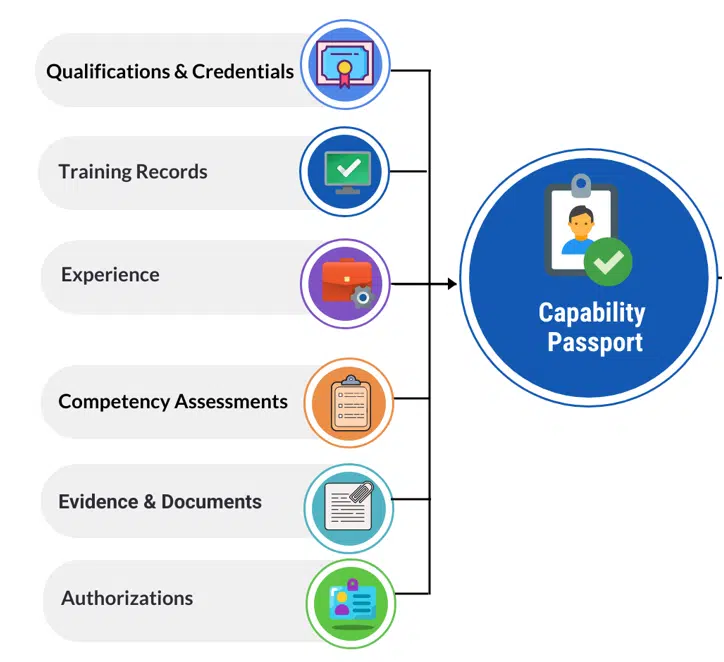
These records do not all demonstrate the same thing. A qualification may show that someone completed an approved program. A training record confirms participation in learning. Experience indicates exposure to particular work. Competency evidence shows whether knowledge and skills have been demonstrated against defined requirements.
Keeping these distinctions visible prevents one type of evidence from being used to support a conclusion it cannot justify.
Evidence needs context
A useful evidence record should show more than a result. Depending on its purpose, it may need to identify:
- What requirement the evidence relates to
- How the person was assessed or verified
- Who provided or approved the evidence
- When it was recorded
- Whether supporting information is available
- How long the evidence remains valid
- Whether reassessment or renewal is required
Evidence changes over time. Certifications expire, requirements are revised, experience becomes dated and competence may need to be reconfirmed after a long period away from particular work.
The evidence profile therefore needs to be maintained as a current record rather than treated as a one-time inventory. In healthcare, this combined evidence record may be managed as the clinician’s professional portfolio.
When role requirements and individual evidence use the same structure, the organization can compare what the work needs with what the person has demonstrated. That comparison provides the basis for identifying gaps—but it should not collapse different forms of evidence into one unexplained capability score.
Track continuing professional development requirements
For regulated professions such as healthcare and engineering, capability also depends on maintaining continuing professional development requirements.
These requirements are often set by a professional or regulatory body rather than by the organization itself. They may specify a number of hours or credits, particular categories of activity, evidence of reflective practice, or learning completed within a defined reporting cycle.
The architecture therefore needs to connect each person with the CPD requirements that apply to their profession, registration, certification or area of practice. It should show
- what has been completed,
- what evidence has been provided
- when the current cycle ends and whether the person remains on track.
CPD participation does not by itself demonstrate competence. However, failure to meet a mandatory CPD requirement may affect professional registration, authorization to practice or readiness for particular work.
That last distinction is important: CPD supports continued professional capability, but it is not a substitute for competency evidence.
It also belongs in workforce-readiness reporting because a future CPD shortfall can become an operational risk before a registration or authorization actually lapses.
Connect competence and performance without confusing them
Competence is the knowledge, skill and ability to perform work effectively in context. It is a prerequisite for successful performance – but it is not sufficient on its own.
A person who achieves an outcome without the required competence may have succeeded through luck, close supervision or circumstances that are unlikely to be repeated. Reliable performance requires the person to be able to apply the necessary knowledge and skills consistently when conditions change or problems arise.
A competent person may still perform below expectations if priorities are unclear, resources are inadequate, workloads are unrealistic, authority is limited or feedback and support are missing.
Competence and performance need to be connected without being treated as the same thing. Competency evidence establishes whether the person has demonstrated the ability to perform the work. Performance evidence shows what the person actually achieved and how effectively the role was carried out within the working environment.
Core behavioral competencies and organizational values may form part of the performance process because they describe how work is expected to be carried out. Technical or professional competence may require separate assessment by an appropriately qualified person using suitable evidence.
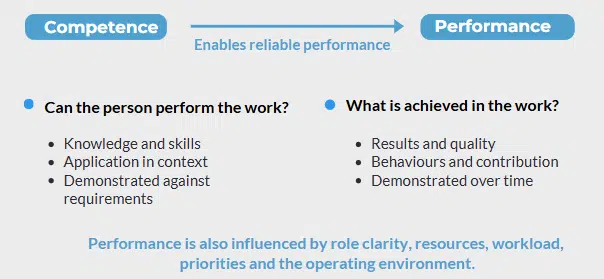
Connecting these records gives managers a fuller picture:
- What the role requires
- What the person has demonstrated
- What results have been achieved
- What conditions affected performance
- What support or development is needed
The combination enables better problem diagnosis and more appropriate action than relying on either a performance rating or a competency score alone.
Use gaps to target development
When role requirements and individual evidence are connected, a gap becomes specific. It may be that a person:
- Does not yet hold a required qualification or certification
- Needs to renew an expiring requirement
- Has completed training but has not demonstrated competence
- Has demonstrated some elements of a competency but not others
- Needs greater proficiency for the current or a future role
- Requires practical experience or supervised exposure
- May already meet the requirement but has not provided suitable evidence
These gaps do not all require the same response.
Training may be appropriate where knowledge or skill needs to be developed. Other gaps may require practice, coaching, supervised experience, direct observation, formal assessment, certification renewal or simply verification of existing evidence.
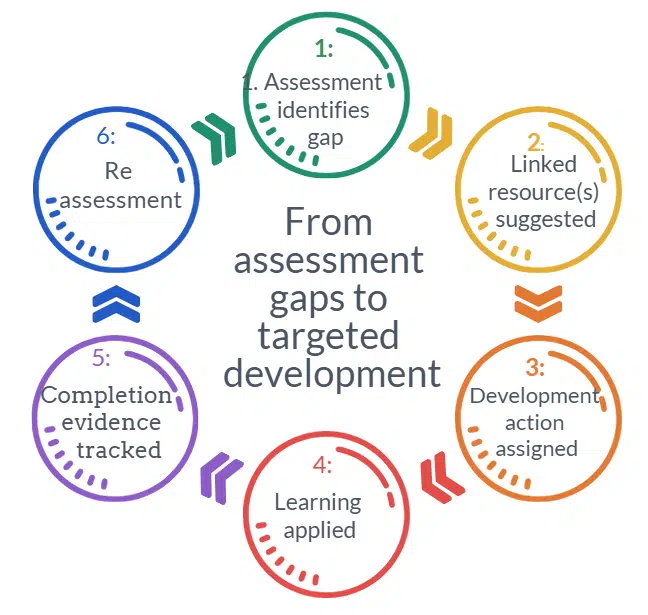
A connected development plan can link each action to the requirement it is intended to address. This makes the purpose of the activity clear and allows progress to be confirmed through new or updated evidence.
It also helps organizations move beyond course completion as the main measure of development. The relevant question is not only whether the person completed an activity, but whether the identified gap has been addressed.
The same approach applies to development for a future role. Comparing the person’s current evidence with the requirements of a target role identifies what is already transferable and what still needs to be developed or demonstrated.
Development then becomes more focused: not a generic list of courses, but a practical route from current evidence to the requirements of the work.
Extend the architecture to career and mobility
The same role requirements and evidence help people explore where they could move next.
Traditional career paths often assume a sequence of job titles. This can overlook lateral opportunities, specialist pathways and roles in other parts of the organization that require similar capabilities.
A connected architecture allows current evidence to be compared with the requirements of another role. The comparison can show:
- Requirements the person already meets
- Transferable competencies and experience
- Qualifications or certifications still needed
- Competency or proficiency gaps
- Experience that needs to be gained
- Requirements that have not yet been assessed
- A realistic development route towards the role
This provides more useful information than a simple percentage match. Two people with the same overall match score may have very different gaps. One may need a short period of supervised experience; another may lack a mandatory qualification or critical competence.
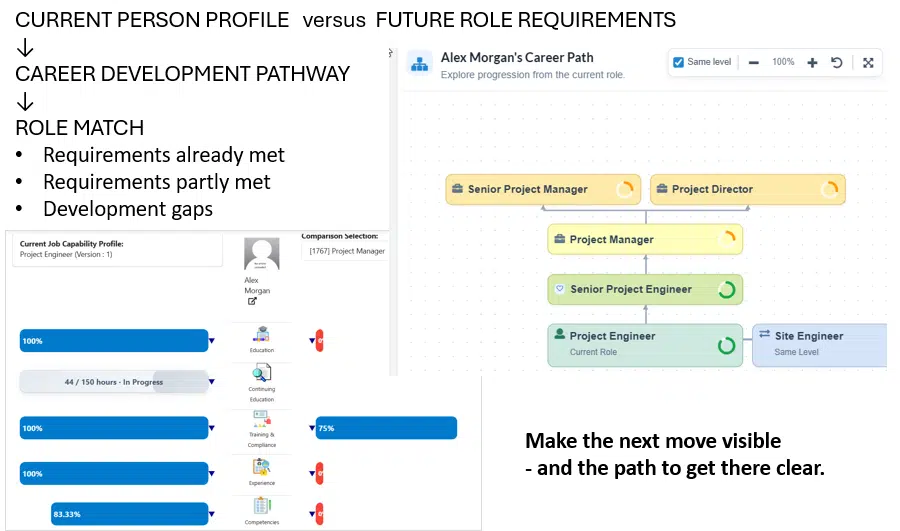
Career decisions need to reflect the person’s interests, aspirations, preferred direction and willingness to move. Evidence may show that someone could become suitable for a role, but it does not mean they want it.
When the employee selects a target role, the identified gaps can feed directly into development planning. Progress can then be updated as new qualifications, experience or competency evidence are added.
Career development becomes connected to real role requirements while remaining led by the individual, rather than job-title similarity or an unexplained recommendation.
Support progression within a role
Career progression does not always require a move into a different role. Healthcare clinical ladders, for example, often support progression through defined levels within the same clinical role or role family.
Advancement is generally founded on validated clinical competence, but competence alone may not be enough. Higher levels may also require evidence of sustained practice, greater autonomy and professional contribution – such as precepting colleagues, leading improvement initiatives, contributing to education or research, or taking on wider leadership responsibilities.
A connected capability architecture can bring these requirements together without treating them as interchangeable. The individual’s portfolio brings together the evidence needed for progression, which may include validated clinical competence, sustained performance, qualifications, continuing professional development and wider professional contributions.
Define succession readiness beyond labels
The same architecture supports succession planning. Readiness for a future role involves more than identifying high performers or assigning labels such as ready now and ready later.
Current performance is relevant, but doesn’t establish that someone can succeed in a role with different requirements. Succession readiness may depend on:
- Qualifications, certifications or professional registration
- Relevant knowledge and competencies
- Experience in particular work contexts
- Evidence of sustained performance
- Leadership or specialist contribution
- Readiness to take on greater scope, complexity or accountability
- Career aspirations, mobility and interest in the role
- Remaining development needs
These factors should remain visible rather than being combined into a single readiness score.
Comparing a person’s current evidence with the requirements of a potential future role can show which requirements are already met, which still need to be demonstrated and what experience or development would help close the gaps.
Managerial judgement remains important, particularly when considering advancement potential and the demands of a future role. But the judgement should be informed by relevant evidence and accompanied by a clear explanation of what still needs to happen before the person would be ready.
Instead of producing a static list of possible successors, succession planning is more useful when it creates an evidence-based development pathway and a clearer view of where the organization has genuine bench strength.
Move from individual evidence to workforce readiness
Individual evidence becomes strategically useful when it can be viewed across teams, locations and the organization as a whole. A connected architecture allows organizations to examine questions such as:
- Do we have enough people who currently meet the requirements for critical work?
- Where are capability gaps concentrated?
- Which qualifications, certifications or competency records are approaching expiry?
- Are important capabilities held by only one or two people?
- Can another team, location or workforce group provide suitable coverage?
- Which future requirements are not supported by the current workforce?
- Where should development or recruitment investment be directed?
This is much more informative than counting employees, completed courses or skills recorded in a system.

Workforce readiness depends on whether sufficient, current and relevant capability is available where and when the work requires it.
The same evidence can also provide earlier warning of operational risk. Upcoming certification expiries, unresolved competency gaps, weak coverage and concentrations of specialist expertise can be identified before they result in an incident, failed audit or inability to deliver the work.
The architecture therefore connects individual development with organizational planning. It shows not only what each person may need next, but whether the workforce as a whole is prepared for its current and future responsibilities.
Maintaining the architecture
A connected architecture is only useful while the information remains accurate.
Roles change as organizations introduce new technology, revise processes, respond to regulation or alter how work is allocated. Qualifications expire, professional requirements change and competency evidence may need to be renewed. Without regular review, the architecture gradually stops reflecting the work.
There must be a clear management structure and process. Clear responsibilities and timelines for:
- Reviewing role and capability requirements
- Approving changes and recording why they were made
- Maintaining shared competency and capability content
- Identifying which roles are affected by a change
- Managing effective dates and previous versions
- Checking the validity and currency of individual evidence
- Triggering renewal or reassessment where required
Changes need to be handled carefully. Updating a competency should not overwrite the evidence previously recorded against an earlier version. Organizations need to retain enough history to understand what was required and what was assessed at the time – a longitudinal log.
Connect the architecture in one system
Centranum connects role requirements, individual evidence and workforce decisions within one workforce capability platform.
Organizations can define role-specific capability profiles using shared qualifications, training, experience and competency requirements. Each person’s Capability Passport brings together their current evidence, including assessment results, professional credentials, development and performance information.
Because the same information supports several processes, organizations can use it to:
- Identify individual and team capability gaps
- Target learning, practice and reassessment
- Monitor qualifications, certifications and continuing professional development
- Support performance and development conversations
- Compare current capability with future roles
- Build career pathways and clinical ladders
- Assess succession readiness and development needs
- Examine capability coverage and workforce readiness
The information remains connected without being reduced to a single score. Different forms of evidence retain their meaning, history and context, while role requirements provide a consistent reference point for development, mobility, succession and workforce planning.
Individuals have a clear view of what is required, their achievements and what they may need next. Managers and workforce leaders have a more reliable basis for decisions about current capability and future workforce needs.
Where to begin
Organizations do not need to connect every workforce process at once. A practical starting point is to select a group of important roles and:
- Confirm the current requirements for the work.
- Identify the evidence already available for each person.
- Make any gaps and evidence limitations visible.
- Connect those gaps to appropriate development or assessment.
- Use the resulting information to examine capability coverage and workforce risk.
Once that foundation is working, the same structure can be extended to further roles and to career development, succession and longer-term workforce planning.
Related Resources
Role & Capability Frameworks
Role and Capability Frameworks are the foundation – a structured way to define job roles, map required capabilities, and align skills with strategy. Learn how they clarify expectations, support consistent assessments, and create clear career pathways. Includes practical examples from manufacturing, healthcare, and technology to show how frameworks link capability with performance, development, career and succession across industries.
What Is Competence?
What is competence? The Definition & differences from terms like competency, skills, capability, proficiency. Learn how it is demonstrated & assessed in the workplace.
Workforce Capability Implementation Guide

Implementation plan with 10 Practical steps – how to get started and implement a capability management initiative to suit your organization – with checklist
FAQs
What is a workforce capability architecture?
A workforce capability architecture connects the requirements of roles with evidence about people and the workforce decisions that information supports. It may include qualifications, certifications, experience, training, competencies, performance evidence and continuing professional development.
Is a capability architecture the same as a competency framework?
No. A competency framework describes the knowledge, skills, behaviours and application required for effective work. A capability architecture is broader. It connects competency requirements with other role requirements, individual evidence, development, career pathways, succession and workforce readiness.
How is this different from a skills taxonomy?
A skills taxonomy provides a common way to classify and relate skills. It can form part of a capability architecture, but typically doesn’t define the complete requirements of a role or establish whether a person has provided sufficient evidence to perform the work.
Does an organization need one standard profile for every role?
No. Centrally maintained requirements can be reused while each role retains its own capability requirement profile. A role can have several capability requirement profile variations to reflect specialty, location, equipment, regulation, operating environment or level of authority.
Can training records demonstrate workforce capability?
Training records show that learning was completed, but do not necessarily demonstrate that a person can apply the learning effectively in practice. Competency may need to be verified through observation, practical demonstration, knowledge assessment, work evidence or another method appropriate to the requirement
How does a connected architecture support career and succession planning?
It allows a person’s current evidence to be compared with the requirements of another role, a higher level within the same role or a potential succession position. This identifies requirements already met, remaining gaps and the development or experience needed to become ready.
For a connected architecture - where should an organization begin?
Start with a manageable group of important roles. Confirm their current requirements, identify the evidence already held for the people performing them and make significant gaps visible. The architecture can then be extended to additional roles and workforce processes.