
How to Measure Workforce Readiness
Workforce readiness sounds measurable. But what are we actually measuring?
Workforce readiness is measured by comparing the requirements of roles and work with current evidence of capability, competency, qualifications, experience, authorization and currency. This shows who is ready, where gaps exist and whether teams have sufficient capability coverage—something training completion, skills lists or headcount cannot establish on their own.

What does workforce readiness mean?
Workforce readiness is becoming an increasingly important goal for organizations trying to respond to changing technology, skills shortages, new ways of working and rapidly evolving capability requirements.
But there is a problem. What exactly does it mean to say that a workforce is “ready”?
An organization may know how many employees have completed required training. It may have detailed employee skills profiles. It may use AI to infer capabilities from work histories, qualifications or experience. It may even have sophisticated dashboards showing skills coverage across the workforce.
All of these provide useful information.
But none, on its own, establishes whether people currently meet the requirements of the work they are expected to perform.
If workforce readiness is going to become a meaningful business measure rather than another loosely defined HR metric, organizations need to be much clearer about what they are measuring.
Readiness is always readiness for something
A person is not simply “ready.”
They may be ready to perform their current role, but not another role. Ready to undertake routine work, but not a safety-critical activity. Ready for today’s process, but not yet ready to use newly introduced equipment. Ready at one level of responsibility, but not the next.
That means workforce readiness needs a defined reference point.
Depending on the organization, that might be:
- a job or role
- a particular task or activity
- a project or assignment
- a professional scope of practice
- a piece of equipment or process
- a work location or operating environment
- a higher level of responsibility
Before readiness can be measured, the requirements for that work need to be known.
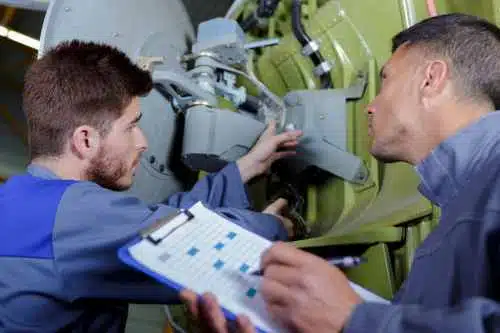
What do most organizations measure today?
Many of the measures organizations already collect are relevant to readiness. The difficulty comes when they are treated as equivalent to readiness.
Learning completion
Training records establish that someone attended or completed learning.
They are important evidence of preparation, particularly where mandatory training is involved. But completing learning does not necessarily demonstrate that someone can apply it to the required standard in practice.

Skills Data
Skills inventories and profiles can provide valuable visibility into the capabilities available across an organization.
But a skill recorded in a profile may have been self-declared, inferred from experience or imported from another system. Without a defined required level and appropriate evidence, it may be difficult to determine whether that skill is sufficient for the work concerned.
Qualifications, certifications and licenses
Formal credentials can be essential requirements for a role or activity.
They establish that particular conditions have been met, but they may represent only one part of readiness. An employee may hold the necessary qualification while still requiring organization-specific training, demonstrated competence or local authorization before undertaking particular work.


Experience
Experience matters — sometimes enormously.
But time spent in a role does not automatically demonstrate current proficiency across every requirement of that role, particularly where work, technology or standards have changed.
AI-inferred capability
AI can increasingly identify likely skills and capabilities from job histories, learning records, projects and other workforce data.
That can make skills discovery and talent matching much more powerful.
But inference is still inference.
A prediction that someone is likely to possess a capability is different from evidence that they currently meet a defined requirement at the required level.

What Does It Take to Measure Workforce Readiness?
Measurable readiness starts by connecting two sides of the equation:
What the work requires and What the person can currently demonstrate.
That requires several elements to come together.
1. Defined requirements
What capabilities are actually required?
These may include competencies, knowledge, qualifications, certifications, training, experience, licenses, authorizations or other requirements.
Different roles — and different work contexts — will require different combinations.
2. A defined standard
Simply possessing a competency or skill is often not enough.
The organization may need to define the level of proficiency required.
A technician expected to work independently, for example, may need a different level of competence from someone performing the same activity under supervision.
3. Appropriate evidence

What evidence is sufficient to establish that the requirement has been met?
Depending on the requirement and its risk, this might include a qualification, assessment, observation, practical demonstration, knowledge test, work evidence, certification or another form of validation.
The strength of the readiness claim depends partly on the strength of the evidence behind it.
4. Currency

Evidence also needs to remain relevant.
Certifications expire. Competence can deteriorate when activities are not performed regularly. Equipment changes. Procedures are revised. Standards evolve.
Someone who met a requirement two years ago may — or may not — meet it today.
Readiness therefore has a time dimension.
5. Context

Capability does not always transfer automatically from one environment to another.
Different sites, equipment, patient populations, operating conditions, regulatory environments or levels of responsibility can introduce additional requirements.
Context determines what “ready” actually means.
From individual readiness to workforce readiness
Once requirements and evidence are connected at individual level, organizations can begin to answer much more useful workforce questions.
Not simply: How many people completed the training? But:
Who currently meets all the requirements for this work?
And then:
- Where are the critical capability gaps?
- Which teams or shifts have sufficient coverage?
- Where is capability concentrated in only one or two people?
- Who could become ready with a small amount of development?
- Which requirements are approaching expiry?
- Where will upcoming changes create new gaps?
- Do we have sufficient capability for a new project, service or production requirement?
This is where workforce readiness moves beyond an individual HR measure and becomes operational information.
Readiness is not necessarily one percentage
There is an understandable attraction to reducing workforce readiness to a single number.
Sometimes a percentage is useful. It can quickly show the proportion of requirements currently met or the proportion of people who meet a defined readiness standard.
But a number without context can also conceal important risk.
A team might be “90% ready” while the missing 10% includes the one authorization required to operate a critical process.
Another team might have relatively low overall competency coverage but possess every capability required for tomorrow’s production schedule.
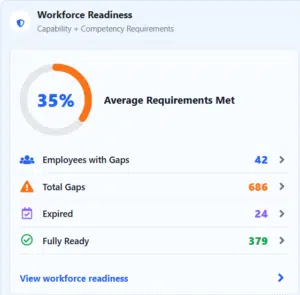
Good readiness measures therefore need to allow organizations to move from the headline number to the underlying requirements and evidence.
The question is not only how ready are we?
It is also ready for what — and what is preventing us from being ready?
Readiness becomes more important as work changes faster
This distinction is becoming increasingly important.
AI is changing tasks and the capabilities required to perform them. Automation is altering operational roles. New equipment and systems require employees to work differently. Regulatory and professional requirements continue to evolve.
At the same time, AI is making it easier to generate skills profiles, infer capabilities and identify possible matches between people and work.

Those developments can provide valuable intelligence.
But faster inference does not remove the need for evidence.
In work where capability matters, organizations still need to know whether people can meet the required standard — not simply whether available data suggests that they
So, can workforce readiness really be measured?
Yes — provided the organization first defines what readiness means.
A meaningful workforce readiness measure connects:
- defined work requirements +
- required standards +
- appropriate evidence +
- currency +
- context
It should be possible to see not only whether a person or workforce is ready, but why that conclusion has been reached and what evidence supports it.
That makes workforce readiness more than a new label for training completion, skills data or workforce analytics.
It becomes an operational view of whether the organization has the capability it needs to perform the work that needs to be done — now, and as requirements change.
FAQs
What is the difference between skills data and workforce readiness?
Skills data identifies capabilities that people have, claim or are inferred to have. Workforce readiness goes further by comparing current capability evidence with the defined requirements and proficiency levels for particular work.
Does every workforce requirement need formal assessment?
No. The level of evidence should reflect the nature and risk of the requirement. A current license or certification may be sufficient evidence for one requirement, while safety-critical or technically complex work may require observation, practical demonstration or assessment against defined competency criteria. The aim is not to assess everything in the same way, but to establish what evidence is appropriate for each requirement.
How should critical requirements affect an overall workforce readiness score?
Not all gaps have the same significance. A simple percentage can be misleading if it treats a missing optional development competency the same as an expired authorization or a critical competency required to perform the work safely. Readiness measures should make critical requirements and gaps visible rather than allowing them to disappear within an aggregate score.
Can someone be considered ready if some capability evidence is missing?
Potentially, depending on what is missing and how readiness has been defined. Organizations need clear rules about which requirements are mandatory, which can be satisfied in different ways, and which gaps prevent someone from being considered ready for particular work. This is why readiness needs to be measured against defined requirements rather than a generic skills profile.
How often should workforce readiness be reassessed?
There is no single appropriate interval. Some requirements have defined expiry or renewal periods, while others may need review when equipment, procedures, regulations, roles or required proficiency change. Higher-risk capabilities may also justify more frequent reassessment. A useful readiness model therefore considers both scheduled renewal and changes that can make existing evidence no longer sufficient.