
Workforce Readiness vs Training Completion
Why completed training does not always mean employees are ready to perform critical work
Many organizations use training completion as a primary indicator of workforce readiness. Training records are often easier to track, report, and audit than broader measures of workforce capability.
However, training completion alone may not provide a complete picture of whether employees are genuinely prepared to perform required work safely, effectively, and consistently under real operational conditions.
Employees may complete mandatory courses, certifications, or online learning modules while still lacking:
- demonstrated competence
- operational experience
- practical confidence
- authorization approval
- reassessment currency
- readiness for changing operational demands
As workforce complexity increases, organizations are increasingly recognizing the difference between training activity and operational readiness.


Training plays an important role in workforce capability development. Organizations use training to:
- introduce procedures and standards
- support compliance requirements
- develop technical knowledge
- onboard employees
- support capability development
- maintain certifications
However, training is typically designed to support learning — not always to confirm operational competence or readiness independently.
In many operational environments, additional validation is required before employees are considered fully ready to perform work without supervision.
Why Training Completion Alone Can Be Misleading
Organizations sometimes assume that completed training automatically confirms workforce readiness.
This can create risks where:
- assessments are knowledge-based only
- practical application is not validated
- operational experience is limited
- supervisors apply inconsistent standards
- authorization processes are unclear
- competency evidence is incomplete
- reassessment processes are weak
As a result, organizations may appear compliant on paper while still lacking visibility into actual operational capability.
Workforce Readiness Requires Demonstrated Capability

Workforce readiness typically requires broader evidence that employees can apply knowledge and skills effectively in practice. Organizations may use:
- competency assessments
- practical observations
- demonstrations
- supervised sign-offs
- proficiency ratings
- operational reviews
- authorization approvals
- evidence records
to help validate operational capability. This is particularly important in environments involving:
- safety-sensitive work
- technical complexity
- regulated activities
- critical infrastructure
- operational risk
- independent decision-making
Authorization Is Different from Training Completion
Many organizations require formal authorization before employees can:
- operate equipment
- perform restricted tasks
- approve work
- access systems
- undertake specialized procedures
- work independently
Authorization decisions may depend on:
completed training
demonstrated competence
operational experience
practical assessment outcomes
supervised sign-offs
reassessment status
CPD requirements
An employee may complete training but still not meet the full requirements for authorization or operational readiness.
Workforce Readiness Changes Over Time
Workforce readiness is not static. Capability can change as:
- procedures evolve
- technology changes
- regulations shift
- operational exposure declines
- reassessment becomes overdue
- experience gaps emerge

Organizations need ongoing visibility into workforce readiness rather than relying only on historical training records. This is one reason why many organizations are implementing:
- reassessment cycles
- readiness reviews
- authorization expiry tracking
- competency evidence management
- workforce readiness reporting
to support ongoing workforce capability visibility.
From Training Records to Workforce Readiness Visibility
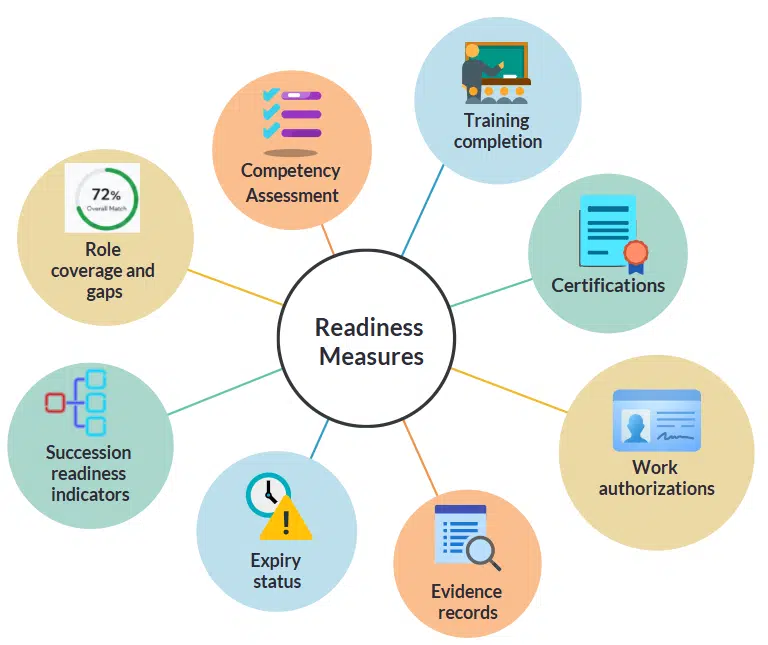
Many organizations already collect significant workforce information but still struggle to connect that information into a meaningful operational view of workforce readiness. Training records alone may not answer questions such as:
- Who is currently ready to perform critical work?
- Who requires reassessment?
- Which authorizations are expiring?
- Where are capability gaps emerging?
- Which roles depend heavily on a small number of individuals?
- Where are operational coverage risks increasing?
As workforce complexity increases, organizations increasingly require more structured approaches to:
- competency validation
- authorization management
- reassessment
- workforce visibility
- operational readiness reporting
- workforce adaptability
Workforce readiness frameworks help organizations connect:
- role requirements
- competency assessments
- operational experience
- training
- authorizations
- reassessment
- workforce visibility
into a broader operational capability model.
Training remains an important part of workforce readiness — but readiness ultimately depends on whether employees can safely and effectively perform the work required of them in practice.
Explore Workforce Readiness Further
Continue exploring:
Workforce Readiness Resource Hub
What Is Workforce Readiness?
Certification vs Competence
Capability & Competency Management Resources
Workforce Readiness Visibility
Or explore how Centranum supports workforce readiness through integrated capability management, competency assessment, authorization tracking, workforce visibility, and operational reporting.
FAQs
Why is training completion not enough to confirm workforce readiness?
Training completion confirms that learning activities have been completed, but it may not confirm whether employees can apply the knowledge and skills effectively in operational conditions. Workforce readiness may also require competency validation, practical experience, authorization approval, reassessment, and ongoing capability visibility.
Can employees complete training but still require supervision?
Yes. In many operational environments, employees may complete required training but still require supervised practice, competency assessment, operational exposure, or formal authorization before working independently.
What is the difference between training records and competency evidence?
Training records show that a learning activity was completed. Competency evidence – which may include observations and proficiency ratings, task demonstrations, operational sign-offs, and supporting evidence shows that competence has been demonstrated on the job.
Why do organizations use authorization processes after training?
In many high-risk, regulated, or operationally complex environments authorization processes are used to confirm that in addition to training, employees have met additional requirements such as competency validation, practical experience, supervised sign-off, regular reassessment, and operational approval before performing specific tasks or restricted activities.
How does reassessment support workforce readiness?
Workforce readiness can change over time as procedures, technologies, regulations, or operational demands evolve. Reassessment processes help organizations maintain confidence that workforce capability remains current and operationally aligned. In many high risk industry environments there is a requirement that safety critical competencies are re-assessed regularly.