
Connecting Workforce Readiness, Development & Succession
A practical approach to connecting workforce expectations, current capability and future workforce decisions.
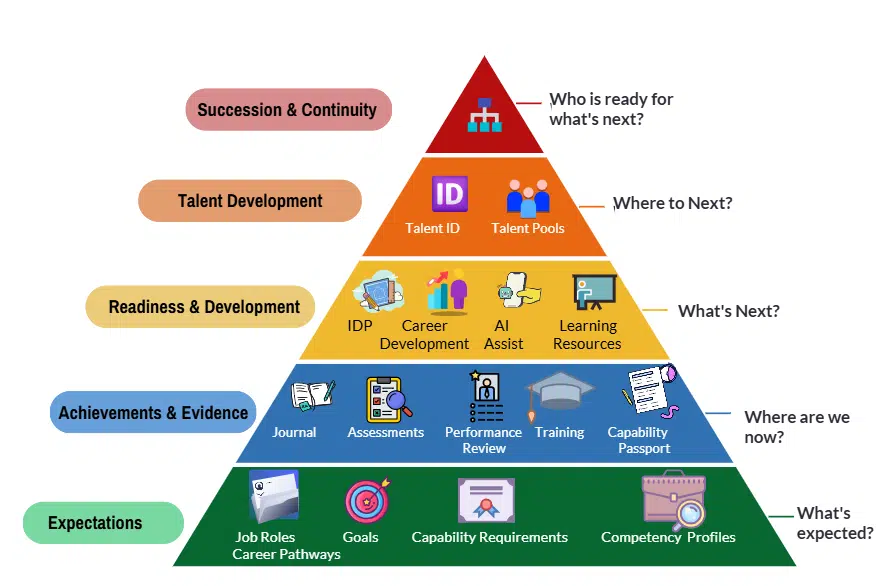
Every workforce decision begins with three fundamental questions:
What is expected?
Where are we now?
What’s next?
The Centranum platform is organized around these three questions, connecting workforce information and workforce processes to help organizations define expectations, understand current capability and performance, and support future workforce decisions.
Built on one configurable platform, it allows organizations to start with the workforce processes they need today and expand over time while maintaining one connected workforce information foundation.
The 3 Key Workforce Questions
What’s Expected
Define workforce expectations
Every workforce decision starts with a clear understanding of what success looks like. Whether for an individual, team, business unit or the wider organization, defining expectations provides the foundation for consistent assessment, development and workforce planning.
Workforce expectations may include:
- Job roles and responsibilities
- Capability requirements
- Skills and competencies
- Qualifications and certifications
- Performance expectations
- Organizational, team and individual goals
Centranum supports this through configurable workforce data structures for all types of expectations.
Where are we now?
Understand current workforce capability and performance
Understanding current workforce capability requires more than training records or completed assessments. Organizations need reliable evidence that provides visibility into capability, performance and workforce readiness across individuals, teams and the organization.
Workforce information may include:
- Skills assessments
- Knowledge testing
- Competency assessments
- Qualifications and certifications
- Training records
- Authorizations
- Workplace evidence
- Competency & Performance Journal entries
- Goal progress
- Performance Reviews
- Workforce readiness analytics
Centranum connects workforce information from multiple sources to provide a complete picture of current capability, performance and workforce readiness.
What’s Next
Support future workforce decisions
Understanding current capability enables organizations to make informed workforce decisions and prepare for future needs.
This may include:
- Career pathways
- Career development
- Individual development planning
- Learning and training
- Internal mobility
- Talent reviews
- Succession planning
Centranum uses the same connected workforce information to support development, career growth and succession, helping organizations improve workforce capability without duplicating information across separate systems.
From Framework to Process
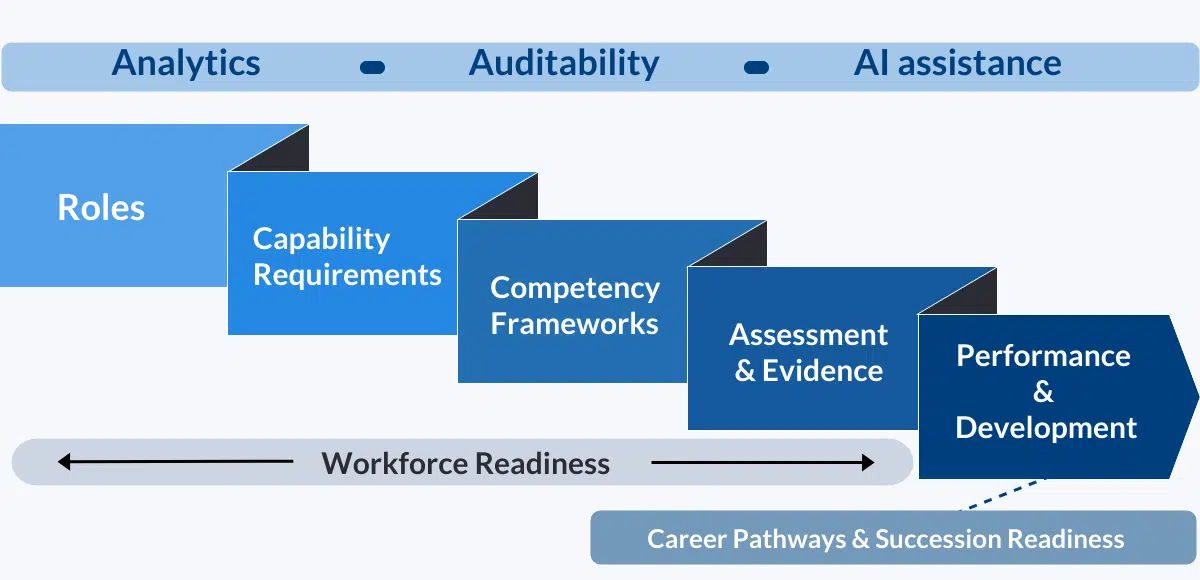
The 3 key question approach is supported by connected workforce processes that share the same workforce information. Rather than treating job definitions, assessments, performance and development as separate activities, each process builds on the information captured in the previous stage.
- Define – establish clear workforce expectations through roles, capability requirements and competency frameworks.
- Measure – verify current capability and performance through structured assessment and evidence.
- Develop – use connected workforce information to support development, career mobility and succession.
Analytics, auditability, and AI-assistance operate across the entire system — not as separate, disconnected tools.
Connected Workforce Processes
How the Platform Supports the 3 Key question Framework
| What is expected? | Where are we now? | What’s next? |
|---|---|---|
| Role Responsibilities | Journal | Development Plans |
| Goals | Competency Assessments | Learning Resources |
| Skills & Competency Frameworks | Knowledge Testing | Role Matching |
| Mapped Competency Requirements | Performance Reviews | Career Pathways |
| Integrated Capability Requirements | Capability Passport | Career Development |
| Other Performance Expectations | Workforce Readiness Hubs | Talent Review |
| Analytics & Reporting | Succession Planning |
Configure the Framework to Reflect Your Organization
Every organization has its own workforce structure, terminology, governance and operating model. Rather than imposing predefined processes, Centranum provides configurable workforce data structures and workflows that can be adapted to different industries, regulatory requirements and organizational practices.
Configure workforce information
- Workforce terminology
- Job architecture and organizational structure
- Organizational, team and individual goals
- Skills/Competency Frameworks
- Rating schemes & Proficiency Levels
- Formal Capability requirements
- Qualifications, certifications, licences
- Experience
- Authorizations
- Continuing Education
- Other credentials
Configure workforce processes
- Job Definition and Capability Analysis
- Competency Assessment methods
- Knowledge Testing
- Goal Management
- Performance Conversations & Reviews
- Development Planning
- Career Pathways & Development
- Talent Identification
- Succession Planning
- Notifications and approvals
A Framework That Grows With Your Organization
No two organizations begin in the same place. Some start by improving workforce readiness, while others focus on performance, development or career planning. The Centranum approach allows organizations to implement the workforce processes that address their current priorities while maintaining one connected workforce information framework.
As workforce needs evolve, additional processes can be introduced without rebuilding workforce information or creating disconnected systems.
The framework is designed to support organizations with different workforce structures, governance requirements and levels of operational complexity—from a single department or business unit through to large, multi-entity organizations.
- Implement Workforce Readiness, Performance & Development, or Career & Succession independently while maintaining one connected platform.
- Support simple or complex organizational structures, from single entities to multi-entity hierarchies with consolidated reporting.
- Configure workforce information, workflows and governance to reflect your organization’s operating model.
- Expand from focused workforce initiatives to enterprise-wide workforce capability management over time.
For organizations operating in highly regulated or high-assurance environments, the framework also supports structured evidence, auditability and governance requirements where workforce readiness, performance and talent decisions must be consistent, evidence-based and defensible.
This flexibility allows organizations to standardize critical workforce processes while adapting to different business units, regulatory requirements and operational contexts—without fragmenting workforce information or creating disconnected systems.
Security, Assurance, and Enterprise Readiness
- SOC 2 Type II independently audited
- Per-client database isolation
- Role-based access controls and audit trails
- Designed to support regulated, safety-critical, and compliance-driven environments
SOC 2 Type ll Certification badge
Supporting Every Level of the Organization
The three key workforce questions apply across every level of an organization. While the information each person needs may differ, everyone benefits from a shared understanding of expectations, current capability and future development.

For staff
- Clear role expectations and workforce requirements
- Visibility of current capability, role readiness and progress
- Transparent development plans and career opportunities
- One place to view requirements, manage assessments, evidence, goals and ongoing development

For managers
- Clear visibility of team capability, performance and team readiness
- Identify strengths, capability gaps and development priorities
- Support for meaningful performance and development conversations with structured evidence
- Reduced administration through connected workforce processes

For senior leaders
- Real-time insight into workforce capability, performance and organizational readiness
- Early identification of capability risks and succession opportunities
- Better workforce planning supported by connected workforce information
- Consolidated reporting across teams, business units and the enterprise
For HR & L&D
- One configurable platform instead of disconnected workforce systems
- Configure workforce data structures to reflect your organization’s operating model
- Configure workforce processes to support governance, assessment and development practices
- AI-assisted tools to reduce administration and maintain workforce information
- Better visibility for workforce planning, development, compliance and assurance
Proven in practice


Explore Centranum Solutions
Explore Platform Capabilities
Related Resources
FAQs
What are the 3 key workforce questions?
The three key workforce questions are:
- What is expected?
- Where are we now?
- What’s next?
Together they provide a practical approach to connecting workforce expectations, current capability and performance, and future workforce decisions. The Centranum platform is organized around these questions to support workforce readiness, development, career and succession within one configurable platform.
Why start with workforce expectations?
Clear workforce expectations provide the foundation for consistent workforce management. Defining roles, capability requirements, skills, competencies, qualifications and goals ensures assessments, performance discussions and development activities are all measured against agreed expectations.
How do the 3 key workforce questions support workforce readiness?
Workforce readiness is created by connecting defined expectations with evidence of current capability and performance. The platform brings together assessments, qualifications, training, knowledge testing and other workforce information to provide visibility of role readiness, team readiness and organizational workforce readiness.
Can organisations start with one workforce process and expand later?
Yes. Organizations can begin with the workforce processes that address their current priorities, such as workforce readiness, performance management or career development, while maintaining one connected workforce information framework. Additional processes can be introduced over time without rebuilding workforce information.
How does the platform connect workforce readiness, performance and development?
Rather than treating these as separate processes, the Centranum platform uses shared workforce information across assessments, performance reviews, development planning and career management. This reduces duplicate administration while improving consistency and visibility.
Can the framework be configured for different organisations?
Yes. Workforce information, competency frameworks, capability requirements, organizational structures, goals, assessment methods and workflows can all be configured to reflect different industries, governance requirements and operating models.
Is Centranum suitable for regulated or high-assurance environments?
Yes. The platform supports structured evidence, configurable governance, auditability and reporting, making it suitable for organizations where workforce readiness, performance and capability decisions must be consistent, evidence-based and defensible.
Can Centranum integrate with existing HR and learning systems?
Yes. Centranum can integrate with HRIS, payroll, identity management, learning management systems and other enterprise applications to maintain connected workforce information while reducing duplicate data entry.
Is Centranum secure and enterprise-ready?
Yes. Centranum provides enterprise-grade security, configurable permissions, audit logging and SOC 2 Type II compliance to support organizations with demanding security and governance requirements.
How does AI support the platform?
AI assists with creating and maintaining workforce information, including role definitions, capability requirements and competency frameworks. AI is designed to improve efficiency while structured workforce information, governance and human oversight remain central to workforce decisions.