
Why Workforce Capability Data Is Becoming Strategic Infrastructure
Workforce capability data is evolving beyond training records to become a strategic asset that supports workforce readiness, compliance, operational resilience and better organisational decision-making.
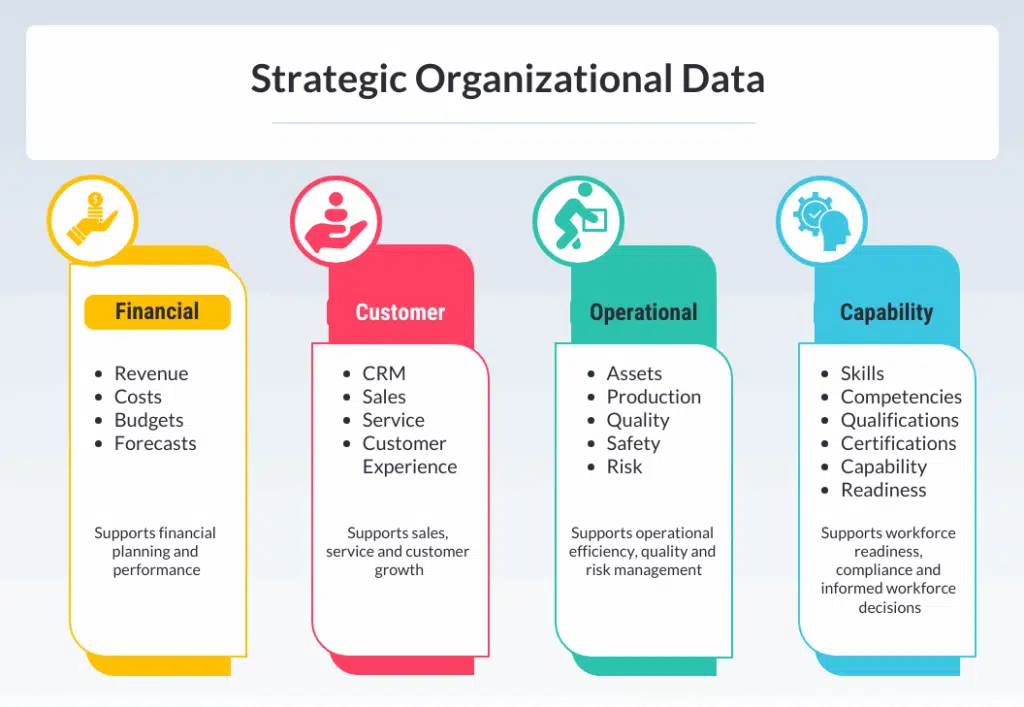
Together these strategic data assets enable better organisational decision-making.
Workforce capability is joining an organisation’s strategic data assets
For decades, organisations have invested heavily in systems that provide visibility into finance, customers, assets and operations. These information systems have become essential infrastructure for planning, decision-making and organisational performance.
Yet information about workforce capability has often remained fragmented.
Training records may sit in a learning management system. Qualifications and licences are maintained in spreadsheets. Competency assessments are recorded elsewhere, while managers often rely on personal knowledge to understand who is capable of performing critical work.
As a result, one of an organisation’s most valuable assets—its people—has often lacked the same level of visibility as its finances, equipment or customers.
That is beginning to change.
Increasingly, organisations are recognising that workforce capability data is more than an HR record. It is becoming strategic infrastructure that supports workforce readiness, operational resilience and better organisational decision-making.
Why capability data matters more than ever
Several trends are changing the way organisations think about workforce capability.
Many industries continue to experience skills shortages, increasing retirement rates and difficulties recruiting experienced workers.
The challenge is no longer simply filling positions. Organisations also need to understand where critical knowledge resides, whether sufficient capability exists across teams, and how resilient the workforce will be if key individuals leave.
Without reliable capability data, these questions are difficult to answer.
Workforce shortages and changing demographics
Many industries continue to experience skills shortages, increasing retirement rates and difficulties recruiting experienced workers.
The challenge is no longer simply filling positions. Organisations also need to understand where critical knowledge resides, whether sufficient capability exists across teams, and how resilient the workforce will be if key individuals leave.
Without reliable capability data, these questions are difficult to answer.

Operational complexity
Modern organisations expect employees to perform multiple responsibilities, work across different locations and adapt quickly to changing operational demands.
Managers increasingly need visibility into who is capable of performing specific work, where additional support may be required, and whether teams have sufficient depth of capability.
This requires more than organisational charts or training records.
Compliance & Assurance

In regulated industries, organisations must often demonstrate that people are appropriately qualified, trained and competent to perform their work.
Increasingly, compliance depends on more than showing that someone attended a course.
It requires confidence that capability has been demonstrated, evidence has been captured, and authorisations remain current.
Reliable workforce capability information helps organisations respond more efficiently to audits, accreditation processes and regulatory requirements.
Workforce resilience
Organisations today operate in an environment where disruption has become normal.
Unexpected absences, changing customer demand, new technologies and organisational change all place pressure on workforce capability.
Leaders need confidence that they can identify capable people, redeploy resources where necessary and understand the risks associated with capability gaps.
Reliable workforce data becomes a foundation for resilience.
Beyond training records
Training records remain an important part of workforce information.
They answer questions such as:
- Has mandatory training been completed?
- When was the course attended?
- When is refresher training due?
These are valuable administrative records. Operational leaders, however, often need different information. They need to understand:
- Who is currently ready to perform this role?
- Has competence been demonstrated in practice?
- What evidence supports that decision?
- Which qualifications or licences are current?
- Where are capability gaps emerging?
- Who is ready to take on additional responsibilities?
- Which teams are becoming increasingly dependent on a small number of individuals?
Answering these questions requires a broader view of workforce capability than training records alone can provide.
From disconnected records to connected capability data
The value of workforce capability information increases significantly when it is brought together in a structured and meaningful way.
Rather than maintaining isolated records, organisations can build a richer understanding of workforce capability by connecting information such as:
- qualifications and certifications
- mandatory and role-specific training
- competency assessments
- practical observations
- workplace evidence
- licences and authorisations
- knowledge assessments
- experience
- development activities
- capability gaps
- readiness for current and future roles
Viewed individually, each provides useful information.
Viewed together, they provide a much clearer picture of workforce capability across teams, departments and the organisation as a whole.

What makes capability data strategic?
Structured
Capability requirements are consistently defined across roles rather than relying on local knowledge or informal expectations.
Current
Information reflects an individual’s current capability, including reassessments, expiries and ongoing development.
Evidence-based
Capability decisions are supported by documented evidence, observations and assessments rather than assumptions.
Connected
Training, competency, qualifications, experience and evidence contribute to a single view of workforce capability.
Visible
Managers and leaders can quickly understand workforce capability through dashboards, reports and readiness views.
Trusted
Decision-makers have confidence that workforce information is accurate, consistent and actively maintained.
Supporting better organisational decisions
When workforce capability data becomes structured and visible, its value extends well beyond learning and development.
- Operations managers gain greater confidence when allocating work.
- Learning and development teams can target investment where capability gaps are greatest.
- Compliance teams can respond more effectively to audits and regulatory reviews.
- Executives gain better visibility into organisational capability, workforce risk and readiness for future challenges.
The same information supports multiple business functions, making it a strategic organisational asset rather than a collection of isolated records.
Preparing for an AI-assisted future
Artificial intelligence is rapidly changing the way organisations analyse information and support decision-making.
Increasingly, AI will be able to identify capability trends, recommend development priorities, highlight workforce risks and support succession and workforce planning.
However, AI is only as effective as the information it can access.
Organisations with fragmented, inconsistent or incomplete workforce data will struggle to realise these benefits.
Those with structured, connected capability information will be far better positioned to use AI responsibly and effectively.
In many respects, today’s investment in workforce capability data is an investment in tomorrow’s AI capability.
Looking ahead
The organisations that perform best are rarely those with the most data. They are the organisations with the most useful data.
Financial information, customer information and operational information have long been recognised as strategic business assets.
Workforce capability data is increasingly joining them.
By creating structured, connected and trusted capability information, organisations gain greater visibility into workforce readiness, stronger support for operational decision-making, and a foundation for future innovation.
As workforce expectations continue to evolve and AI becomes more integrated into organisational decision-making, workforce capability data is likely to become one of the most valuable strategic assets an organisation can build.
Related Reading
FAQs
What is workforce capability data?
Workforce capability data is information that helps an organisation understand whether its workforce has the qualifications, skills, competencies, experience and evidence needed to perform specific roles safely and effectively. It goes beyond training records by providing a broader view of workforce readiness.
Why is workforce capability data becoming more important?
Organisations face increasing skills shortages, regulatory requirements, operational complexity and pressure to make better workforce decisions. Reliable capability data helps leaders understand workforce readiness, identify capability gaps, manage risk and plan for future workforce needs.
How is workforce capability data different from training records?
Training records typically show whether someone has completed a course. Workforce capability data combines training with qualifications, competency assessments, practical evidence, certifications, authorisations and other information to provide a more complete picture of an individual’s capability and readiness.
Who uses workforce capability data?
Workforce capability data supports multiple business functions. Managers use it to allocate work and identify development needs, learning teams use it to target training, compliance teams use it for audit and assurance, and executives use it to understand organisational capability and workforce readiness.
What makes workforce capability data strategic?
Capability data becomes strategic when it is structured, current, evidence-based and connected across the organisation. This enables leaders to make more informed decisions about workforce readiness, operational resilience, compliance and future capability requirements.
How does workforce capability data support AI?
AI relies on high-quality, structured data. Organisations with connected workforce capability information are better positioned to use AI for workforce planning, capability analysis, development recommendations and decision support than those relying on fragmented records.