
AI Has More Knowledge Than Ever. But Is That Expertise?
Artificial intelligence can access and apply more recorded knowledge than any individual could acquire in a lifetime. It can analyze complex information, identify patterns, write software, support diagnosis, and generate solutions to increasingly sophisticated problems.
It is tempting to conclude that human expertise is becoming less important.
But recent events tell a more complicated story.
Ford’s quality challenges have drawn attention to the consequences of losing experienced engineering capability. Meanwhile, at the forefront of AI development, Anthropic and OpenAI have been recruiting specialists in weapons, explosives, and chemical and biological risks to evaluate increasingly capable AI systems and help prevent their misuse.
AI is becoming extraordinarily capable at working with accumulated human knowledge. Yet the companies developing it still need access to deep human expertise—and organizations still depend on expertise that may exist nowhere outside the experience of their own people.
This raises a more fundamental question: is access to more knowledge the same as having expertise?
So what makes someone an expert? How does expertise develop? What can AI replicate—and what is missing from the knowledge available to it?
And as organizations redesign work around AI, are they augmenting their expertise – or inadvertently allowing it to disappear?
What expertise actually is
What Is Expertise?
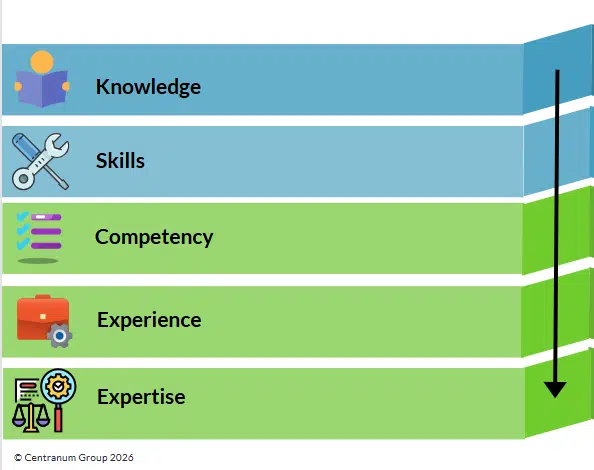
Expertise is sometimes treated as another word for knowledge, skill, or competence. They are related, but they are not the same.
Knowledge provides an understanding of information, principles, concepts, and procedures.
Skills enable someone to perform particular activities.
Competence is the demonstrated ability to apply relevant knowledge and skills to perform to an expected standard.
Experience comes from encountering and dealing with situations over time.
Expertise is the ability to apply that knowledge effectively in situations that are often complex, uncertain, or constantly changing. Expertise develops when experience progressively transforms how knowledge is organized, retrieved, interpreted, and applied.
This distinction matters.
But time served is not the same as expertise. Someone can repeat substantially the same work for years without encountering the variety of problems, feedback, consequences, and novel situations that deepen their understanding.
Expertise develops through experience that produces learning.
Expertise Is Built Through Experience
Experts have typically encountered far more than routine situations.
They have dealt with exceptions, failures, unusual combinations of circumstances, conflicting information, and problems for which established procedures provide no straightforward answer. They have seen the consequences of decisions, received feedback, adjusted their understanding, and learned what matters in different contexts.
That accumulated experience enables experts to distinguish important signals from irrelevant information, anticipate consequences, identify exceptions, and make judgments when information is incomplete.
It also gives them something particularly important: a much richer understanding of when the usual answer does not apply.
An experienced quality engineer, clinician, plant operator, or technical specialist may therefore recognize that something is wrong before they can fully articulate why.
That is one reason expertise can be both difficult to replace and difficult to capture.
How Expertise Develops
When experts encounter a problem, they draw on knowledge accumulated and transformed through previous experience.
They recognize potentially relevant patterns, retrieve associated knowledge, and assess whether it fits the current situation.
Where the pattern fits, existing knowledge can be applied. The outcome and consequences provide further experience and reinforce, refine, or challenge what is already known.
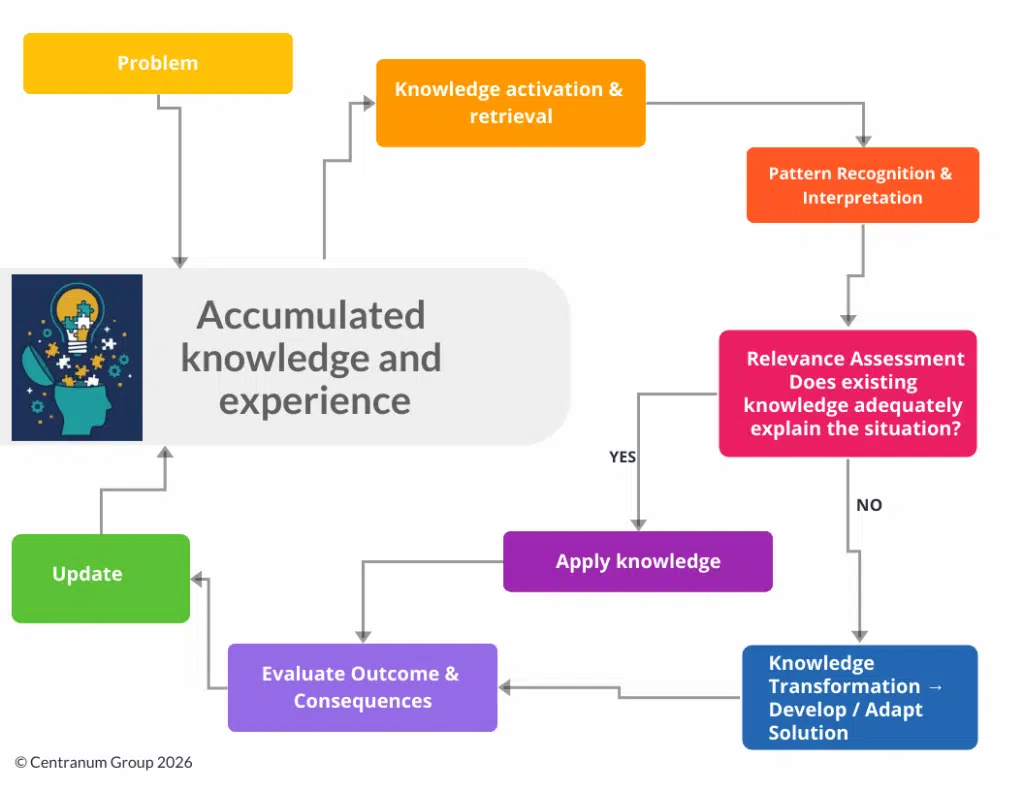
But sometimes the pattern does not fit. Something is different.
The expert must identify what has changed, reconsider assumptions, assess possible consequences, and develop or adapt a solution.
That process transforms existing knowledge.
What has been learned then becomes part of the expert’s accumulated knowledge, ready to be retrieved, applied – or questioned when another problem arises.
Expert Pattern Recognition Is More Than Recognizing the Familiar
Pattern recognition is one of the defining characteristics of expertise, but it is easily misunderstood.
It is not simply: “I’ve seen this before.”
Accumulated experience gives experts a richer set of patterns against which to interpret a new situation. More importantly, it helps them recognize when the apparent pattern is misleading.
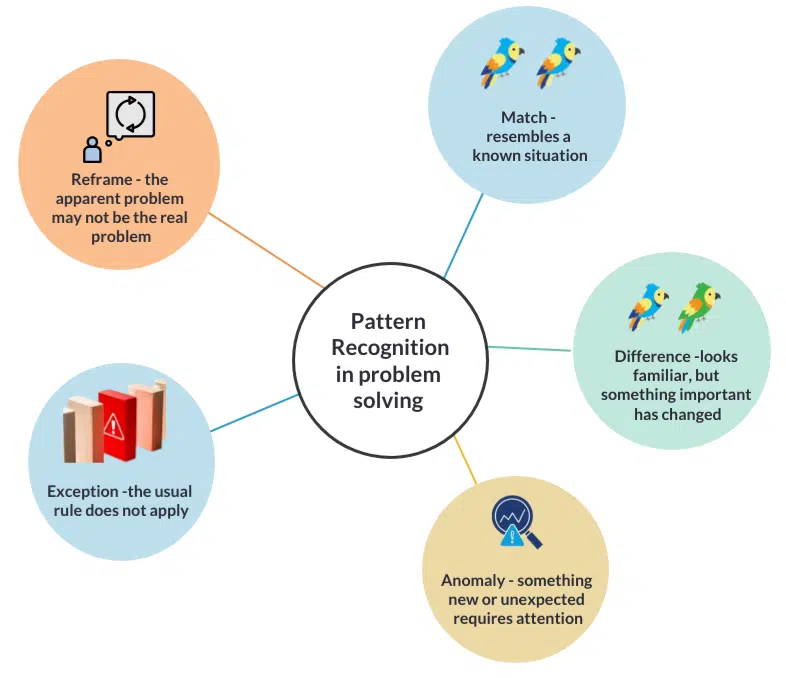
Expert pattern recognition can mean:
Recognizing a match – identifying a familiar pattern and retrieving relevant knowledge quickly.
Spotting a difference – recognizing that a familiar-looking situation contains an important contextual difference.
Identifying an exception – knowing when an established rule or usual response does not apply.
Detecting an anomaly or weak signal – noticing something that appears insignificant but may indicate a larger problem.
Judging incomplete or conflicting information – determining what matters when the evidence does not provide a straightforward answer.
Questioning assumptions – recognizing that something being treated as fact may not be valid.
Reframing the problem – recognizing that the problem itself has been incorrectly defined.
This last capability is particularly significant. Expertise is not simply knowing the right answer. Sometimes expertise means recognizing that the obvious answer—or even the question itself—is wrong.
AI and the expertise problem
What AI can do
AI can already perform many activities once associated with substantial human expertise.
It can search and synthesize enormous bodies of recorded knowledge, identify complex patterns, retrieve relevant information, analyze data, compare alternatives, reason through problems, and generate potential solutions. In some defined tasks, AI systems already perform at or above the level of many human specialists.
And its capabilities will continue to advance.
AI also has an advantage no individual person can match: it can draw upon quantities of recorded knowledge that no human could acquire or retain in a lifetime.
But there is a catch. Scale of knowledge is not the same as completeness of expertise.
AI depends on the information, examples, and feedback available to it. However extensive its training data becomes, it represents what has been captured – not necessarily what is true, what is relevant, or everything that people know.
What AI Can’t Do Reliably.
AI can only work with the knowledge, data, context, and patterns available to it. And those are incomplete.
Published information can be outdated, biased, contradictory, or simply wrong. Commercially valuable expertise may never be published. Organizations protect proprietary knowledge. And much expertise exists only in the accumulated experience of people working in particular contexts.
This exposes a critical limitation: AI does not reliably know what it doesn’t know.
If an important variable, exception, experience, or piece of context is missing, AI can still identify the closest available pattern and produce a convincing response.
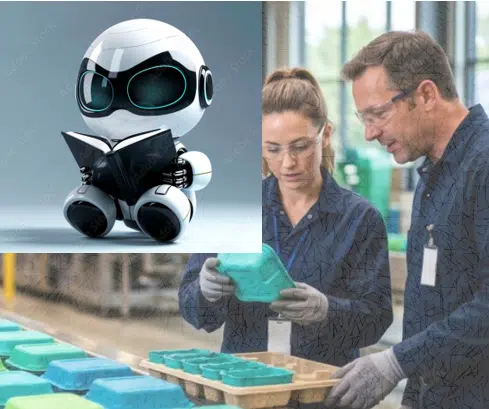
An expert may recognize something different.
The pattern doesn’t quite fit. Something is unusual. A normally reliable assumption may not apply. Important information may be missing. A familiar-looking situation may differ in one critical respect.
Sometimes the expert response isn’t an answer at all – Something is missing or we’re asking the wrong question.
This matters most when situations fall outside established patterns. Strong performance on familiar problems does not guarantee the same performance when something genuinely unusual occurs.
Nor does access to general knowledge provide the context accumulated by people working within a particular organization, process, environment, or system.
Organizations can give AI more of that context. They can capture expert knowledge, provide proprietary data, and build AI systems around their own information.
But then another question arises – Who identifies the knowledge worth capturing, the exceptions that matter, and what the AI is missing?
That still requires expertise.
Why AI Companies Are Recruiting Human Experts
The companies developing frontier AI provide an interesting test of the distinction between knowledge and expertise.
Anthropic and OpenAI have recruited specialists in areas including weapons, explosives, and chemical and biological risks to help evaluate what their models can do and prevent dangerous information from being made readily accessible.
AI makes substantial amounts of publicly available technical knowledge easier to find, combine, and apply. But the most advanced expertise may never have been available in its training data at all. It may be classified, commercially protected, unpublished, inaccessible, or held only in the experience of a small number of specialists.
Human experts are therefore needed to recognize both what the AI knows and what may be missing, identify dangerous capabilities and edge cases, and determine where safeguards are required.
The example exposes both sides of the expertise problem:
AI can make existing knowledge dramatically more accessible. But access to knowledge is still not the same as possessing the expertise required to judge its limits, consequences, or appropriate use.
Your Organization Still Needs Its Own Experts

A general AI system may have access to an extraordinary amount of knowledge about engineering, healthcare, manufacturing, finance, technology, or almost any other domain.
It does not follow that it possesses your organization’s expertise.
Every organization develops knowledge through experience.
People learn how particular systems behave, why processes evolved in particular ways, which exceptions matter, which apparently minor signals precede larger problems, which solutions have already been tried, and what happens when established procedures meet real-world circumstances.
Much of this knowledge never appears in a procedure, training course, database, or document.
And it does not necessarily reside with people who have “expert” in their title.
Critical expertise may sit with a highly qualified specialist. But it may equally sit with an experienced operator, technician, nurse, supervisor, salesperson, administrator, or anyone else who has accumulated deep knowledge of a particular task or context.
Before organizations decide what work AI can automate, they need to understand where their own expertise actually resides.
Otherwise, the risk isn’t simply that AI gets something wrong. It’s that the organization discovers what its people knew only after those people are gone.
What organizations should do about it
AI Is Changing the Economics of Expertise
AI creates two broad paths for organizations.
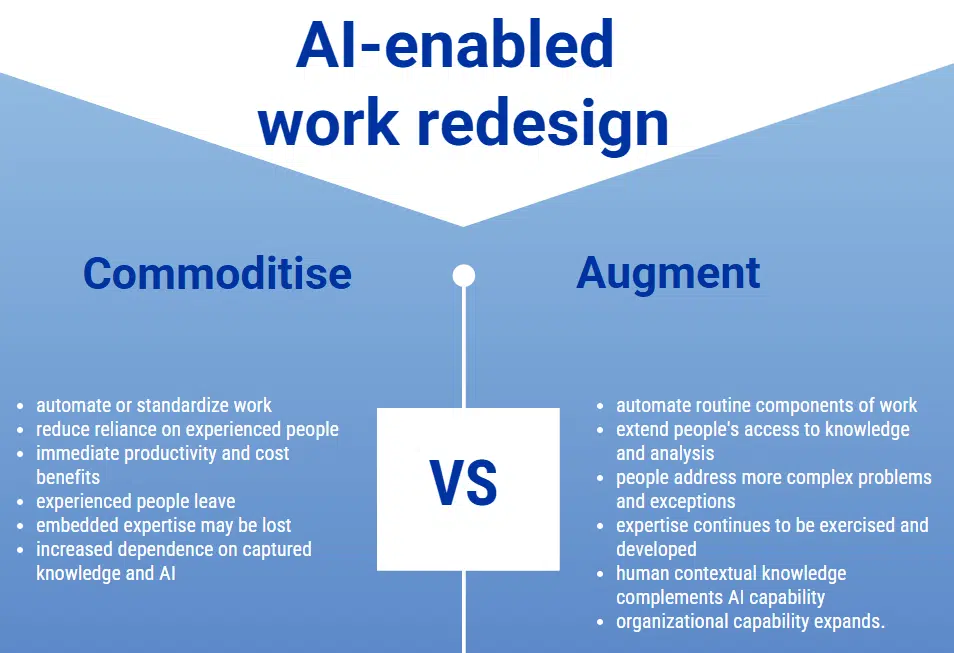
The technology enables both paths. Organizational choices determine the balance.
⬇️ Commoditize expertise
Knowledge and task performance that once depended on experienced people can increasingly be made accessible, standardized, or automated through AI.
The economic attraction is obvious: greater productivity, fewer labor-intensive tasks, redesigned roles, and lower costs.
Under pressure to deliver near-term efficiencies, many organizations will follow this path.
But if roles are reduced or removed, experienced people leave—through restructuring, resignation, retirement, or because the work itself becomes less rewarding.
And they take more than the automated tasks with them.
They may also take years of contextual expertise that was never captured anywhere else.
⬆️ Augment expertise
AI can remove routine work, provide access to broader knowledge, analyze more information, generate alternatives, and allow experienced people to concentrate on exceptions, complex problems, judgment, innovation, and higher-value work.
The alternative is to use AI to extend what people can do.
AI can handle routine work, provide access to broader knowledge, analyze more information, and generate alternatives—allowing experienced people to focus on exceptions, complex problems, judgment, and innovation.
In this model, AI increases human capability while expertise continues to be exercised and developed.
Most organizations will do both. Some work will be automated; other work will be augmented.
The Hidden Cost of Losing Expertise
The benefits of automation are easy to measure. Time saved. Tasks automated. Reduced headcount. Improved throughput, lower labor costs.
The expertise lost when experienced people leave is much harder to put on a balance sheet. Often, organizations don’t discover what they have lost until something unusual happens.
The procedure doesn’t cover it. The available data doesn’t explain it. AI produces a plausible answer from the knowledge available to it.
And the person who would have said: “We’ve seen something like this before—but this time something is different.” is no longer there.
Ford: When the Experienced Engineers Had to Come Back
Ford provides a striking recent example.
After relying increasingly on AI and automated quality systems, Ford concluded that the technology was not delivering the quality improvements it expected. Over the past three years, the company has hired around 350 veteran technical specialists, including former Ford employees and experienced people from suppliers.
The issue wasn’t simply a shortage of engineering knowledge.
Ford acknowledged that it had underestimated the value of engineers who had been through multiple product cycles—and the accumulated experience they brought with them. Some of that knowledge had left the organization before it could be transferred into automated systems.
The returning specialists are now doing three particularly interesting things: identifying potential failure points before components reach production, helping younger engineers develop their judgment, and improving the AI and automated tools themselves.
In other words, Ford didn’t abandon AI. It brought experience back into the system. That distinction matters.
Expertise cannot necessarily be recreated simply by hiring someone with the same qualifications. It may have developed through years of experience with particular products, systems, equipment, customers, processes, and operating conditions.
And expertise doesn’t disappear only through deliberate restructuring. It leaves continuously through resignation and retirement.
Organizations need to understand what expertise they cannot afford to lose before they have to try to hire it back.
If AI Does the Entry-Level Work, Where Will Future Experts Come From?
Today’s experts were once beginners. They became experts by doing the work.
They applied theoretical knowledge to straightforward problems, observed experienced colleagues, made decisions, made mistakes, received feedback, encountered exceptions, and gradually tackled more complex situations.
Yet much of the work AI can most readily automate sits near the beginning of this pathway – Research. Analysis. Drafting. Routine problem solving. Preliminary interpretation.
These aren’t simply outputs organizations need produced cheaply. They are also how people learn.
If AI removes them, organizations may gain productivity while simultaneously removing some of the experiences through which future expertise develops.
Giving a novice the same AI used by an expert doesn’t solve the problem.
The expert brings accumulated knowledge and experience to the interaction. They are better equipped to challenge an output, spot an exception, detect a missing assumption, or recognize that an apparently convincing answer simply doesn’t make sense.
The novice may be the person least equipped to recognize when AI is wrong.
So there is a critical workforce question: If people no longer learn by doing the work, how will they acquire the experience required to become experts?
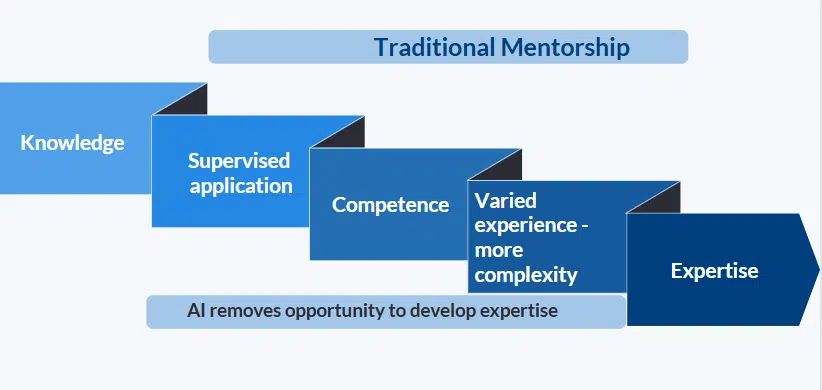
Automating work can also automate away learning opportunities.
Developing Expertise Has to Become Deliberate
Organizations have often allowed expertise to develop relatively organically. People learn the fundamentals, do the work, encounter harder situations, learn from experienced colleagues, and gradually become the people others turn to when something unusual happens.
AI may disrupt that pathway.
If developmental work disappears, organizations will need to deliberately create the experiences through which expertise develops.
Training isn’t enough. Neither is access to information.
Expertise requires people to apply knowledge, encounter variation and exceptions, experience consequences, receive feedback, and exercise increasing judgment in more complex situations.
That means organizations need to connect processes that have traditionally been managed separately:
- Capability requirements — defining the knowledge, skills, competence, and experience required for effective performance.
- Competency assessment – establishing whether people can actually apply what they know.
- Developmental experience – deliberately exposing people to different contexts, problems, exceptions, and increasing complexity.
- Coaching and observation – enabling developing practitioners to see not only what experts do, but how they interpret situations.
- Feedback and reflection – turning experience into learning rather than simply time served.
- Progressive responsibility – increasing autonomy and judgment as capability develops.
- Development and career pathways – creating progression through experiences that build deeper capability.
- Knowledge transfer and succession – identifying expertise that is vulnerable to loss and creating opportunities to transfer it.
But developing expertise also requires knowing where the organization stands today.
Where does critical expertise reside? Where is it concentrated in too few people? Who is developing toward it? What experience do they need next? Which expertise is vulnerable to retirement, resignation, or restructuring? And where might automation remove the very experiences needed to develop its successors?
These are workforce capability questions:
What’s expected? What knowledge, competence, experience, and expertise does the work require?
Where are we now? Who can demonstrate that capability? Where does critical expertise reside, and where are the gaps and risks?
What’s next? What experience, development, coaching, career moves, and knowledge transfer will build the capability required next?
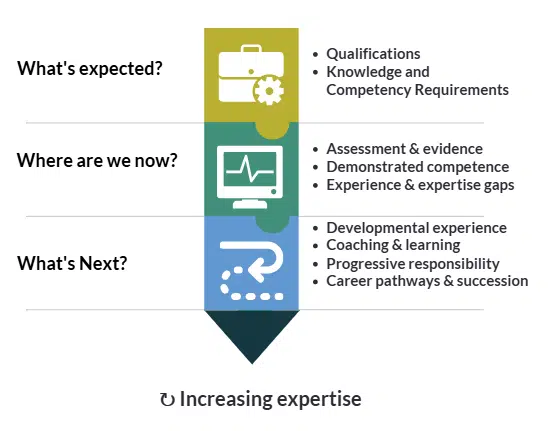
The future of expertise development cannot be reduced to teaching people how to use AI.
AI may make recorded knowledge abundant. Expertise is not abundant simply because knowledge is.
Organizations need to understand the expertise they already depend on—and deliberately build the expertise they will need next.
FAQs
What is the difference between knowledge and expertise?
Knowledge is an understanding of information, principles, concepts, and procedures. Expertise develops through applying knowledge across varied situations and learning from experience, feedback, exceptions, and consequences. An expert not only recognizes familiar patterns but is more likely to recognize when the usual pattern, assumption, or solution does not apply.
Can AI replace human expertise?
AI can perform many tasks that draw on specialist knowledge and can identify patterns across far more information than any individual could process. But access to recorded knowledge is not the same as accumulated expertise. AI may lack context-specific, proprietary, tacit, or undocumented knowledge and does not reliably recognize when important information or experience is missing.
Why is experience important in developing expertise?
Experience exposes people to variation, exceptions, failures, consequences, and situations that cannot be resolved simply by following established procedures. When combined with feedback and reflection, these experiences transform how knowledge is organized, interpreted, and applied. Time served alone does not create expertise; experience must produce learning.
Can AI help people develop expertise?
Yes. AI can provide access to knowledge, support analysis, generate alternatives, provide feedback, and reduce routine work. But organizations also need to ensure people continue to apply knowledge, solve problems, encounter exceptions, exercise judgment, and learn from consequences. AI can support expertise development, but access to AI is not a substitute for experience.
How can organizations retain and develop critical expertise?
Organizations first need visibility into what expertise is critical, where it resides, and where it is vulnerable to loss. They can then connect capability requirements, competency assessment, developmental experience, coaching, career pathways, knowledge transfer, and succession to deliberately retain existing expertise and develop the people who will provide it in the future.