
Best Skills Management Software (2026)
Choosing the right skills management software depends on more than comparing feature lists. Some platforms focus on skills inventories and internal mobility, while others support structured competency management, workforce capability and operational readiness.
This guide compares leading skills management platforms, explains the different approaches available, and helps you identify which solution best fits your organisation’s goals.

At a Glance (vendors + evaluation criteria)
Platforms
365Talents
AG5
Avilar
Centranum
Comaea
iMocha
Kahuna
MuchSkills
Nestor
Skillsoft
Skills Base
SkillsTX
SkillStation
TalentGuard
Workday Skills Cloud
Evaluation Criteria
Workforce capability
Skills and competency management
Assessment and proficiency
Evidence and validation
Qualifications and certifications
Workforce readiness
Learning and development
Career and succession
AI-assisted skills management
Enterprise scalability and flexibility
What is Skills Management Software?
Skills management software helps organisations identify, organise and maintain information about workforce skills, capabilities and competencies. It provides a structured way to understand what people know, what they can do and where development or recruitment may be required.
Different skills management platforms support different organisational goals. Some focus on maintaining a skills inventory or skills matrix, while others specialise in competency management, technical skills assessment, workforce planning, internal mobility or operational qualification management. More comprehensive platforms bring these capabilities together to provide a broader view of workforce capability and readiness.
By replacing disconnected spreadsheets and manual records with a centralised system, skills management software helps organisations improve workforce visibility, identify capability gaps, support development planning and make more informed operational, compliance and workforce planning decisions.
The Different Types of Skills Management Software
Although the term skills management software is widely used, organisations purchase these platforms for very different reasons. Some need a simple skills inventory, others want to support career mobility, while many require structured competency management, workforce capability or operational qualification management.
Understanding these different approaches makes it easier to identify which platform is best suited to your organisation’s goals.
Skills Inventory Platforms
These platforms focus on recording workforce skills and providing visibility of current capability through skills matrices and reporting. They are often used to identify skills gaps, monitor proficiency and support workforce planning.
Typically best for:
- Skills inventories
- Skills matrices
- Gap analysis
- Basic workforce reporting
Talent Intelligence Platforms
These platforms use skills data to support workforce planning, career development, internal mobility and AI-driven talent recommendations. Many integrate closely with HR systems and focus on helping organisations understand and deploy workforce capability.
Typically best for:
- Internal mobility
- Career development
- Workforce planning
- AI skills intelligence
Skills Assessment & Learning Platforms
These platforms specialise in measuring skills and knowledge through assessments, testing or learning activities. They often integrate with learning management systems and help organisations verify technical or role-specific knowledge.
Typically best for:
- Technical skills assessment
- Knowledge verification
- Learning and development
- Recruitment and hiring assessments
Operational Skills & Competency Platforms
These platforms help organisations define role requirements, assess competence, validate evidence, manage qualifications and authorisations, and demonstrate workforce capability in operational or regulated environments.
Typically best for:
- Manufacturing
- Utilities
- Engineering
- Healthcare
- Operational qualification management
- Compliance and audit
Why Organisations Invest in Skills Management Software
Most organizations do not begin looking for skills management software because they want a better skills database. They start looking when existing spreadsheets, disconnected systems or manual processes no longer provide enough visibility to support workforce decisions.
As organizations grow, introduce new technologies or face increasing compliance requirements, leaders need greater confidence that people have the right skills, capabilities and competencies for the work they perform. Skills management software provides a structured way to maintain workforce information, identify capability gaps and support development, workforce planning and operational decision-making.
📊 Replace spreadsheets
Replace spreadsheet-based skills matrices that have become difficult to maintain.
👁️ Improve workforce visibility
Gain better visibility of workforce skills, capabilities and competency gaps.
🎯 Identify capability gaps
Improve consistency in skills or competency assessment across teams and locations.
📚 Support workforce development
Support workforce planning, internal mobility and career development.
🛡️ Strengthen compliance
Track qualifications, certifications and other role requirements.
📋 Manage qualifications
Strengthen compliance, audit readiness and operational assurance.
🔄 Connect learning & assessment
Connect learning, assessment and workforce development within a single process.
🚀 Improve workforce readiness
Improve deployment decisions by understanding workforce capability and readiness.
The challenge is not simply recording skills—it’s having accurate, current information that supports confident workforce decisions.
How We Evaluated the Platforms
Skills management software varies significantly in scope and purpose. Some platforms focus on maintaining a skills inventory, while others support competency management, workforce planning, technical assessment or operational qualification management.
Rather than ranking platforms on the number of features they offer, we evaluated them against the capabilities organisations commonly consider when selecting a skills management solution. These include workforce visibility, assessment capabilities, compliance support, scalability and how well each platform aligns with different organisational requirements.
Our evaluation considered factors such as:
📊 Workforce Capability
🔷 Skills inventories & skills matrices
🔷 Competency framework support
🔷 Role-based capability management
🔷 Workforce capability & readiness visibility
🛡️ Assessment & Compliance
🔷 Skills & competency assessment
🔷 Qualifications, certifications & authorisations
🔷 Evidence capture & audit readiness
📈 Workforce Development
🔷 Learning & development integration
🔷 Career development
🔷 Workforce planning
🔷 AI capabilities & skills intelligence
⚙️ Platform & Enterprise
🔷 Reporting & analytics
🔷 Enterprise scalability
🔷 Configuration
🔷 Integrations
No single platform is the best choice for every organisation. The right solution depends on your industry, workforce, regulatory requirements and the outcomes you are trying to achieve.
Not All Skills Data Is Created Equal
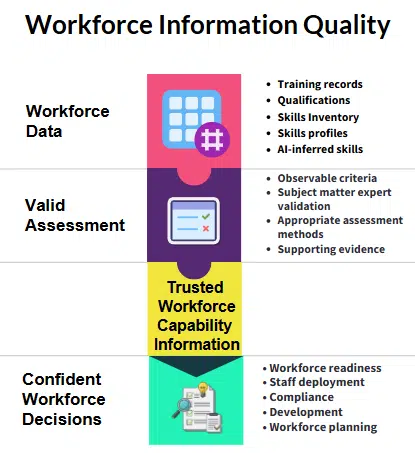
Many skills management platforms can record skills, training completions or proficiency ratings. Some use AI to infer workforce skills from learning activity, employee profiles or work history. Others rely primarily on self-assessment or manager ratings.
These approaches provide valuable workforce visibility. However, the quality of workforce information depends not only on how much data is collected, but also on how that information is assessed and validated.
For many workforce decisions, organisations need confidence that workforce information reflects demonstrated capability rather than assumptions, training participation or inferred skills.
This distinction becomes particularly important in regulated, technical and operational environments where workforce information supports deployment, compliance, workforce readiness and operational decision-making.
Why Assessment Quality matters
The confidence organisations can place in workforce information depends on the quality of the underlying assessment process. Observable competency criteria, appropriate assessment methods, subject matter expert input and supporting evidence all contribute to more reliable workforce information.
Artificial intelligence can accelerate competency framework development and identify potential skills. However, it cannot determine what competent performance looks like within a specific workplace or role. For technical, operational, clinical and safety-critical work, competency standards still depend on subject matter experts who understand the work, the risks involved and the evidence required to demonstrate competence.
When comparing skills management platforms, consider not only how workforce information is collected, but also how confidence in that information is established.
Comparison Tables
Based on publicly available product information. Some capabilities may be configurable, edition-specific or partner-supported. Where public information was unclear, this is marked “?”.
Legend
🟢 Strong capability
🟡 Supported
⚪ Limited / Basic or not a primary focus
❓ Not evident from publicly available information
Table 1 Vendors A-C
| Criteria | 365Talents | AG5 | Avilar | Centranum | Comaea |
|---|---|---|---|---|---|
| Custom Skills & Competency Frameworks | 🟡 | 🟡 | 🟢 | 🟢 | 🟢 |
| Role & Capability Mapping | 🟢 | 🟢 | 🟡 | 🟢 | 🟢 |
| Assessment & Proficiency Management | ⚪ | 🟡 | 🟢 | 🟢 | 🟢 |
| Qualifications & Certifications | ⚪ | 🟢 | ⚪ | 🟢 | 🟢 |
| Evidence & Validation | ⚪ | ⚪ | ⚪ | 🟢 | 🟢 |
| Configurable Assessment Methods | ⚪ | ⚪ | ⚪ | 🟢 | 🟢 |
| Compliance / Audit Support | ⚪ | 🟡 | ⚪ | 🟢 | 🟢 |
| Workforce Readiness & Reporting | 🟡 | 🟡 | ⚪ | 🟢 | 🟢 |
| Learning & Development | ⚪ | ⚪ | 🟢 | 🟢 | 🟢 |
| Career & Succession | 🟢 | ⚪ | ⚪ | 🟢 | 🟢 |
| AI-Driven Skills Intelligence | 🟢 | ⚪ | ❓ | 🟡 | ⚪ |
| Integrations | 🟢 | 🟢 | ❓ | 🟢 | ❓ |
| Enterprise Scalability | 🟢 | 🟢 | 🟡 | 🟢 | 🟢 |
| Platform Flexibility | 🟡 | 🟡 | 🟡 | 🟢 | 🟢 |
Table 2 Vendors I-S
| Criteria | iMocha | Kahuna | MuchSkills | Nestor | Skillsoft |
|---|---|---|---|---|---|
| Custom Skills & Competency Frameworks | 🟢 | 🟢 | ⚪ | 🟡 | ⚪ |
| Role & Capability Mapping | 🟢 | 🟢 | 🟡 | 🟢 | 🟡 |
| Assessment & Proficiency Management | 🟢 | 🟢 | ⚪ | 🟡 | ⚪ |
| Qualifications & Certifications | ⚪ | 🟢 | ⚪ | ⚪ | ⚪ |
| Evidence & Validation | 🟡 | 🟢 | ⚪ | ⚪ | ⚪ |
| Configurable Assessment Methods | 🟡 | 🟢 | ⚪ | ⚪ | ⚪ |
| Compliance / Audit Support | ⚪ | 🟢 | ⚪ | ⚪ | ⚪ |
| Workforce Readiness & Reporting | 🟡 | 🟢 | ⚪ | 🟡 | ⚪ |
| Learning & Development | ⚪ | 🟡 | 🟡 | 🟢 | 🟢 |
| Career & Succession | ⚪ | ⚪ | ⚪ | 🟢 | ⚪ |
| AI-Driven Skills Intelligence | 🟡 | ⚪ | 🟡 | 🟢 | 🟢 |
| Integrations | 🟢 | 🟢 | ❓ | ❓ | 🟢 |
| Enterprise Scalability | 🟢 | 🟢 | ⚪ | 🟢 | 🟢 |
| Platform Flexibility | 🟡 | 🟢 | ⚪ | 🟡 | ⚪ |
Table 3 – Vendors S-W
| Criteria | Skills Base | SkillsTX | SkillStation | TalentGuard | Workday |
|---|---|---|---|---|---|
| Custom Skills & Competency Frameworks | 🟡 | 🟡 | 🟢 | 🟢 | ⚪ |
| Role & Capability Mapping | 🟡 | 🟢 | 🟢 | 🟢 | 🟢 |
| Assessment & Proficiency Management | 🟡 | 🟡 | 🟢 | 🟢 | ⚪ |
| Qualifications & Certifications | ⚪ | 🟢 | 🟢 | 🟡 | ⚪ |
| Evidence & Validation | ⚪ | 🟡 | 🟡 | 🟡 | ⚪ |
| Configurable Assessment Methods | ⚪ | 🟡 | 🟡 | 🟡 | ⚪ |
| Compliance / Audit Support | ⚪ | 🟢 | 🟡 | 🟢 | ⚪ |
| Workforce Readiness & Reporting | ⚪ | 🟡 | 🟡 | 🟢 | 🟢 |
| Learning & Development | ⚪ | 🟡 | ⚪ | 🟢 | 🟢 |
| Career & Succession | ⚪ | 🟡 | 🟡 | 🟢 | 🟢 |
| AI-Driven Skills Intelligence | ⚪ | ⚪ | ⚪ | 🟢 | 🟢 |
| Integrations | ❓ | 🟢 | 🟡 | 🟢 | 🟢 |
| Enterprise Scalability | ⚪ | 🟢 | 🟡 | 🟢 | 🟢 |
| Platform Flexibility | 🟡 | 🟡 | 🟡 | 🟡 | ⚪ |
Public information does not always describe every capability available within each platform. These comparisons are based on publicly available product documentation and demonstrations at the time of writing.
Vendor Reviews.
365Talents
365Talents is an AI-powered skills intelligence and talent mobility platform designed to help organisations understand workforce skills, improve internal mobility and support strategic workforce planning. The platform combines AI with employee profiles, career history, learning activity and employee-declared skills to build dynamic workforce skills profiles and recommend career opportunities, learning pathways and internal talent matches.
The platform is particularly well suited to organisations pursuing skills-based workforce transformation, career mobility and AI-supported workforce planning. Its strengths lie in skills intelligence and workforce agility rather than structured competency assessment or evidence-based competency management. Organisations operating in regulated, technical or safety-critical environments may require additional validation processes where workforce decisions depend on demonstrated competence rather than inferred or self-declared skills.
Primary Strengths
- AI-driven skills intelligence and workforce insights
- Strong internal mobility and career opportunity matching
- Skills-based workforce planning and talent marketplace capabilities
- Integration with enterprise HR systems
- Well suited to organisations adopting a skills-first workforce strategy
Considerations
- Skills profiles are built from AI inference, employee information and self-declared skills, which may require additional validation for high-assurance workforce decisions.
- Organisations requiring competency assurance, compliance or workforce readiness typically need evidence of demonstrated competence in addition to inferred skills.
- AI-assisted skills intelligence delivers the greatest value when supported by well-governed workforce data and appropriate validation processes.
AG5
AG5 is an operational skills management platform designed to give organisations clear, real-time visibility of workforce skills, qualifications and training status. Best known for its digital skills matrix, the platform helps organisations replace spreadsheets with a centralised view of workforce capability, making it easier to identify skill gaps, manage qualifications and support day-to-day workforce deployment.
The platform is particularly well suited to manufacturing, engineering, logistics and other operational environments where managers need rapid visibility of workforce capability and qualification status. Its strength lies in providing a straightforward, user-friendly operational skills management solution rather than a highly configurable competency management platform.
Primary Strengths
- Digital skills matrices with real-time workforce visibility
- Qualification and certification tracking
- Operational workforce planning and deployment support
- Strong reporting for manufacturing and regulated industries
- Simple, intuitive interface that is easy to adopt
Considerations
- Assessment appears to focus primarily on skills and proficiency tracking rather than detailed competency criteria and evidence-based assessment.
- Organisations requiring configurable competency frameworks, multiple assessment methods or complex competency assurance workflows may require additional capability.
- Broader talent management functions such as career development and succession planning are not the platform’s primary focus.
Avilar
Avilar is a competency management platform focused on helping organisations define, assess and develop workforce capability through structured competency frameworks. The platform combines competency management with learning, performance support and workforce development, making it well suited to organisations seeking a structured, competency-based approach to employee development.
Avilar is particularly suited to organisations that want to establish competency frameworks, align learning with competency requirements and support employee development through structured assessment. Its approach is centred on competency management rather than broader workforce readiness or operational capability assurance.
Primary Strengths
- Structured competency framework development and management.
- Competency assessment linked to learning and employee development.
- Integration of competency management with learning and performance support.
- Suitable for organisations establishing competency-based workforce development programmes.
- Flexible framework design supporting a wide range of industries.
Considerations
- Public information places greater emphasis on competency management and learning than on workforce readiness, operational deployment or complex competency assurance workflows.
- Organisations requiring configurable assessment pathways, multiple validation methods, authorisation management or evidence-based workforce readiness may require broader workforce capability functionality.
- AI-assisted skills intelligence and advanced workforce planning are not the primary focus of the platform.
Centranum
Centranum is a configurable workforce capability platform that brings together skills management, competency management, qualifications, workforce readiness and workforce development within a single system. Organisations can begin with a straightforward implementation—such as a digital skills matrix, competency management or qualification tracking—and progressively enable additional capabilities as workforce requirements evolve.
Rather than requiring custom development, Centranum uses configurable workflows, assessment models and business rules to support organisations ranging from office-based and professional environments through to highly regulated, technical and safety-critical operations. The same platform can support simple skills visibility or sophisticated competency assurance, depending on organisational requirements.
Primary strengths
- Supports skills management, competency management, qualifications and workforce capability within a single platform.
- Configurable for professional, technical, operational and safety-critical environments without custom development.
- Manages qualifications, certifications, authorisations, assessment evidence and workforce readiness where required.
- Flexible assessment models support a wide range of organisational approaches, from straightforward proficiency tracking through to evidence-based competency assurance.
- Organisations can start with the capabilities they need today and expand over time using the same workforce information and platform.
- Extends naturally into workforce development, career development, succession planning and workforce planning as organisational maturity grows.
Considerations
- The platform is highly configurable, allowing organisations to tailor competency frameworks, assessment workflows and business rules to their own operating model rather than adopting a single predefined methodology.
- Many organisations begin with a focused implementation—such as skills management, competency assessment or qualification tracking—and progressively enable additional capabilities as business priorities evolve.
Comaea
Comaea provides competency and workforce assurance solutions for maritime, offshore, energy and industrial environments. The platform focuses on helping organizations define competency standards, verify workforce competence, maintain qualifications and support compliance in safety-critical operations.
Comaea is strongest where workforce competence must be demonstrated and maintained against structured requirements. Its focus is narrower than broad talent platforms, but that specialization is a strength for organizations operating in high-risk technical environments where competency assurance, qualifications and auditability matter.
Primary Strengths
- Competency assurance for maritime, offshore and industrial operations.
- Structured competency frameworks and workforce validation.\
- Qualification and certification management.
- Compliance and operational assurance support.
- Strong fit for safety-critical and regulated environments.
Considerations
- More specialized toward maritime, offshore and industrial sectors than broad enterprise workforce capability platforms.
- Less emphasis on career development, internal mobility and succession planning.
- Organizations seeking both operational competency assurance and wider workforce capability, development and readiness processes should compare the breadth of functionality carefully.
iMocha
iMocha is a skills assessment platform that helps organisations measure technical, functional and role-specific skills through a comprehensive library of online assessments. The platform is widely used for recruitment, workforce development, skills benchmarking and talent mobility, enabling organisations to assess demonstrated capability rather than relying solely on qualifications, experience or self-reported skills.
The platform is particularly well suited to organisations that want to validate workforce skills through structured assessments and generate skills intelligence from assessment results. While it provides strong assessment capability, organisations requiring ongoing competency management, qualification tracking or configurable workforce readiness processes may combine assessment data with broader workforce capability management.
Primary Strengths
- Extensive library of technical, functional and professional skills assessments.
- Strong support for recruitment, hiring and technical skill validation.
- Skills benchmarking, analytics and workforce insights.
- AI-assisted assessment and skills intelligence.
- Integration with HR, talent and learning platforms.
Considerations
- Primarily focused on skills assessment rather than end-to-end workforce capability management.
- Organisations requiring structured competency frameworks, qualification management or configurable competency assurance workflows may require complementary capabilities.
- Assessment results provide valuable workforce information, but workforce readiness typically depends on combining assessment outcomes with role requirements, qualifications, experience and other workforce capability data.
Kahuna
Kahuna is a workforce competency and skills management platform designed for organisations with frontline, operational and technical workforces. The platform combines digital skills matrices, competency assessment, qualification tracking and workforce planning to help organisations understand who is qualified to perform specific work, identify capability gaps and support workforce deployment.
Kahuna is particularly well suited to manufacturing, utilities, energy, logistics and other operational environments where workforce competency, qualifications and operational readiness are central to day-to-day operations.
Primary Strengths
- Digital skills matrices and workforce visibility.
- Competency assessment and qualification management.
- Qualification and certification tracking.
- Workforce planning and deployment.
- Strong support for operational and technical workforces.
Considerations
- Primarily focused on operational and technical workforces rather than broader enterprise talent management.
- Public information places greater emphasis on operational competency management than on highly configurable competency frameworks, evidence management or broader workforce capability processes.
- Organisations seeking integrated career development, succession planning or enterprise workforce capability management may require complementary systems.
MuchSkills
MuchSkills is a collaborative skills management platform that helps organisations build a visual understanding of workforce skills, interests and capabilities. The platform enables employees to create and maintain skills profiles, making it easier to identify expertise, support team formation and improve internal collaboration.
The platform is best suited to knowledge-based organisations seeking a lightweight, collaborative approach to skills mapping and workforce visibility. Its emphasis is on helping organisations understand who knows what, rather than managing structured competency frameworks, qualifications or workforce assurance.
Primary Strengths
- Collaborative skills mapping and workforce visibility.
- Visual skills profiles and team capability insights.
- Internal talent discovery and project staffing.
- User-friendly employee experience.
- Supports collaboration and knowledge sharing.
Considerations
- Relies significantly on employee participation and self-maintained skills profiles.
- Focuses on skills visibility and collaboration rather than structured competency assessment, qualifications or workforce assurance.
- Organisations requiring evidence-based competency management, compliance or workforce readiness processes may require complementary capabilities.
Nestor
Nestor is an AI-powered skills intelligence and talent management platform that helps organisations identify workforce skills, support employee development and improve internal mobility. Using AI, the platform builds dynamic workforce skills profiles and recommends career opportunities, learning pathways and workforce planning insights based on employees’ skills, experience and development goals.
The platform is particularly well suited to organisations adopting a skills-based workforce strategy centred on employee development, workforce planning and internal talent mobility. Its strengths lie in AI-driven workforce intelligence and talent development rather than structured competency assurance or operational workforce management.
Primary Strengths
- AI-powered skills intelligence and workforce insights.
- Career development and personalised learning recommendations.
- Internal mobility and talent marketplace capabilities.
- Workforce planning and skills gap analysis.
- Strong support for organisations adopting skills-based talent strategies.
Considerations
- Workforce skills profiles are largely AI-derived and should be appropriately validated where workforce decisions require demonstrated competence.
- Focuses primarily on talent development and workforce planning rather than operational competency management or compliance.
- Organisations requiring evidence-based competency assessment, qualification management or workforce readiness processes may require complementary capabilities.
SkillSoft
Skillsoft is a workforce learning and development platform that combines an extensive digital learning library with skills benchmarking, AI-assisted learning recommendations and workforce development capabilities. The platform helps organisations identify skills gaps, recommend relevant learning and support continuous workforce development through integrated learning experiences.
Skillsoft is particularly well suited to organisations where learning and workforce development are central to their skills strategy, especially where access to a comprehensive enterprise learning content library is a key requirement. Its strengths lie in helping organisations develop workforce capability through learning rather than managing ongoing competency assurance or operational workforce readiness.
Primary Strengths
- Extensive enterprise learning content library.
- Skills benchmarking and learning recommendations.
- AI-assisted workforce development.
- Personalised learning pathways.
- Strong enterprise learning ecosystem.
Considerations
- Skills intelligence is closely aligned with learning activity, course metadata and embedded learning assessments rather than demonstrated workplace competence.
- The platform focuses primarily on learning and workforce development rather than structured competency management, qualifications or operational workforce assurance.
- Organisations requiring evidence-based competency assessment, qualification management or workforce readiness based on demonstrated competence may require complementary workforce capability management processes.
Skills Base
Skills Base is a skills management platform focused on helping organisations build and maintain skills inventories, skills matrices and workforce capability profiles. The platform provides a structured way to record workforce skills, identify capability gaps and improve visibility across teams.
It is best suited to organisations looking to replace spreadsheet-based skills matrices with a dedicated skills management solution, particularly where the primary objective is maintaining a central skills inventory and improving workforce visibility rather than implementing broader workforce capability or talent management processes.
Primary Strengths
- Skills inventories and digital skills matrices.
- Skills gap analysis and workforce visibility.
- Centralised recording of workforce skills.
- Reporting on workforce capability.
- Suitable for organisations moving from spreadsheet-based skills tracking.
Considerations
- Primarily focused on skills inventories and skills management rather than structured competency management.
- Public information places limited emphasis on qualifications, competency assessment, evidence management or workforce readiness.
- Organisations requiring configurable competency frameworks, operational workforce assurance or broader workforce capability management may require additional capabilities.
SkillsTX
SkillsTX is a workforce capability platform built around the SFIA (Skills Framework for the Information Age) framework, helping organisations manage skills, competencies and workforce capability for digital, technology and knowledge-based roles. The platform combines skills management, competency mapping and workforce planning to support capability development, organisational change and future workforce planning.
It is particularly well suited to organisations adopting SFIA or other strategic skills frameworks, especially within technology, digital and professional services environments where workforce capability planning and skills development are key priorities.
Primary Strengths
- Structured skills and competency frameworks.
- Workforce capability planning and analytics.
- Skills visibility and gap analysis.
- Support for capability development and workforce transformation.
- Alignment of skills data with organisational planning.
Considerations
- Particularly relevant to technology, digital and professional workforces.
- Organisations with frontline, safety-critical or operational competency requirements should confirm fit for qualifications, authorisations, practical assessment and evidence-based validation.
- Public information on integrations and some advanced assessment capabilities is limited.
SkillsStation
SkillStation is an operational competency management platform designed to help organisations manage workforce competence, training records and qualification requirements. The platform combines skills tracking, competency assessment and compliance reporting to provide visibility of workforce capability across operational environments.
It is particularly well suited to manufacturing, engineering and other operational industries where organisations need to track workforce competence, qualifications and compliance using structured operational processes.
Primary Strengths
- Operational competency management.
- Skills and qualification tracking.
- Training records and competency assessments.
- Workforce reporting and operational compliance.
- Strong support for frontline operational workforces.
Considerations
- The platform focuses primarily on operational competency management and compliance rather than broader workforce capability management.
- Qualification and certification management is centred on recording and maintaining evidence of credentials rather than managing more complex qualification or authorisation requirements.
- Career development, succession planning and broader talent management are not primary areas of focus.
TalentGuard
TalentGuard is an enterprise workforce capability and talent management platform that combines AI-powered skills intelligence, workforce governance and readiness management to support strategic workforce decisions. Through its Enterprise Skill Trust & Readiness Intelligence (ESTRI) framework, the platform helps organisations standardise workforce skills information, improve governance and provide greater confidence in workforce planning, career development, succession and readiness decisions.
The platform is particularly well suited to large enterprises adopting a skills-based workforce strategy where governance, workforce intelligence and executive decision support are strategic priorities. Its strengths lie in creating a governed framework for workforce skills and readiness across the enterprise.
Primary Strengths
- AI-powered skills intelligence and workforce insights.
- Strong governance, auditability and workforce data management.
- Workforce readiness and executive decision support.
- Career development, succession planning and talent management.
- Enterprise-scale workforce capability and skills governance.
Considerations
- Organisations requiring competency evidence, qualifications or operational workforce assurance should evaluate how these requirements are supported within the platform and whether they align with their operational and regulatory needs.
- AI-driven recommendations and workforce intelligence are most effective when supported by appropriate governance, validation and organisational oversight.
- Organisations with highly specialised operational, technical or safety-critical roles should consider how competency standards, assessment methods and evidence requirements are established and maintained.
Workday Skills Cloud
Workday Skills Cloud is an AI-powered skills intelligence capability within the broader Workday Human Capital Management platform. It helps organisations infer workforce skills, recommend learning and career opportunities, and support skills-based workforce planning across the Workday ecosystem.
Primary Strengths
- AI-driven skills intelligence.
- Integration across the Workday HCM platform.
- Career development and internal mobility.
- Enterprise workforce planning.
- Strong ecosystem for existing Workday customers.
Considerations
- Best suited to organisations already invested in the Workday ecosystem.
- Skills intelligence is primarily derived from workforce data, employee profiles and learning rather than structured competency assessment.
- AI-inferred skills should be validated before being relied upon for workforce deployment or compliance decisions.
- Organisations requiring configurable competency management, qualifications, operational workforce assurance or evidence-based readiness may require complementary solutions or specialised applications.
Summary: Which Skills Management Platform Fits Which Need?
| Platform | Primary Approach | Best Suited For | Key Consideration |
|---|---|---|---|
| 365Talents | AI-powered skills intelligence and talent mobility | Organisations adopting a skills-based workforce strategy with a focus on internal mobility, workforce planning and career development. | Skills intelligence is largely AI-driven and benefits from appropriate validation where workforce decisions require demonstrated competence. |
| AG5 | Operational skills matrices and qualification tracking | Manufacturing, engineering, logistics and other operational environments replacing spreadsheet-based skills tracking. | Best suited to operational skills visibility rather than highly configurable competency management or broader talent processes. |
| Avilar | Competency management and workforce development | Organisations establishing structured competency frameworks linked to learning and employee development. | Greater emphasis on competency management and learning than on workforce readiness or operational competency assurance. |
| Centranum | Configurable workforce capability and readiness | Organisations wanting a platform that can support everything from simple skills management through to evidence-based competency assurance, qualifications and workforce readiness. | Configurable to suit different industries and levels of workforce capability maturity without requiring custom development. |
| Comaea | Competency assurance for safety-critical operations | Maritime, offshore, energy and industrial organisations managing operational competence and compliance. | Highly specialised operational competency platform with less emphasis on broader enterprise talent management. |
| iMocha | Skills assessment and validation | Organisations prioritising technical assessment, recruitment and workforce skills benchmarking. | Strong assessment capability that may be complemented by broader workforce capability management processes. |
| Kahuna | Operational competency management | Frontline and technical workforces requiring competency management, qualifications and workforce deployment. | Focused on operational competency rather than wider workforce capability or talent management. |
| MuchSkills | Collaborative skills mapping | Knowledge-based organisations wanting better visibility of workforce skills and expertise. | Emphasises collaborative skills mapping rather than structured competency assessment or workforce assurance. |
| Nestor | AI-powered skills intelligence and workforce development | Organisations focused on learning, career development and workforce planning. | Skills intelligence is primarily AI-driven and centred on employee development rather than operational competency management. |
| Skillsoft | Learning-driven skills development | Organisations where enterprise learning, reskilling and workforce development are strategic priorities. | Skills intelligence is closely linked to learning activity and development rather than demonstrated workplace competence. |
| Skills Base | Skills inventory and workforce visibility | Organisations seeking a structured alternative to spreadsheet-based skills tracking. | Focused on maintaining skills inventories rather than comprehensive competency management or workforce readiness. |
| SkillsTX | Strategic workforce capability planning | Organisations adopting structured workforce capability frameworks, particularly in digital and professional environments. | Particularly relevant to organisations using structured skills frameworks and strategic capability planning. |
| SkillStation | Operational competency and compliance management | Manufacturing, engineering and operational organisations managing workforce competence and compliance. | Focuses on operational competency management rather than broader workforce capability, career development or succession planning. |
| TalentGuard | Governed skills intelligence and workforce readiness | Large enterprises seeking AI-supported workforce intelligence, governance and enterprise readiness. | Strong governance and enterprise readiness focus. Organisations should evaluate how competency standards, assessment methods and evidence align with operational and regulatory requirements. |
| Workday Skills Cloud | AI-powered enterprise skills intelligence | Existing Workday customers implementing skills-based talent management within the Workday ecosystem. | Organisations requiring detailed competency management, workforce readiness or operational assurance may complement Skills Cloud with specialised workforce capability applications. |
Which Skills Management Platform Is Right For You?
- Choose a skills inventory platform if you mainly need visibility.
- Choose an AI skills intelligence platform if mobility and planning are the priority.
- Choose an assessment platform if testing is the core need.
- Choose an operational competency platform if compliance and qualification tracking are central.
- Choose a configurable workforce capability platform if you need simple skills management now, with the option to grow into competency assurance, evidence, readiness and workforce development.
FAQs
What is skills management software?
Skills management software helps organisations record, assess and analyse workforce skills so they can understand current capability, identify gaps and support workforce planning, development and deployment. Some platforms focus on simple skills inventories, while others support competency management, qualifications, workforce readiness and broader workforce capability processes.
What is the difference between skills management and competency management?
Skills management focuses on identifying and tracking the skills people possess. Competency management extends this by defining the behaviours, knowledge, proficiency and evidence required to perform a role successfully, often using structured assessment processes.
How do skills matrices differ from workforce capability platforms?
A skills matrix provides visibility of workforce skills and proficiency levels. Workforce capability platforms typically extend this by supporting competency frameworks, qualifications, evidence, assessments, workforce readiness, development planning and workforce analytics.
Should skills be self-assessed?
Self-assessment can be a useful starting point for development conversations and career planning. However, organisations making workforce deployment, compliance or safety-critical decisions typically combine self-assessment with manager assessment, subject matter expert validation or other forms of competency assessment.
Can AI accurately identify workforce skills?
AI can help infer skills from employee profiles, work history, learning activity and other workforce data. While this provides valuable workforce insights, organisations should consider how AI-generated skills are reviewed and validated before using them for operational, compliance or workforce deployment decisions.
How important is competency evidence?
The level of evidence required depends on organisational risk. For workforce planning or career development, skills profiles may be sufficient. In regulated, technical or safety-critical environments, organisations often require documented evidence, practical assessment or other forms of competency validation to support workforce decisions.
What should organisations look for when comparing skills management software?
Beyond features, organisations should consider how workforce information is created, assessed and maintained. Important questions include how skills are validated, whether competency evidence can be captured, how qualifications are managed, and whether the platform can support future workforce capability requirements as the organisation grows.
Can skills management software support workforce readiness?
Many platforms provide visibility of workforce skills. Some also support workforce readiness by combining skills, competency assessments, qualifications, evidence and business rules to help organisations understand whether individuals or teams are ready to perform specific roles or tasks.
Can organisations start with a simple skills matrix and expand later?
Some platforms allow organisations to begin with straightforward skills management and progressively introduce competency management, qualifications, workforce readiness or workforce development as requirements evolve. This approach can reduce implementation complexity while supporting long-term workforce capability goals.
Which skills management platform is right for my organisation?
The best platform depends on your objectives. Organisations focused on workforce planning and internal mobility may prioritise AI-driven skills intelligence. Operational organisations may prefer digital skills matrices and qualification tracking. Organisations needing configurable competency management, workforce readiness and evidence-based assessment should look for platforms that support broader workforce capability management.