

AI is changing how performance evidence is created
Performance management once depended largely on what managers and employees could observe, remember and document. AI changes that.
Meetings, calls, teaching sessions, written communication and system activity can now be recorded, transcribed and analyzed at scale. AI can identify patterns, flag behavior and generate summaries or scores for managers to review.
This potentially gives organizations a richer evidence base, but creates a much more fundamental question:
When AI observes something, what makes it legitimate performance evidence?
A recent case involving UK training company Multiverse illustrates the problem. Its AI system analyzes transcripts of online teaching sessions, flags possible performance issues and assigns risk and confidence indicators for managers. Multiverse says that human managers remain responsible for performance reviews, but employees have raised concerns about accuracy, transparency, continuous scrutiny and the future use of their information.
The distinction between AI and human decision-making is important – but it is not enough. A human decision can still be questionable if it relies on evidence that is irrelevant, incomplete, taken out of context or collected without appropriate safeguards.
Organizations therefore need to make decisions about more than whether AI should make the final judgment. They need to decide:
- Which employee behaviors/actions should AI observe or track
- Whether those behaviors are genuinely relevant to the work
- How this performance context will be retained and considered
- Whether employees can see and challenge the evidence
- When an AI-generated observation should inform coaching
- Whether it is sufficiently valid to contribute to formal assessment
- Where the underlying information accessed by the AI is processed and stored
- What else that information may be used for
These are performance-management questions, evidence questions and privacy questions. They cannot be resolved by adding a human reviewer at the end of the process.

More observable does not mean more relevant
AI can detect behaviors that previously went unnoticed or were too time-consuming to examine consistently. It may count interruptions, identify filler words, measure response times, analyze sentiment or flag departures from an expected process.
But observing and counting something doesn’t make it a meaningful measure of performance.
Frequency is an example. Speaking more often doesn’t necessarily mean contributing more value. Responding quickly does not mean the response is correct. Standard scripts support consistency, but departing from them may be necessary to address an unusual situation or meet an individual customer’s needs.
A behavior can therefore be:
- Accurately detected but unrelated to effective performance
- Relevant in one role or situation but not in another
- Useful as a prompt for discussion but unsuitable for assessment
- Meaningful only when considered alongside its outcome
- Misleading when separated from the circumstances in which it occurred
AI also sees only the data available to it. Activities such as Planning, preparation, problem-solving, informal support and offline work may not be captured. The resulting picture may be highly detailed but still incomplete.
Organizations therefore must distinguish between observable activity and valid performance evidence. The question is not simply, “Can we measure this?” It is, “What does this observation tell us about performance against a legitimate expectation?”
Performance evidence must be tied to the work
The availability of data can easily reverse the logic of performance management. Instead of defining effective performance and then identifying suitable evidence, organizations may begin with the information their systems can collect and treat it as important because it is available.
The risk is measuring what is technically visible rather than what matters.
Valid performance evidence begins with a clear understanding of the role:
- Why the role exists
- What the person is accountable for
- What outcomes and standards are expected
- Which behaviors are genuinely important to performing the work
- What evidence would demonstrate effective performance
Goals provide evidence about particular priorities and results, but they do not define the whole job. Continuing accountabilities, quality standards, professional judgment, collaboration, customer outcomes and relevant organizational values also matter.
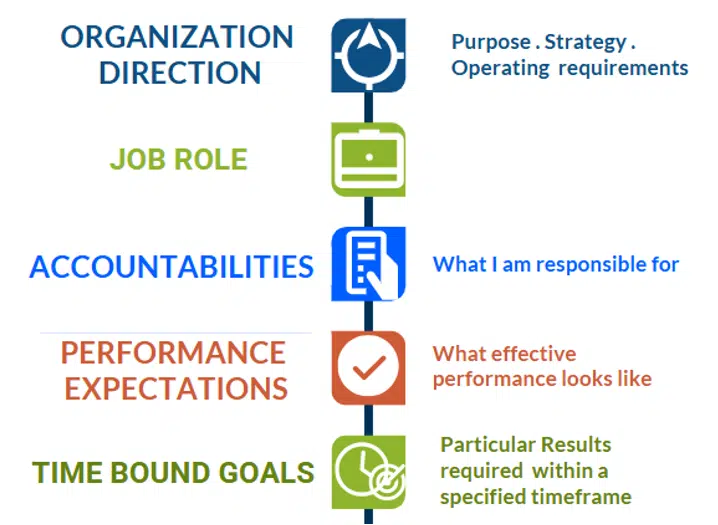
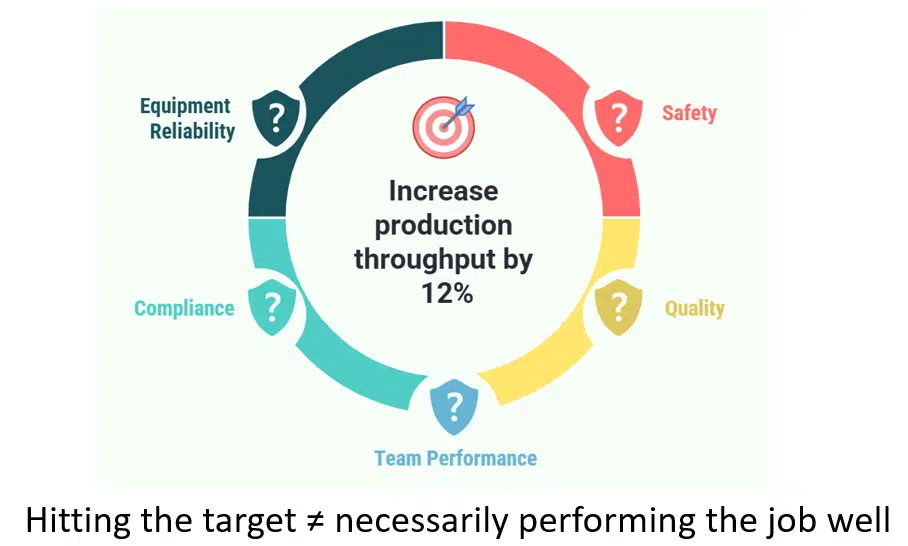
Any AI-observed behavior must therefore be traceable to an established performance expectation. If you can’t explain why the behavior or action matters to the work, it should not be used as a performance measure just because the technology can detect it.
Even where the connection appears credible, the organization should check.
- Does the behavior reliably distinguish effective from ineffective performance?
- Could there be different but equally effective approaches?
- Might the observation process result in a narrow focus on this target, behavior or action – with adverse consequences?
These questions should be answered before monitoring begins, not after employees have been scored.
The foundation remains the same whether evidence is recorded by a manager, generated by an operational system or inferred by AI: first define the work and the expected standard, then decide what evidence is relevant.
AI can identify a problem - but not necessarily its cause
AI may accurately detect that an employee responded slowly, departed from a standard process, spoke less than expected in a meeting or had an unsuccessful task outcome. What it cannot safely infer is why.
The same observable behavior can have very different causes. A delayed response might reflect insufficient knowledge, an unavailable system, conflicting priorities or the need to investigate a complex issue properly. A departure from an expected process might indicate poor understanding—or sound professional judgment in circumstances the process did not anticipate.
Possible causes of an apparent performance gap include:
- Expectations that were unclear, inconsistent or recently changed
- Insufficient knowledge, skill or practical experience
- Inadequate tools, information or resources
- Workload pressure or conflicting priorities
- Lack of authority to make the required decision
- Failures elsewhere in the process or system
- Adaptation to unusual circumstances
- Weak or no feedback or support
- Consequences that unintentionally discourage the expected behavior
- A genuine problem with effort, judgment or performance
Some of these causes sit with the employee. Others sit with the manager, the process or the organization.
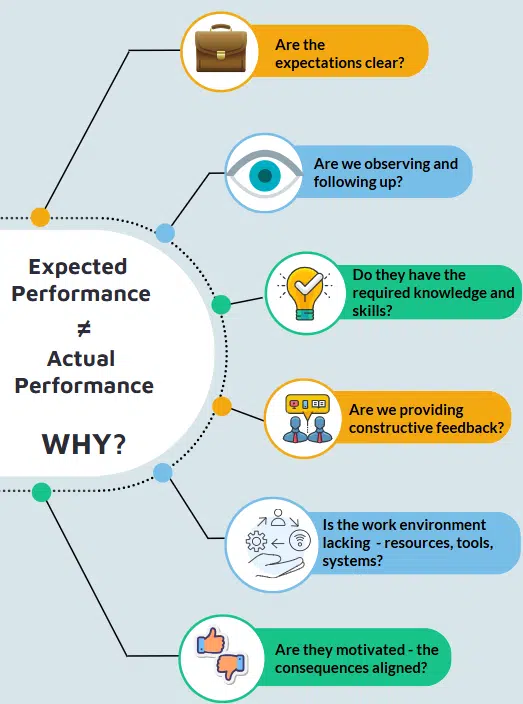
AI sees only part of this picture. It may analyze the recorded interaction without sufficient context – what occurred beforehand, what constraints applied, what information was available or why the employee chose a particular course of action.
Even when the observation itself is correct, the interpretation may not be.
Human review is necessary. It needs to involve more than confirming the AI’s conclusion. The reviewer should examine the underlying evidence, seek the employee’s explanation and consider the conditions surrounding the work.
This distinction affects what happens next. If the cause is a knowledge or skill gap, targeted learning, practice or assessment may be appropriate. If expectations were unclear, the manager needs to clarify them. If tools, authority or workload prevented effective performance, development activity will not solve the problem.
AI-generated performance data is a starting point – not the gap analysis itself. It should initiate a performance diagnostic process.
What makes an AI-generated observation valid performance evidence?
An AI-generated observation should not enter a performance record simply because the system produced it. Its value depends on whether it can support a fair and meaningful conclusion about the person’s work.
Before using an observation as performance evidence, organizations should apply several tests.
1. Relevant

Relates directly to an established requirement of the role, an agreed goal or core behavioral expectation, with a clear explanation of why it matters. Correlations with performance or assumptions are not enough.
2. Accurate

The underlying event is detected and reported correctly. Checking means access to the source data. Transcription errors, missing information and incorrect interpretation can all create an apparently precise but inaccurate record.
3. In Context

There must be context. A transcript may show what was said but not why it was said. Response time measures may not show the complexity of the issue. The employee’s explanation and other relevant evidence should be considered before a conclusion is reached.
4. Representative

AI may analyze only the activities captured by a particular system. Visible and easily measured behavior is reported while other important contributions are not. A large quantity of data does not correct a biased or incomplete sample.
5. Transparent

Employees should know what information is being collected, what the AI is assessing and how the resulting observations may be used. They should be able to see relevant evidence, identify inaccuracies, provide context and challenge an interpretation before it contributes to a consequential decision.
6. Proportional

The strength of the evidence should match the significance of the decision. The more consequential the decision, the stronger, more complete and more independently reviewed the evidence should be.
These tests do not require organizations to reject AI-generated observations. They distinguish between a useful signal and defensible performance evidence.
AI can help direct attention and organize information. The organization remains responsible for determining whether that information is relevant, accurate, contextualized and sufficiently robust for its intended use.
Coaching evidence is not automatically assessment evidence
AI-generated observations can be useful without becoming part of a formal performance assessment.
A tentative pattern might prompt a manager to review a session, ask a question or offer feedback. An employee might use AI-generated suggestions privately to reflect on communication, prepare for a conversation or identify an area they want to develop.
These are relatively low-consequence uses. The observation initiates reflection or discussion; it does not establish a judgment about the person’s performance.
The position changes when the same information is used to:
- Contribute to a formal performance rating
- Compare or rank employees
- Influence pay, promotion or access to development opportunities
- Identify someone as a performance risk
- Begin a disciplinary or capability process
- Support decisions about continued employment
Evidence used for these purposes requires a much higher standard of relevance, accuracy, context and review.

If employees are told that a tool is intended for coaching or quality improvement, information collected through it should not subsequently be used for formal assessment without clear notice, appropriate consultation and further validation.
Not every useful observation needs to become permanent performance evidence. Development depends on a degree of psychological safety. Employees are less likely to experiment, acknowledge uncertainty or discuss their difficulties openly if every interaction may later be used to evaluate them.
Employees need to see and challenge the evidence
Telling employees that AI is being used is not the same as making its use transparent. An employee may know that meetings or work activities are being analyzed. But they may not know what actions, behaviors or results are involved, how they are converted to flags or scores, who can see them, how long they are kept and what decisions they influence.
If AI-generated observations are used in performance management, employees need access to the relevant underlying evidence and a meaningful opportunity to respond, including the option to:
- Correct factual or transcription errors
- Explain the circumstances surrounding an event
- Identify important work or outcomes the system did not capture
- Challenge whether the observed behavior is relevant to their role
- Question how the AI reached its interpretation
- Ask for an appropriately qualified person to review the evidence
- Add their response to the formal record
AI-generated language can appear more objective than it is. A precise score, confidence percentage or risk label may give an interpretation undue authority, even when it is based on incomplete information or assumptions that have not been exposed or validated.
The manager must remain willing to disagree with the system. Human oversight has little value if the reviewer simply accepts the AI’s framing and asks the employee to disprove it.
Transparency also needs to operate at the organizational level. Employees and their representatives should understand why the technology is being introduced, what problem it is intended to solve and what limits will apply to its use.
A fair process does not require employees to understand the technical workings of the model. It does require them to understand what is being assessed, see the evidence that affects them and have a genuine opportunity to influence the conclusion.
Where does the information go - and what else can it be used for?
AI performance monitoring creates risks beyond the accuracy of the resulting assessment.
To analyze work, the system may receive recordings, transcripts, messages, documents, customer interactions and system activity. This material can contain personal information about the employee and other people. It may also reveal customer information, internal processes, operating problems, commercial decisions and the organization’s intellectual property.
Removing an employee’s name or replacing it with an identifier does not necessarily resolve these concerns. The content itself may identify the people involved or disclose sensitive information about how the organization operates.
Before implementing an AI monitoring tool, organizations need clear answers to questions such as:
- What information is collected and from which sources?
- Is continuous collection necessary, or could a smaller sample meet the purpose?
- Where is the information processed and stored?
- Does it leave the organization’s systems or jurisdiction?
- Which AI models, vendors and subcontractors receive it?
- Is the information retained by the provider?
- Can it be used to train, test or improve external models?
- Who can access the original material, generated observations and performance reports?
- How long is each form of information retained?
- Can the information be combined with data collected from other systems?
- How will records be corrected or deleted?
- What happens to historical observations if the model, criteria or expected behaviors change?
Information collected to create meeting notes, support coaching or improve service quality should not automatically become performance evidence. Nor should performance data quietly be reused to train an automated replacement, build broader employee profiles or support unrelated workforce decisions.
Consent may not be enough to resolve this issue. Employees may have little practical choice about using a system introduced by their employer. Organizations must demonstrate that collection is necessary, proportionate, secure and consistent with the stated purpose.
These decisions should be made before data begins to accumulate. Once detailed behavioral information has been collected, it becomes much harder to prevent use expanding beyond its original purpose.
The question is therefore not only, “Can the AI assess this information?” It is also, “Should this information leave the work environment, who gains access to it, and what future uses are we permitting?”
Before introducing AI into performance management
Before AI-generated observations are used in performance management, organizations should be able to answer eight questions:
- Purpose: What problem are we trying to solve?
- Necessity: Is monitoring necessary, and is there a less intrusive way to achieve the same result?
- Relevance: What legitimate work expectation does each observation relate to?
- Validity: Has the behavior been identified accurately, and does it provide meaningful evidence of performance?
- Use: Is the information for reflection, coaching, quality assurance or formal assessment?
- Employee input: Can employees see, correct, explain and challenge the evidence?
- Information governance: Do we know what is collected, where it goes, who can access it, how long it is retained and whether it can be reused?
- Ongoing review: Will we monitor accuracy, unintended effects and expansion beyond the original purpose?
The answers should be established before information begins influencing managers’ judgments. Higher-consequence uses require stronger evidence, greater transparency and more rigorous human review.
AI can make aspects of work more visible. Governance determines whether that visibility supports better performance – or becomes surveillance without a sound performance management purpose.
AI should support judgment - not manufacture certainty
AI can help employees reflect, help managers identify patterns and bring more evidence into performance conversations. But increased visibility is not the same as increased understanding.
An AI system may accurately identify a behavior while misunderstanding its importance, context or cause. Human oversight provides little protection if the manager relies on incomplete evidence or accepts the AI’s interpretation without question.
The central question is not whether AI can observe performance. It is whether the organization can justify turning what it observes into evidence.
Build performance decisions on clear expectations and traceable evidence
Centranum connects ongoing job expectations, goals, organizational values, feedback, competency evidence, development activity and formal reviews within one performance and capability framework.
This gives managers and employees a shared reference point for performance conversations and a traceable evidence history across the review period. It also helps organizations distinguish between role requirements, demonstrated competence, development needs and performance outcomes, rather than reducing them to a single automated signal.
FAQs
What is AI performance monitoring?
AI performance monitoring uses artificial intelligence to analyze information about employees’ work or behavior. This may include recordings, transcripts, communications, customer interactions, system activity, work outputs or operational data. The AI may identify patterns, flag possible issues, generate summaries or produce scores for managers to review.
Can AI-generated observations be used in performance reviews?
They can contribute to a performance review, but they should not automatically be treated as established facts. The observation should be relevant to a defined work expectation, accurately represented, considered in context and open to employee response. Evidence used for consequential decisions requires a higher standard than information used to prompt coaching or discussion.
Is AI-generated performance evidence objective?
Not necessarily. AI can apply criteria consistently, but the criteria, source data and interpretation may still be incomplete or biased. A precise score or confidence level does not guarantee that the observation is relevant, accurate or fair.
Should employees be able to see AI-generated performance evidence?
Yes. Employees should understand what is being assessed and be able to see relevant evidence, correct errors, explain the context and challenge an interpretation before it contributes to a significant performance decision.
Can a human manager rely on an AI recommendation?
A manager can consider an AI-generated signal, but should review the underlying evidence and investigate the circumstances rather than simply approve the recommendation. Human involvement is not an effective safeguard if the manager cannot question the system or understand the limitations of its information.
What should organizations check before introducing AI performance monitoring?
Organizations should define the purpose, establish which work expectations the observations relate to, validate the interpretation, set limits on permitted uses, provide employee access and challenge processes, and decide how information will be processed, stored, retained and protected. They should also review whether the monitoring remains necessary and proportionate over time.