

What Is Competence?
What is competence?
Competence is the demonstrated ability to perform effectively to a required standard in a specific context. It is not simply a list of skills, qualifications, or behaviours, but the proven application of those elements in real work situations, supported by evidence and assessment.
Organisations that clearly define, assess, and maintain competence gain:
- clearer role expectations & standards
- safer, more consistent performance
- stronger development and progression decisions
- reduced operational and compliance risk
Because competence is often confused with related terms such as competency, skills, capability, and proficiency, the sections below explain how competence fits within broader workforce frameworks.
Definition, Meaning, and Application in the Workplace
Competence refers to a person’s demonstrated ability to perform effectively in a specific role or context.
In the workplace, competence is not just what someone knows or has been trained in — it is what they can consistently apply, under real conditions, to achieve required outcomes.
In simple terms: Competence is proven performance, not potential.
Related definitions & frameworks (competency, capability, proficiency, skills)
Competence is closely connected to several other workforce concepts. If you’re comparing related workforce terms, the links below explain in more detail how competency, capability, skills, and proficiency differ and how they’re used in practice.
Capability-competency-skills-proficiency-competence (differences and resource hub)
What is a competency? (definition + examples)
What is a competency model? (structure + levels)
What are core competencies? (values, culture, citizenship behaviours)
What are proficiency levels ( progression pathways)
Capability vs competency (what each term includes)
Capability, competency & skills — what’s the difference? (integrated model)
Competence debt (why evidence decays over time)
These resources expand on specific aspects of competence. This page explains what competence is and how it is demonstrated in workplace settings.
What Does Competence Mean in Practice?
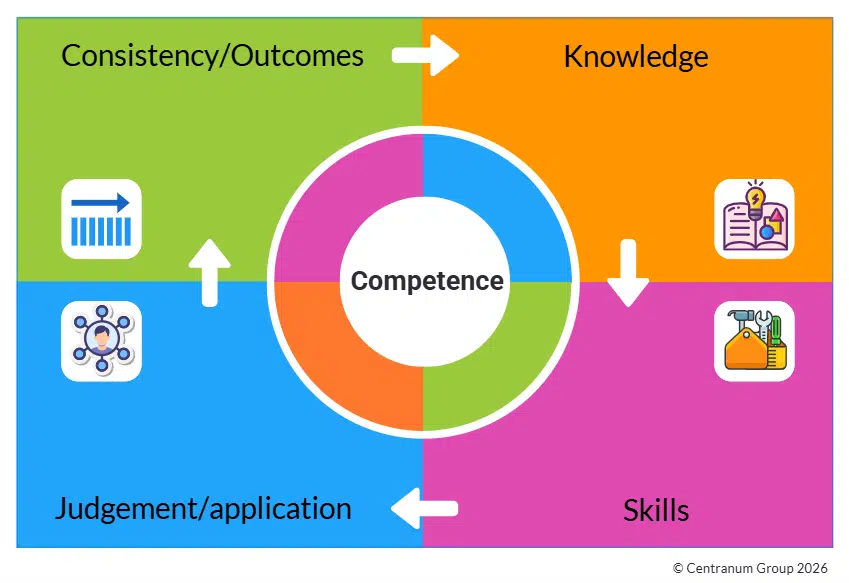
Competence combines several elements, all of which must be present:
- Relevant knowledge – understanding what needs to be done and why
- Practical skills – the ability to carry out tasks and activities
- Judgement and application – knowing how to act in different situations
- Consistency – performing reliably over time
- Context – meeting the expectations of a specific role, environment, or standard
This is why competence cannot be confirmed by training completion or qualifications alone. Those factors indicate capability, but competence requires evidence of application in real work.
Competence in the Workplace
In organisational settings, competence is used to answer practical questions such as:
- Is this person ready to perform this role safely and effectively?
- Can they operate independently, or do they require supervision?
- Are they prepared for progression, mobility, or increased responsibility?
- Can the organisation demonstrate competence for audit or regulatory purposes?
Workplace competence matters most in roles where performance affects:
- safety or quality
- compliance and professional standards
- customer or patient outcomes
- operational continuity
Competence vs Competency (and Why the Terms Are Often Confused)
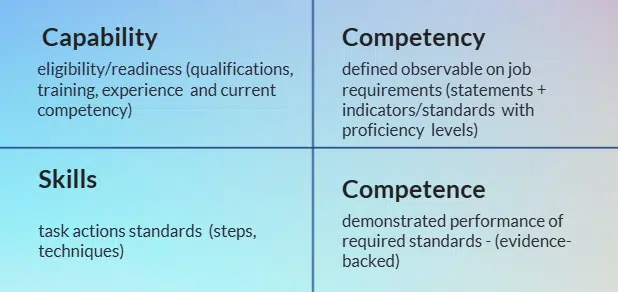
The terms competence and competency are closely related and often used interchangeably, but in practice they serve different purposes.
- Competence refers to the state of being competent — the demonstrated ability to perform effectively.
- Competencies are the defined components used to describe, assess, and evidence that competence.
A competency framework breaks competence down into:
- defined competencies (e.g. “Clinical Assessment”, “Equipment Maintenance”, “Stakeholder Communication”)
- observable indicators or behaviours
- proficiency levels
- measurement method
- evidence requirements
For a deeper explanation, see: Competence or Competency
Skills and competence in the workplace
Skills are an important part of competence — but they are not the same thing.
- Skills are discrete task-level abilities (what someone can do).
- Competence is the correct application of those skills, supported by knowledge and judgement, in context.
For example:
- A person may have the skill to operate equipment.
- Competence requires operating it safely, correctly, and consistently under real conditions.
In many roles, especially regulated or high-risk ones, skills must be verified and evidenced as part of demonstrating competence.
If you’re comparing framework terms, see Capability- Competency-Skills – what’s the difference
Capability evidence and competence
Capability describes potential; competence describes performance.
Capability includes qualifications, certifications, training, experience, and licenses.
These indicate readiness but do not confirm effectiveness.
Competence answers the follow-up question:
Can the person actually perform to the required standard in this role?
Robust workforce systems recognize both:
- Capability as the foundation
- Competence as the evidence
Proficiency scales used to assess competence
Competence indicates achievement of a required performance standard.
Proficiency describes variations in the levels of those standards.
A person becomes competent when they can perform the task as required.
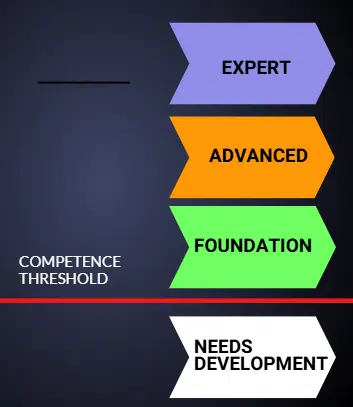
Proficiency levels are usually described in terms of levels of mastery for example
Developing Learning to perform with supervision
Foundation Performs to standard independently
Advanced Performs in new and unexpected situations
Expert Innovates and/or teaches others
or by Seniority or Complexity Level – example
- Level 1 – Minimum entry level
- Level 2 – Independent operator
- Level 3 – Team Leader
- Level 4 – Manager/Specialist – puts processes and policies in place
- Level 5 – Senior manager or specialist – designs processes and policies
- Level 6 – Executive/Strategist – prompts innovation – sets directions
For proficiency level examples and rating models, see What Are Proficiency Levels?
How Competence Is Structured in Organizations
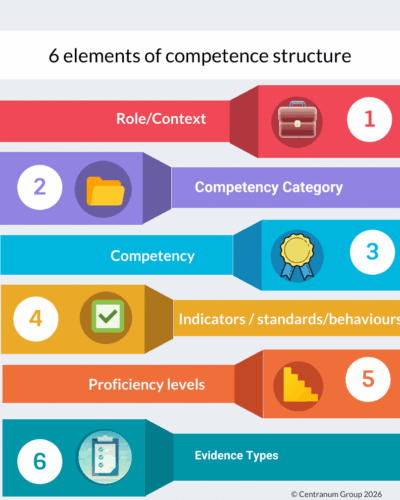
In practice, competence is usually structured through a framework that includes:
- Role or job context
- Competency categories (e.g. technical, clinical, professional)
- Defined competencies
- Indicators or behaviours that show effective performance often at
- Proficiency levels (e.g. Foundation → Advanced → Expert)
- Measurement method
- Evidence requirements (observation, assessment, work artefacts, sign-off)
This structure allows organisations to assess competence consistently across teams, locations, and role types.
How Competence Is Assessed
Competence is typically assessed using one or more of the following methods:
- Direct observation
- Structured assessments or checklists
- Knowledge testing linked to competencies
- Review of work outputs or artefacts
- Supervisor or assessor sign-off
- Periodic revalidation
The key principle is that competence must be observable and defensible, particularly where decisions affect safety, pay, progression, or compliance.
Why Competence Is Often Hard to See
Many organisations assume competence based on:
- training completion
- tenure or experience
- self-assessment
- role assignment
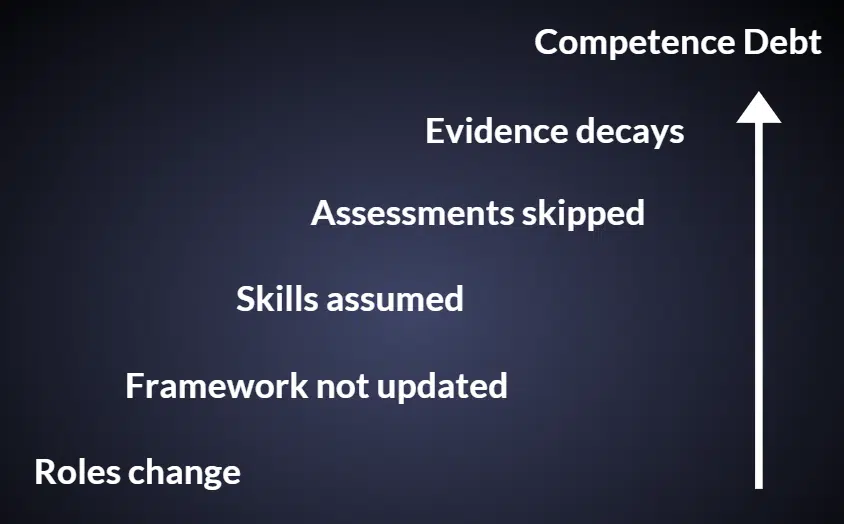
Over time, this creates competence debt — a gap between what is assumed and what can be evidenced.
This risk is highest when:
- roles change faster than frameworks
- assessments are infrequent or informal
- evidence is scattered across systems
See also: Competence Debt Diagnostic
Why Competence Matters More Now
As organisations plan for 2026 and beyond, competence has become more critical due to:
- skills-based pay and progression models
- increased workforce mobility
- regulatory scrutiny and audit requirements
- AI-generated skills profiles and inferred capability
- succession and readiness planning
In all of these areas, unverified skills and assumptions are no longer sufficient. Decisions require competence data that is structured, current, and defensible.
How Competence Is Used in Practice
When defined and assessed properly, competence supports:
- performance diagnostics and development planning
- safe and effective onboarding
- internal mobility and career progression
- succession planning
- compliance and audit readiness
Competence does not replace performance management or job expectations — it complements them by providing evidence of readiness and effectiveness.
How Centranum Supports Competence
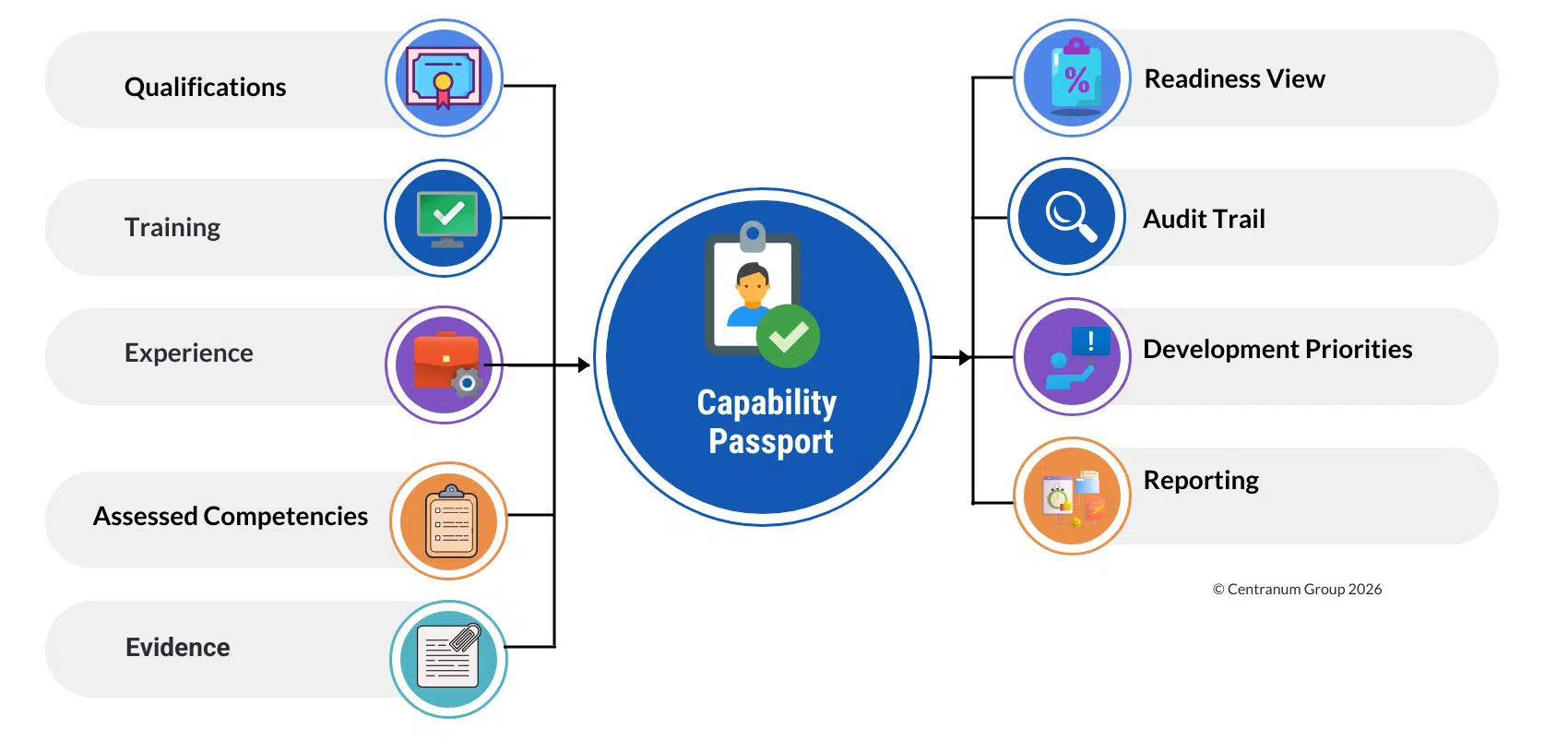
In Centranum’s platform, competence is not a theoretical construct — it’s a verifiable state recorded and maintained within each person’s Capability Passport.
The Capability Passport brings together:
- All capability factors — qualifications, certifications, training records, and experience
- Competency assessments — formal evaluations of skill and behavior performance showing
- The latest proficiency level or competence rating, confirming that required standards are achieved
This unified view allows managers and professionals to see not only what people know and can do, but also what they have proven they can perform — their current, validated competence.
In practice, competence becomes a living record of demonstrated performance — continuously updated as new training, experience, and assessments occur.
Make competence visible and defensible
Many organisations define competence, but struggle to maintain clear, current evidence of who is actually competent to perform critical work.
Centranum supports competence as a verifiable, living record — linking role requirements, proficiency levels, assessments and evidence in each person’s Capability Passport.
See how it works in Centranum:
- capability requirements and role expectations
- competence assessment and evidence capture
- capability passports that show verified competence over time
- reporting for readiness, mobility and compliance
If you’re reviewing competence frameworks or evidence practices:
Related Reading
If you’re exploring how competence fits into your organisation, you may find these resources useful:
FAQ
What is competence in the workplace?
Workplace competence is the demonstrated ability to perform a role or task to a required standard in real conditions. It requires evidence of performance, not just qualifications or training.
What is the difference between competence and proficiency?
Competence confirms that a required standard has been achieved. Proficiency describes how well that standard is demonstrated, often using levels such as developing, foundation, advanced or expert.
Can someone be proficient but not competent?
No. Proficiency levels are part of demonstrating competence. A person is not considered proficient until they can perform to the required standard in context.
How are proficiency levels typically defined?
Proficiency levels may reflect mastery (e.g. developing to expert), independence, complexity, or seniority. The key requirement is that levels are clearly defined and consistently assessed.
How is competence recorded in Centranum?
Competence is recorded within each person’s Capability Passport, combining assessed competencies, proficiency levels, evidence and supporting capability factors such as qualifications and training.
Does training completion prove competence?
No. Training supports capability readiness, but competence requires demonstrated performance and evidence that standards have been met in practice.
How often should competence be reassessed?
This depends on role risk and context. High-risk clinical or technical tasks often require periodic revalidation, while other roles may reassess competence after role changes, incidents or development activities.
What is competence debt?
Competence debt builds when competence frameworks and evidence are not maintained over time. Organisations continue to assume competence, but cannot consistently verify it when decisions or audits require proof.
Is competence the same as performance?
Competence supports performance but is not the same thing. Performance management focuses on outcomes and behaviours, while competence confirms readiness and capability to perform role requirements.
Can AI-generated profiles be used to confirm competence?
AI can assist with identifying potential skills or experience, but competence decisions require assessment and evidence aligned to defined standards.
Why is consistency important when assessing competence?
Without shared definitions, proficiency levels and evidence requirements, competence assessments vary by assessor or location, reducing reliability and trust.