

Artificial intelligence is already changing how work gets done. Across industries, AI is automating or accelerating routine work, while humans focus more on judgement, problem solving, and complex decisions.
Many organisations are investing heavily in AI training programmes, and governments and workforce agencies are doing the same. For example, Singapore recently announced initiatives to develop 100,000 AI-capable workers by 2029, recognising that AI will affect work across many professions.
However, training alone is not enough. If job structures and capability frameworks remain unchanged, organisations will struggle to translate AI capability into productivity or innovation.
The key step is job redesign.
What AI Job Redesign Means
AI job redesign involves reviewing how work is performed and updating roles to reflect the changing balance between automation, AI-supported work, and human judgement.
AI typically affects work first at the task level. Some activities may be automated or accelerated, while others become supported by AI tools. As these changes accumulate, the mix of responsibilities within a role shifts.
Over time this can lead to:
- less routine preparation or processing work
- greater emphasis on analysis and decision support
- new responsibilities for validating or supervising AI-supported outputs
When the balance of work changes, organisations need to review whether the overall role design still makes sense.
Job redesign therefore ensures that roles remain coherent, meaningful, and aligned with how work is actually performed.
Why Job Redesign Matters
Introducing AI tools without reviewing job design often creates confusion. Employees may be unsure:
- when to rely on AI and when to apply their own judgement
- who is accountable for AI-assisted outputs
- how responsibilities within their role have changed
Managers may also find that workloads become uneven as some tasks disappear while new responsibilities emerge. As a result, organisations may experience:
- duplicated or inconsistent work processes
- unclear accountability for decisions
- under-utilized AI capabilities
- outdated job descriptions and competency frameworks
Job redesign helps organisations translate AI adoption into clear roles, defined responsibilities, and realistic capability requirements.
Starting with Task-Level Analysis
Most AI-driven job redesign begins by examining the tasks that make up a role.
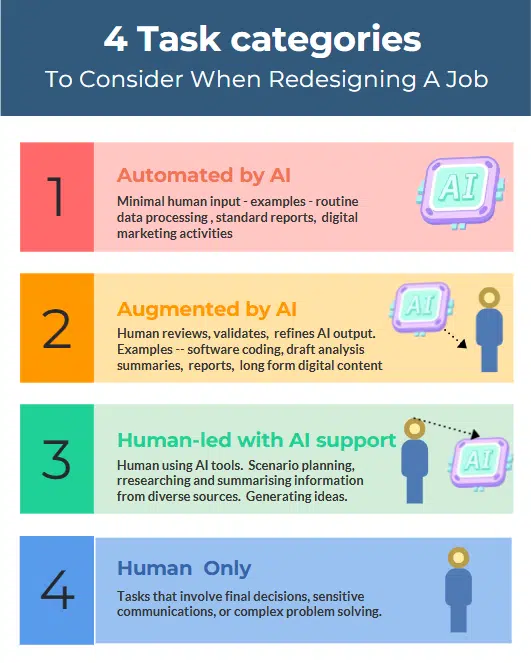
A structured task review helps organisations determine how AI may affect different types of work and provides the foundation for reviewing responsibilities and role scope. A practical approach is to review tasks using four categories:
- Automated by AI – AI performs the task with minimal human involvement. Examples may include data extraction, routine document processing, or standard reporting.
- Augmented by AI – AI produces a substantial output that a human reviews, validates, or refines. Examples include draft reports, analytical summaries, or initial recommendations.
- Human-led with AI support – The human performs the task but uses AI tools to assist parts of the work. Examples include exploring alternative scenarios, summarizing background information, or generating ideas.
- Human-only – Tasks that require judgement, accountability, ethical consideration, or interpersonal interaction. Examples include final decisions, sensitive communications, or complex problem solving.
Determining How AI Can Affect Tasks
To apply these categories effectively, organisations should evaluate tasks against several practical criteria:
- Repetition and standardization – Tasks that follow consistent rules or formats are often easier to automate.
- Data structure – Work involving structured information or large volumes of data may be well suited to AI processing or summarization.
- Judgement and accountability – Tasks requiring professional judgement, contextual interpretation, or responsibility for outcomes typically remain human-led.
- Risk and governance – Activities involving compliance, safety, financial risk, or people decisions often require human oversight even if AI assists with analysis.
- Interaction and relationship management – Work involving negotiation, trust, or complex interpersonal communication usually remains primarily human.
Using these criteria allows organisations to identify where AI can realistically support work without creating governance or quality risks.
From Task Changes to Role Redesign
Once tasks are reviewed, organisations can assess how the balance of responsibilities within the role changes.
Key questions include:
- Which responsibilities remain central to the role?
- Which activities reduce significantly due to automation?
- Are new responsibilities emerging, such as validating AI outputs or supervising AI-supported processes?
- Does the role still represent a coherent and sustainable workload?
Answering these questions helps organisations determine whether the role simply evolves or requires broader redesign.
Example: Redesigning an Analyst Role for AI
To illustrate job redesign in practice, consider a typical business or reporting analyst role. Traditionally, a large portion of the role is devoted to gathering, preparing, and summarizing information. Typical responsibilities include:
- collecting data from multiple systems
- preparing spreadsheets and reports
- analyzing trends and identifying issues
- producing summaries for managers
- supporting decision-making with analysis
In many organisations, significant time is spent on data preparation and report drafting, rather than interpretation.
How AI affects the tasks
AI tools can now support or automate several of these activities. Examples include:
Automated or accelerated tasks
- extracting and consolidating data, generating standard reports
- producing first drafts of analytical summaries
AI-augmented tasks
- identifying patterns in data
- generating scenario comparisons
- drafting explanations of trends
Human-led tasks
- Interpreting results in organisational context
- Determining implications for business decisions
- Advising managers on possible actions
Human only tasks
- Final decisions and accountability (e.g. hiring decisions, approvals, risk acceptance).
- Sensitive interpersonal interactions such as negotiations, conflict resolution, coaching
- Complex judgement in ambiguous situations, where context, ethics, or organisational understanding are critical.
How the role may evolve
As preparation work is reduced, the balance of responsibilities shifts. Less time is spent on;
- manual data preparation
- routine report generation
- drafting basic summaries
More time can be devoted to:
- reviewing and validating AI-generated analysis
- identifying anomalies or emerging trends
- providing decision support and insight
- investigating issues highlighted by AI analysis
The role therefore becomes more focused on interpretation, insight, and decision support, rather than routine preparation work.
Capability implications
As the role evolves, new competencies may become important, including:
- evaluating and validating AI-generated analysis
- using AI tools effectively in analytical workflows
- communicating insights clearly to decision-makers
- maintaining accountability for AI-supported recommendations
These capabilities can then be incorporated into updated role requirements and competency frameworks.
A Practical Approach to AI Job Redesign
AI-driven job redesign does not require a complete organisational overhaul. In most cases, organisations can follow a structured process that begins with understanding how work is currently performed and then reviewing how AI may change it.
The following steps provide a practical starting point.
1. Analyse the Tasks That Make Up the Role
Begin by identifying the key activities performed within the role. This typically includes reviewing:
- routine operational tasks
- analytical or decision-support activities
- coordination or communication responsibilities
- governance, compliance, or oversight work
Breaking the role down into tasks makes it easier to assess where AI may automate, augment, or assist work.
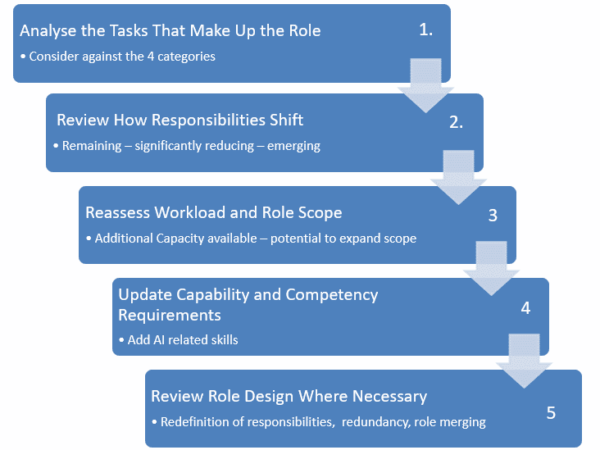
2. Review How Responsibilities Shift
Once tasks are assessed, review how the overall mix of responsibilities within the role changes. Key questions include:
- Which responsibilities remain central to the role?
- Which activities reduce due to automation or AI support?
- Are new responsibilities emerging, such as validating AI outputs or supervising AI-supported processes?
This step ensures the role reflects the work that actually needs to be done.
3. Reassess Workload and Role Scope
If AI reduces the time required for certain tasks, the role may gain additional capacity. Organisations should review:
- whether the remaining responsibilities still represent a full workload
- whether additional analytical, advisory, or improvement work should be added
- whether some responsibilities should shift between roles
The goal is to ensure the role remains coherent and productive, rather than simply removing tasks.
4. Update Capability and Competency Requirements
When responsibilities change, the capabilities required to perform the role often change as well. Examples may include competencies such as:
- evaluating AI-generated outputs
- supervising AI-supported workflows
- applying judgement in AI-assisted decision-making
- communicating insights derived from AI-supported analysis
Updating capability and competency frameworks ensures that organisations can:
- assess workforce readiness
- identify capability gaps
- guide development and training
5. Review Role Design Where Necessary
In some cases, the cumulative impact of AI may require broader role redesign. This might involve:
- expanding the role to include additional analysis or advisory work
- redefining responsibilities within the role
- merging or redistributing responsibilities between roles
Not all roles will require structural redesign. Many will simply evolve as responsibilities shift.
The objective is to ensure that roles remain aligned with how work is actually performed in an AI-enabled environment.
The New Reality: Managers Leading Hybrid Teams

AI adoption changes not only operational roles but also how managers lead their teams.
As AI tools become integrated into workflows, managers increasingly oversee hybrid environments where work is performed by both people and AI-supported systems. This shifts management responsibilities toward:
- overseeing AI-supported workflows and outputs
- defining when decisions rely on AI analysis versus human judgement
- monitoring the reliability of AI-assisted processes
- helping teams use AI tools effectively while maintaining accountability
As a result, management roles may need to evolve, and organisations may need to update management competency frameworks to reflect these responsibilities.
Using Role and Capability Frameworks to Support Job Redesign
Redesigning jobs in response to AI is easier when organisations have structured ways to define roles and capabilities. Three elements are particularly important:
- Role architecture – Clear definitions of job responsibilities and role scope.
- Capability requirements – The qualifications, experience, and knowledge required for redesigned roles.
- Competency frameworks – Observable skills and behaviours required to perform work effectively in AI-supported environments.
Together these structures help organisations ensure that redesigned roles are clearly defined, assessable, and aligned with workforce development.
How Organisations Can Start
Most organisations do not need to redesign every job immediately. A practical approach is to begin with roles where AI is already influencing how work is performed, such as:
- Digital marketing specialists (content creation, campaign analysis, SEO insights)
- Business and data analysts (report generation, trend analysis, forecasting support)
- Customer support and service roles (AI-assisted responses and knowledge retrieval)
- Operational coordinators (scheduling, reporting, and process monitoring)
- Financial analysts and reporting roles (data consolidation and analysis support)
- Human resources and talent specialists (screening, policy drafting, workforce analytics)
- Legal and compliance analysts (document review and regulatory research)
Starting with roles where AI tools are already being adopted allows organisations to develop repeatable approaches to job redesign that can later be applied more broadly across the workforce.
Related Reading
Skills for AI Readiness AI
AI and Employment: What the Research Shows
AI and Talent Decisions
AI in Competency Management
AI Governance and Risk Briefing
These resources explore the skills, governance frameworks, and workforce strategies organisations need as AI becomes integrated into everyday work.
FAQ
What is AI job redesign?
AI job redesign is the process of reviewing how work is performed and updating roles to reflect the changing balance between automation, AI-supported tasks, and human judgement.
Rather than simply introducing AI tools, organisations reassess responsibilities, workload, and capability requirements to ensure roles remain aligned with how work is actually performed.
How does AI change job roles?
AI typically changes jobs by automating routine tasks, augmenting analytical work, and shifting human effort toward judgement, interpretation, and decision-making.
As preparation work decreases, roles often evolve to include more analysis, oversight of AI outputs, and decision support responsibilities.
Which tasks should remain human-only when using AI?
Tasks that usually remain human-led include those involving final decisions and accountability, sensitive interpersonal interactions, and complex judgement in ambiguous situations.
Examples include hiring decisions, negotiations, conflict resolution, and decisions involving significant organisational risk.
How should organisations start redesigning jobs for AI?
A practical starting point is to review the tasks that make up a role and determine which can be automated, augmented, or supported by AI.
Organisations can then reassess how responsibilities shift, review workload and role scope, and update capability or competency requirements where needed.
Does AI eliminate jobs or change them?
In most cases, AI changes jobs rather than eliminating them entirely.
Automation often reduces time spent on routine preparation work, allowing employees to focus more on analysis, insight, decision support, and oversight of AI-supported processes.
Why are capability frameworks important when redesigning jobs for AI?
Capability frameworks help organisations ensure redesigned roles remain clearly defined and aligned with workforce development.
They provide a structured way to define role responsibilities, identify new capability requirements, and guide training or development as work evolves.