
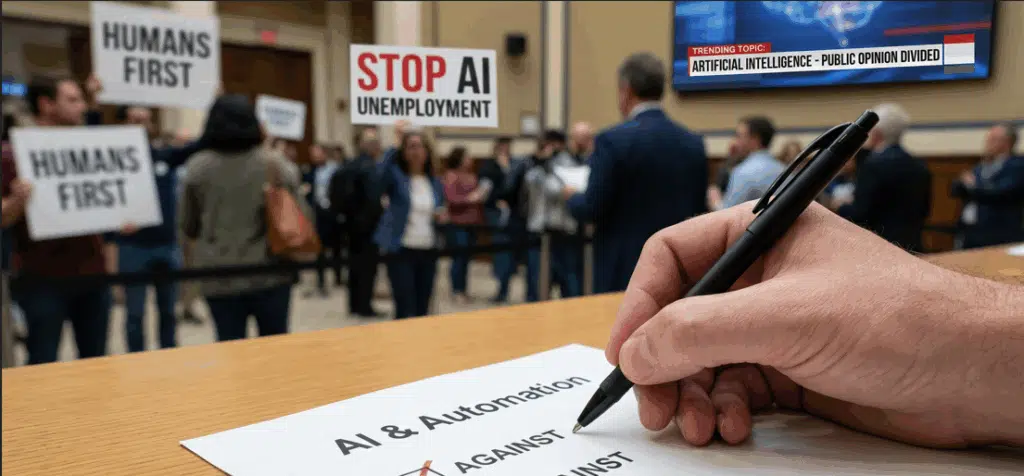
AI and Employment: Key Findings
Current research into AI and employment suggests that artificial intelligence is reshaping the workplace in several ways:
Most occupations are being restructured rather than eliminated, as AI assists individual tasks within jobs.
Entry-level roles may be most affected, because AI can replicate tasks based on codified knowledge.
Experienced workers often benefit, as AI complements expertise and judgement.
Productivity expectations may increase, potentially leading to work intensification.
Labour-market effects may include wage polarization and changes in hiring practices.
Organisations may need new competencies related to critical use of AI and managing highly automated work environments.
These patterns suggest that the primary impact of AI may be changes to how work is organized and how skills are used, rather than large-scale unemployment in the short term.
Understanding the labour market impact of AI also requires understanding how different types of AI systems actually work.
Dramatic Claims in the Media
Predictions about artificial intelligence and employment are becoming increasingly dramatic.
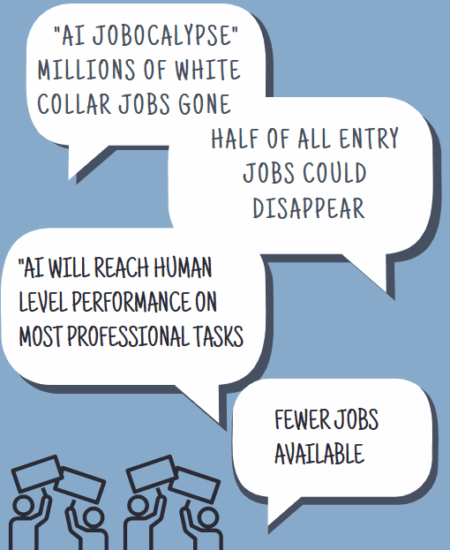
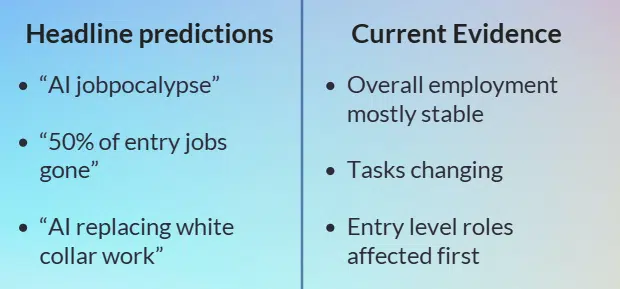
Andrew Yang recently warned that millions of white-collar workers could lose their jobs within the next 18 months, describing the situation as an “AI jobpocalypse.”
CEO of Gift Voucher Company Red Balloon says AI is quietly locking Americans out of the job market.
Other technology leaders have made similarly stark predictions.
Dario Amodei has warned that AI could eliminate a large share of entry-level white-collar roles, while Mustafa Suleyman has suggested that AI systems may reach human-level performance across many professional tasks within the next few years.
The technology company Cognizant has suggested that 93% of jobs will be affected by AI in some way.1
Public concern is rising as well. A recent poll by YouGov found that 62% of Americans believe AI will reduce the number of available jobs.
Yet the research evidence emerging so far suggests a more complex picture.
Why the Debate Exists

Predictions about artificial intelligence and employment vary widely. The technology firm Hostinger predicts a compound annual growth rate of 42% out to 2032. Some commentators warn that rapid advances in AI technology could lead to large-scale job losses, particularly in white-collar occupations where work involves analyzing information, writing reports, or generating digital content.
Others argue that such predictions overstate the likely impact. Historically, new technologies have tended to change how work is performed rather than eliminate large numbers of jobs outright. From this perspective, AI may increase productivity and reshape tasks within occupations without causing widespread unemployment.
A third view emphasizes that the impact of AI will depend less on technical capability alone and more on how organisations adopt the technology. Changes in workflows, business models, and skills requirements may determine whether AI primarily replaces labour or complements it.
Another important difference between these perspectives concerns the speed of change. Some analysts believe that AI could transform labour markets within a few years because the technology can be applied across a wide range of information-based work. Others argue that adoption will take longer, as organisations must redesign processes, adjust business models, and address regulatory and operational risks.
As a result, the debate about AI and employment is not simply about whether the technology can perform certain tasks. The key question is how quickly these capabilities will be integrated into real workplaces and labour markets.
What the evidence shows so far
Little overall impact to date
Some recent layoffs at companies such as Amazon and Salesforce have been attributed to AI. However, several recent studies4 find little evidence so far of large-scale job loss directly attributable to generative AI.
In the United States, since the release of generative AI tools in late 2022, employment in white-collar occupations with high AI exposure has declined slightly (around 1%), while overall employment has continued to grow. However employment in the computer systems design and related services sector has declined 5 percent.
At the same time, wage growth in these AI-exposed sectors has outpaced the national average, suggesting that AI may be augmenting workers rather than replacing them.²
There are indications that employment among younger workers may be more affected. Some studies suggest that job opportunities for workers under 25 have declined in occupations with higher exposure to generative AI.³
The World Economic Forum’s (WEF) Future of Jobs Report 2025 projects 92 million roles displaced worldwide by 2030. This includes roles lost to advancements in automation and robotics. The report also projects the creation of around 170 million new roles, with roles eliminated and recreated faster than workers can realistically reskill. The net gain of 78 million roles is likely to be in technical, supervisory, and human-machine collaboration areas.
These findings suggest that AI is currently changing how work is performed more than it is eliminating jobs outright.
Lessons from Earlier Automation
Evidence from previous waves of automation also suggests that employment effects often unfold gradually.
Highly automated roles already exist in sectors such as food service, where technologies like self-service ordering kiosks and robotic cooking systems are increasingly common. Despite the high theoretical automation potential of many tasks in this sector, employment remains strong. Restaurants continue to rely heavily on workers because the work environment is complex and human labour often remains cheaper than fully automated systems.
Similar patterns can be seen in other industries. In banking, automated teller machines (ATMs) replaced many routine transaction tasks, but bank teller roles evolved toward customer relationships, financial services advice and product sales. In retail, self-checkout systems reduced demand for traditional cashier roles, but many workers shifted into positions such as customer service, shelf stocking, online order preparation and click-and-collect services.
These examples illustrate a common pattern: automation tends to change the mix of tasks within jobs before it eliminates occupations entirely.
Productivity Gains May Reduce Hiring Demand
One of the less discussed effects of AI is that higher productivity may reduce the need for additional hiring, even when existing jobs are not eliminated.
When technology enables workers to complete tasks more quickly, organisations may simply maintain output with fewer new employees rather than actively laying off staff. In this situation, employment growth slows because fewer additional workers are needed.
Recent commentary following U.S. employment reports suggests that some companies may already be taking a cautious approach to hiring while experimenting with AI tools that increase worker productivity. Some executives argue that AI allows existing teams to handle larger workloads.
For example, the CEO of RedBalloon has suggested that companies may increasingly “do more with the same team” as AI assists with administrative and knowledge tasks.
This effect — sometimes described as productivity-driven hiring slowdown — may be one of the earliest labour-market impacts of AI.
If employment effects are limited so far, the next question is which types of jobs may be most exposed to AI in the future.
How is AI changing Work
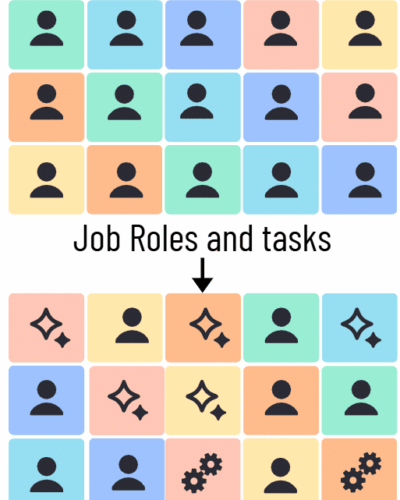
Most occupations consist of many different tasks. AI systems rarely replace an entire role. Instead they automate or assist with specific components of work.
Tasks most affected by AI tend to share several characteristics:
- information processing rather than physical activity
- structured or repeatable procedures
- reliance on documented knowledge rather than experiential judgement
- heavy use of written language
Examples include drafting documents, summarizing information, coding, translation and basic research.
As a result, AI often reconfigures jobs rather than eliminating them. Workers may spend less time on routine information processing and more time on interpretation, decision-making, or interaction with clients and colleagues.
In most occupations AI does not replace the entire job. Instead it alters the mix of tasks that make up the role. This is why many economists expect job redesign to be a more significant impact of AI than outright job loss.
Which jobs are most at risk of AI Exposure
Research consistently shows that AI affects information-processing work most strongly.
Examples of high exposure occupations:
- translators
- writers
- customer service agents
- journalists
- telemarketers
- sales representatives
Jobs with lower exposure include:
- construction
- maintenance
- agriculture
- equipment operation
The reason is simple:
AI works best when the task involves language, symbols, or data rather than physical interaction with the world.
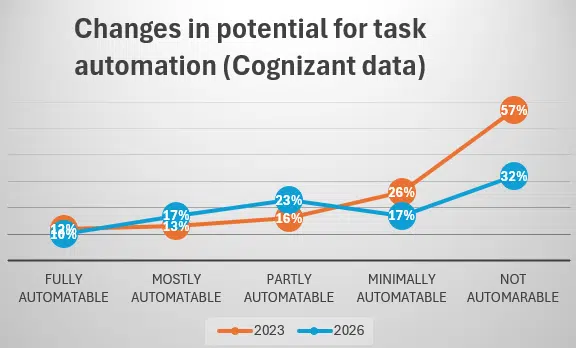
AI’s impact on work is increasingly understood in terms of task exposure rather than full job automation.
Analysis by Cognizant suggests that the share of tasks considered completely non-automatable has fallen significantly as AI capabilities improve. However, the proportion of tasks that can be fully automated remains relatively small, while the largest growth has occurred in tasks that can be partially or mostly assisted by AI systems.
In other words, AI is increasingly able to support parts of many tasks rather than replacing them entirely.
This finding is consistent with research from Anthropic, which analysed interactions with its Claude AI system. The study found that around 57% of AI use involved assisting humans with occupational tasks, rather than fully replacing those tasks.
A similar pattern appears in the MIT “Iceberg” project, which maps more than 32,000 skills across 923 occupations and estimates where current AI systems can perform those skills. The visible changes in technology sectors represent only a small share of total economic exposure. The researchers estimate that current AI capabilities affect work representing roughly $1.2 trillion in wages, but only a small fraction of this exposure has yet translated into direct job losses.
The implication is that AI is primarily restructuring the tasks within occupations rather than eliminating entire jobs.
If AI is changing the structure of work within roles, the next question is how these changes affect career pathways and organisational roles.
Entry-Level Career Pathways May Be Changing
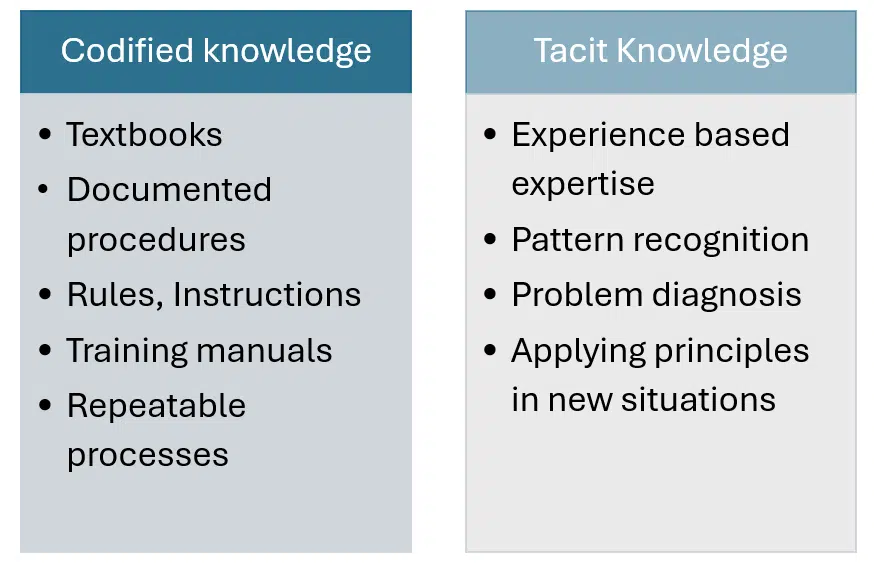
Research from the Federal Reserve Bank of Dallas distinguishes between codified knowledge—knowledge that can be documented in textbooks, manuals or databases—and tacit knowledge, which is developed through experience and practical judgement.
Generative AI systems are particularly effective at tasks that rely on codified knowledge. These include activities such as drafting documents, summarising information, preparing reports and conducting basic research. In contrast, tasks that rely heavily on tacit knowledge—such as interpreting complex situations, applying professional judgement or understanding organisational context—remain much harder for AI systems to replicate.
Because many entry-level roles are built around tasks involving codified knowledge, AI tools may reduce the need for some traditional early-career work. Evidence from labour-market analysis suggests that employment in AI-exposed industries has declined disproportionately among younger workers, particularly those under 25.
This raises an important workforce question. Many professions rely on junior roles as a way for employees to build experience. Tasks such as drafting reports, conducting research and preparing documentation often serve as training opportunities for early-career workers.
If these activities are increasingly handled by AI systems organizations are likely to;
- hire fewer entry-level workers
- expect new employees to arrive with stronger skills
- redesign traditional career pathways within professions
This does not necessarily eliminate jobs, but it may change how experience is acquired within organisations. The paradox is that AI skills acquisition depends on exposure in context and employer-supported training not easily accessed by job market entrants and those early in their careers.
Experience Is Becoming More Valuable
Early labour-market evidence suggests that the effects of AI differ significantly across experience levels.
Some studies indicate that employment declines in AI-exposed occupations have been concentrated among younger workers in early-career roles, where codified knowledge predominates, while more experienced workers using more tacit knowledge have seen stronger wage growth.
AI tools tend to assist tasks performed by experienced professionals while automating and reducing demand for some of the routine analytical work traditionally carried out by junior staff.
As a result, experienced workers may be able to complete certain tasks more efficiently while continuing to rely on judgement developed through practice and organisational knowledge.
In effect, AI may increase the value of experience even as it changes the pathways through which that experience is gained.
Advances in AI Reasoning Capabilities
Recent developments in generative AI models have also focused on improving structured reasoning capabilities.
According to analysis by Cognizant, new approaches such as structured reasoning frameworks and reinforcement-style fine-tuning allow AI systems to produce more transparent chains of reasoning. These systems can break down complex problems, test hypotheses and evaluate alternative strategies.
As a result, some forms of analytical work are becoming increasingly amenable to AI assistance. Tasks in fields such as consulting, finance and law may increasingly involve AI-supported analysis, where systems help construct models, identify patterns in data and generate structured recommendations.
However, these capabilities remain dependent on prompt design, data quality and human oversight. Even as AI systems become more capable of reasoning through problems, human judgement remains essential for interpreting results and making organisational decisions.
Agentic AI and Automated Workflows
Another emerging development is the use of agentic AI systems.
These systems can perform sequences of tasks autonomously, such as
- gathering information
- analyzing data
- producing reports
- recommending actions.
Rather than assisting with a single task, agentic AI can execute parts of or an entire workflow.
This raises questions about the future of some middle-management functions, particularly roles that involve coordinating information flows or producing routine analytical reports.
However, management roles that rely on judgement, organisational context, and interpersonal leadership are less easily automated.
These changes suggest that AI may reshape organisational structures and labour-market dynamics in ways that extend beyond individual job roles.
Management Roles and Organizational Structure
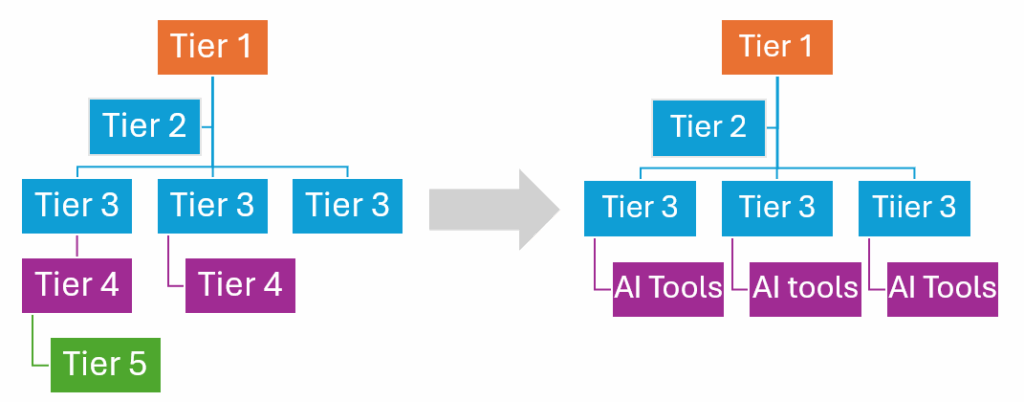
The growing capability of AI systems to analyze information, generate reports and automate parts of complex workflows raises questions about how organisations structure management roles.
Traditionally, middle management performs several key coordination functions within organisations. These include monitoring operational performance, synthesizing information from teams, coordinating work across departments and reporting progress to senior leadership.
Many of these activities involve processing and summarizing information — tasks that AI systems increasingly assist through dashboards, automated analytics and workflow platforms.
As a result, some analysts suggest that organisations may be able to operate with fewer layers of middle management, with remaining managers overseeing larger teams supported by AI-driven monitoring and reporting tools.
Similar questions are emerging in parts of the consulting industry. Much consulting work involves gathering information, analyzing data and preparing structured recommendations. Generative AI tools now allow organisations — particularly smaller firms — to perform some of these analytical tasks internally without relying on external advisors.
However management responsibilities include organisational judgement, resolving conflicts, motivating teams and interpreting complex business contexts. These aspects of leadership remain far harder for AI systems to replicate.
For this reason, many researchers expect AI to reshape managerial work rather than eliminate it entirely. Routine reporting and coordination tasks may decline, while greater emphasis may be placed on leadership, decision-making and organisational context.
Emerging Labour Market Effects
Evidence from labour-market studies suggests that AI will reshape employment in several ways. Some roles and tasks are likely to decline as automation expands, while new roles emerge around the development, supervision and use of AI systems.
For example, the World Economic Forum estimates that technological change could displace around 92–98 million jobs globally by 2030, while creating approximately 170 million new roles, resulting in net job growth but significant restructuring of occupations and skills.
Recent labour-market data also suggests that the impact of AI may fall unevenly across experience levels, with evidence of declining opportunities for younger workers in AI-exposed sectors — an issue discussed earlier in this article.
Beyond direct job displacement, AI adoption may also reshape labour markets through gradual changes in wages, work intensity and hiring practices.
Wage Polarisation Is Possible
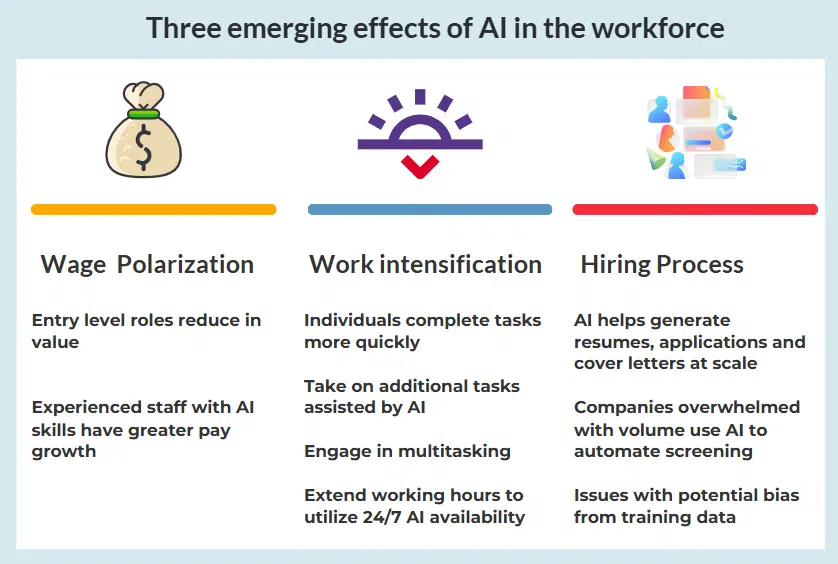
Several economic analyses suggest that AI adoption could increase wage inequality across occupations.
Workers who are able to use AI tools effectively often command significant wage premiums, in some studies reaching around 20–25%. At the same time, AI may increase demand for complementary capabilities such as digital literacy, collaboration, judgement and domain expertise.
Meanwhile, routine information-processing tasks — particularly those involving codified knowledge — may decline in value as AI systems perform them more efficiently.
These dynamics could lead to labour-market polarisation, where workers who can effectively use AI tools benefit from higher productivity and wages, while roles centred on routine knowledge work face downward pressure.
AI and the Explosion of Job Applications
AI is also changing the hiring process itself.
Generative AI tools allow job seekers to rapidly generate customized resumes, rewrite cover letters and tailor applications to specific job descriptions. This makes it easier for candidates to rapidly apply to a large number of roles.
As a result, some organisations report significant increases in application volumes, resulting in a feedback loop;.
- AI helps applicants generate more applications
- employers adopt AI screening tools to process them
- concerns emerge about algorithmic bias and transparency
Regulators in several jurisdictions have already warned that automated hiring systems may introduce discrimination if algorithms rely on biased training data or poorly designed selection criteria.
AI May Increase Productivity Expectations and Work intensification
AI tools allow workers to complete some tasks much more quickly. However, in many organisations the result is not necessarily reduced workloads.
Rather than eliminating tasks, AI may enable workers;
• to take on more tasks
• complete them more quickly
• engage on more multitasking across projects
Combined with the constant availability of digital tools, this may contribute to higher levels of cognitive workload and increased burnout risk.
Risks for Decision Quality and Skills
Decision Quality Risks
A further challenge arises from how people interact with AI systems.
Generative AI produces outputs that are often fluent and convincing. This can create a risk of uncritical acceptance, particularly when users assume the technology is more reliable than it actually is.
Research in decision support systems shows that users may:
- over-trust automated recommendations
- fail to verify incorrect outputs
- rely on AI suggestions even when they conflict with professional judgement
This highlights the importance of developing the skills needed to use AI critically and effectively.
Skills degradation and over-reliance on AI
A related risk of widespread AI use is skills degradation.
When technology performs tasks that workers previously carried out themselves, the opportunity to practice and develop those skills may decline. Over time this can weaken individual expertise and reduce organisational capability.
This phenomenon has been observed with other forms of automation. For example, increased reliance on navigation systems has been linked to declines in spatial navigation skills, while highly automated aviation systems have raised concerns about pilots losing manual flying proficiency.
Similar dynamics may occur with generative AI tools.
If AI systems routinely perform tasks such as drafting documents, analysing data, coding or summarising research, workers may gradually lose familiarity with the underlying processes involved in producing those outputs.
In knowledge-based work this creates a particular risk. If individuals rely heavily on AI-generated answers without understanding how the conclusions were reached, their ability to critically evaluate those outputs may decline over time.
This creates a paradox: the more capable AI systems become, the more important human expertise may be for identifying errors, questioning assumptions and applying judgement in complex situations.

In the extreme, widespread reliance on AI systems could create a workforce that is highly dependent on automated tools but less capable of performing core analytical tasks independently.
For organisations, this suggests that the effective use of AI may require active management of skill development, ensuring that employees continue to build underlying capabilities rather than becoming passive users of automated tools.
AI Is Changing Skill Demand More Than Employment
Shifts in capability requirements
One of the most consistent findings across recent studies is that AI changes the skills required within jobs rather than eliminating them entirely.
As AI tools become embedded in everyday work, demand is increasing for capabilities such as:
- AI literacy – understanding how AI systems work and what their limitations are
- digital and data skills – working with structured information and automated tools
- critical evaluation of AI output – verifying and questioning automated results
- ethical judgement in technology use – recognizing privacy, bias and governance risks
- effective use of AI tools in work processes – using AI systems to draft, analyze and organize information productively
At the same time, capabilities that AI struggles to replicate may become more valuable, particularly those involving professional judgement and contextual understanding. This includes the ability to interpret complex situations, apply experience, and make decisions where information is incomplete or ambiguous.
Economists often describe this dynamic as AI complementarity: workers who can combine human judgement with AI-assisted analysis become significantly more productive.
New Competencies May Be Emerging
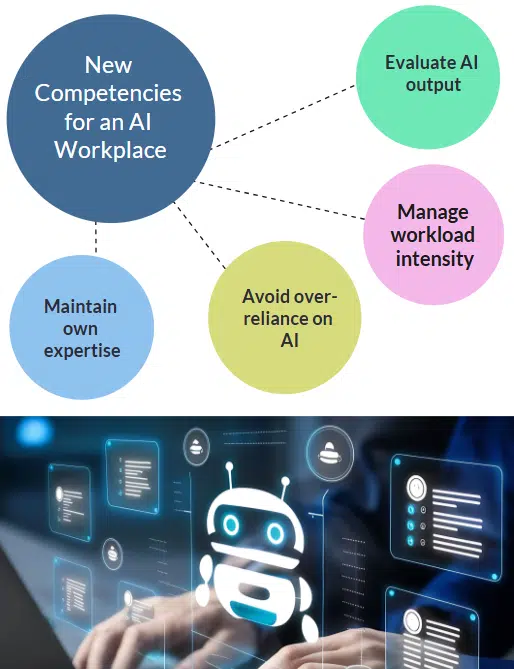
As AI becomes embedded in everyday work, organisations may need to develop new competencies related to working effectively with these systems.
In some cases, employees may feel pressure to keep pace with colleagues who are heavily using AI tools, creating a new form of productivity competition within knowledge work.
So, while much discussion about AI focuses on technical skills, another set of capabilities may become increasingly important: how individuals manage their work when AI tools dramatically increase productivity.
Research on the use of generative AI suggests that many employees actively choose to use these tools to complete tasks more quickly and to take on additional work. In many cases this behaviour is voluntary rather than imposed by employers, as workers explore the potential of AI assistance.
This creates new challenges for how work is managed.
As AI systems allow tasks to be completed much faster, employees may find themselves taking on more assignments, working across multiple projects simultaneously, or responding to requests more quickly than before.
To operate effectively in highly automated environments, employees may need to develop competencies such as:
- managing workload to avoid burnout when AI enables work intensification
- avoiding excessive cognitive load from multiple simultaneous projects
- deciding when to rely on AI outputs and when to question them
- maintaining independent analytical skills rather than relying solely on automated results
In this sense, the challenge of AI adoption may not simply be learning to use new tools. It may also involve developing the judgement and discipline needed to use AI productively without allowing it to undermine human expertise or sustainable work practices.
Conclusion
Artificial intelligence is widely expected to transform the labour market, but the evidence so far suggests that the changes may be more complex than simple job replacement.
Across many sectors AI appears to be reshaping work in several important ways:
- altering the mix of tasks within many occupations
- increasing the value of experience and judgement
- changing traditional entry-level career pathways
- raising productivity expectations and work intensity
- creating new skill requirements for working effectively with AI systems
Some jobs will undoubtedly disappear as technologies advance, while new roles emerge around the design, management and application of AI. However, the most immediate effects are likely to be changes in how work is organised and how human capability is applied alongside automated systems.
For organisations, the challenge is therefore not simply whether to adopt AI technologies. The deeper question is how work will be redesigned and how employees will develop the capabilities needed to operate effectively in increasingly automated environments.
In this sense, the long-term impact of AI may depend less on the technology itself and more on how organisations adapt their work design, workforce development and decision-making practices.
The real question may not be whether AI will replace jobs, but whether organisations can redesign work and develop human capability quickly enough to keep pace with the technology.
FAQ
Will AI eliminate most jobs?
Current research suggests that AI is more likely to change tasks within occupations rather than eliminate entire jobs. Many roles contain a mix of tasks, some of which can be automated while others still require human judgement, experience and interpersonal interaction.
Which types of jobs are most exposed to AI?
Jobs that involve information processing, written language and structured procedures appear most exposed to AI systems. Examples include roles in administration, research, customer service, translation and some forms of analysis. Jobs involving physical work or complex real-world environments tend to be less affected.
Why are entry-level jobs more affected by AI?
Many entry-level roles involve tasks based on codified knowledge, such as preparing reports, conducting research or drafting documents. These are tasks that AI systems can often assist with effectively. More experienced roles rely more heavily on tacit knowledge and situational expertise, which are harder to automate.
Does AI increase productivity or replace workers?
In many cases AI acts as a productivity tool rather than a full replacement for workers. AI systems can help individuals complete certain tasks more quickly, allowing workers to focus on higher-value activities such as interpretation, decision-making and collaboration.
What skills will be most valuable in an AI-enabled workplace?
Skills that complement AI technologies are likely to become more important. These include AI literacy, critical evaluation of automated outputs, professional judgement, ethical awareness and the ability to integrate AI insights with domain expertise.
Will AI create new jobs?
Historically, technological change has both displaced and created jobs. Some projections suggest that while many roles may decline as automation expands, new jobs will emerge in areas such as AI development, data analysis, digital infrastructure and the management of AI-enabled systems.
How is AI changing career pathways?
AI may change how experience is gained within professions. Some routine analytical tasks traditionally performed by junior employees may increasingly be assisted by AI tools. Organisations may therefore redesign career pathways and place greater emphasis on developing practical experience and judgement.
How should organisations prepare for AI and employment changes?
Organisations may need to redesign roles, rethink career pathways and invest in workforce development. In many cases the key challenge will be helping employees develop the capabilities required to work effectively alongside AI systems.
Related Resources: AI, Work and Workforce Capability
Organisations exploring the impact of AI on employment often need to understand both the technology itself and how it affects workforce capability and decision-making. The following resources explore these issues in more detail.
What AI Actually Means in HR Systems – A clear explanation of the different types of AI used in talent and workforce systems — including automation, machine learning and generative AI. AI in Talent Systems: Key Questions
AI in Talent Decisions – How AI systems influence hiring, promotion and workforce decisions — and why governance and transparency matter. AI & Decision Quality in Talent Systems
/resources/ai-decision-quality-in-talent-systems/
AI and Competency Management – How organisations can use AI responsibly when building competency frameworks, capability models and workforce analytics. AI in Competency Management: What to Automate, What to Govern, What to Avoid
Capability, Competency and Skills – A short visual explainer of the differences between capability, competency and skills — useful when considering how AI is changing workforce requirements. Capability, Competency and Skills: What’s the Difference (Video)?
Workforce Capability Frameworks – How organisations define roles, capabilities and development pathways in changing environments. Workforce Capability & Competency Management Framework
Competency Management Software – How competency frameworks help organisations manage capability gaps, training and workforce development. Competency Management Software
Sources and Research
- Cognizant Research New Work New World 2026: How AI is reshaping work faster than expected.
- J Scott Davis 2026 AI is simultaneously aiding and replacing workers, wage data suggest. Federal Reserve Ban of Dallas Feb 2026. https://www.dallasfed.org/research/economics/2026/0224
- Erik Brynjolfsson, Bharat Chandar, and Ruyu Chen 2026 Canaries, Interest Rates, and Timing: More on the Recent Drivers of Employment Changes for Young Workers. Stanford Digital Economy Lab / February 9, 2026 https://digitaleconomy.stanford.edu/news/canaries-interest-rates-and-timinga-more-on-recent-drivers-of-employment-changes-for-young-workers/
- Martha Gimbel , Molly Kinder , Joshua Kendall and Maddie Lee 2025 Evaluating the Impact of AI on the Labor Market: Current State of Affairs The Budget Lab at Yale October 1, 2025 https://budgetlab.yale.edu/research/evaluating-impact-ai-labor-market-current-state-affairs
- AI Doesn’t Reduce Work—It Intensifies It by Aruna Ranganathan and Xingqi Maggie Ye HBR February 10, 2026