

Why a Journal Matters
Evidence for fair, balanced performance reviews
 Managers avoid “recency bias” by having a complete record of the year:
- achievements
- behaviours
- challenges
- conversations
- examples of applied capability
Continuous competence insight
For roles where competence is demonstrated frequently (clinical, technical, operational), the Journal:
- captures micro-evidence
- logs exposure
- supports progressive skill development
- links directly to required competencies
Better quality conversations
 Journal entries provide real examples, so reviews and 1:1s become:
- specific
- factual
- constructive
- actionable
A structured place for every type of performance note
No more scattered Word files, emails, or notebooks. Everything is centralized and linked to role expectations.
How the Journal Fits Into the Centranum Platform
The Centranum Journal is one part of a broader, integrated capability system.
It works alongside — not instead of — the other evidence layers.
Centranum captures evidence at three levels:
1. Capability Passport — “Verified Records”
The official record of:
- qualifications
- certifications
- licenses
- verified competencies
- completed training
2. Competency Assessments — “Formal Evaluation”
Mapped to roles and competency profiles, using:
- behavioral indicators
- observation-based assessment
- knowledge tests
- case-based clinical assessments
- evidence files uploaded in assessments
- formal sign-off workflows
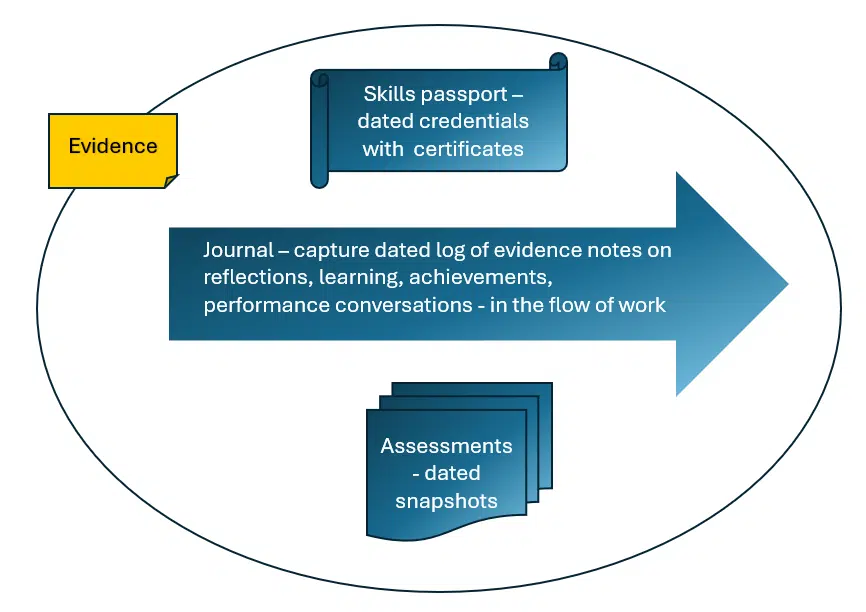
3. Journal — “Continuous Evidence in the Flow of Work”
Where managers and staff capture:
- performance conversation notes
- examples of applied skills and behaviours
- progress on responsibilities and goals
- clinical practice reflections
- CE/CPD hours
- issues flagged and resolved
- everyday observations that support reviews, audits and development
Together, these layers create a complete, defensible picture of capability, combining:
- verified qualifications
- assessed competence
- ongoing demonstrated performance and learning
This is the foundation for fair performance reviews, precise development planning, and consistent competency assurance — especially in clinical, technical, and operational environments.
A Structured Journal With Tabs for Every Expectation
The Journal mirrors the structure of the role and performance system.

Job Responsibilities
Notes linked to specific responsibilities and tasks:
- examples of effective performance
- challenges
- improvement opportunities
- observed behaviours
- uploaded evidence


Goals & Objectives
Track progress on goals, barriers, achievements, and adjustments.
Values, Core & Leadership Competencies
Capture behavior-based examples aligned to organisational culture and leadership expectations.
Functional / Technical Competencies
Manager observations, practice notes, and evidence of applied skills.

Clinical Competencies (Healthcare)
- case-based discussion summaries
- exposure logs
- reflective notes
- preceptor observations
- CE/CPD hours
- remediation notes
-
remediation notes
General Notes
For broader observations, ideas, or reflections not tied to specific elements.
Features of the Journal
File Uploads
 Attach:
- photos
- documents
- certificates
- practice checklists
- video evidence (if enabled)
Flag and Resolve Issues
Quickly mark an entry as an issue:

- barrier to performance
- issues and their resolution
- behavior concern
- safety observation
- patient-care concern
- technical error
- process deviation
Then add follow-up actions and resolution notes.
Informal Review (Optional)
Managers can add a short performance comment or rating to capture the overall period.
When the Journal Is Most Valuable
- improves review accuracy
- supports evidence-based ratings
- strengthens calibration
- enables clear feedback conversations
 Competency Assurance
- logs observations between assessment points
- supports early detection of skill gaps
- builds a record of applied competence
 Clinical Education / Preceptorship
- case-based discussions
- practice notes
- CE hours
- remediation
- sign-off preparation
 Technical/Operational Work
- safety notes
- practice observations
- troubleshooting logs
- shift-based performance insight
 Career & Succession
- captures achievements
- documents development steps
- supports readiness decisions
Reporting, Dashboards & Notifications
The Journal is most powerful when paired with real-time visibility. Centranum provides practical dashboards and reports that help managers stay informed and take timely action.
Team Dashboards
Team dashboard – managers real time view:
Per person
- number of Journal entries for the selected period
- number of issues logged and resolved
- “last updated” timestamp for each team member
- staff with no entries
Click through to review details and identify
- where conversations are and are not happening
- where support may be needed
- where documentation is missing
- patterns in issues or performance concerns
Reports

Standard Journal-related reports include:
- Issues Log Report — all issues raised, unresolved, and resolved with timestamps
- Journal Activity Report — entries by person, type, date range
Notifications

Built-in notifications ensure nothing is overlooked:
- automated prompts for managers to record performance conversations
- alerts when issues are logged
- reminder notifications for mid-cycle check-ins
- optional email summaries of Journal activity for selected periods
These automations help maintain a consistent rhythm of feedback and documentation throughout the year — without adding administrative load.
Individual Personal Dashboard
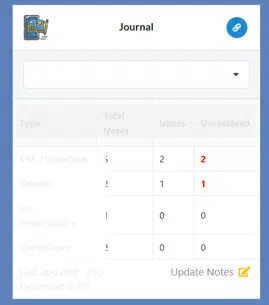 Every employee sees their own “Where I Am” summary:
- total entries this period
- entries by category
- issues logged and resolved
- last updated
This keeps employees fully informed about their own progress and development discussions.
Why Managers Love It
- Easy to use
- Structured (notes aren’t lost)
- Evidence is always available
- Supports fair, consistent reviews
- Keeps performance conversations grounded in real examples
- Works across all types of roles
And because the Journal links to role expectations, it keeps the focus on what truly matters.
Related Reading
1. Performance Management: Practical Model for Better Reviews
A clear, research-based framework for fair and effective performance reviews — grounded in responsibilities, goals, competencies, and evidence.
2. Core Competencies in Performance Management
Explains how values, behaviours, and core competencies shape the “HOW” of performance, and why they matter for reviews and development.
3. Competence & Performance — What’s the Difference?
Clarifies the relationship between job performance and demonstrated competence, and how evidence from real work supports both.
4. Driving Performance: Work Design & Expectations
Shows how clear role expectations and well-defined responsibilities improve performance and make evidence-based conversations easier.
5. How to Achieve a Feedback Culture
Practical guidance for building consistent, constructive feedback habits — supported by tools like the Journal.
FAQ
What’s the difference between the Journal and a performance review?
The Journal captures day-to-day evidence throughout the year. Reviews summarise verified evidence and outcomes.
Does the Journal replace competency assessments?
No. Assessments remain the formal verification method. The Journal adds ongoing context and micro-evidence.
Can managers attach files to Journal entries?
Yes — photos, documents, certificates, forms, checklists and other evidence types- like audio
Is the Journal used in healthcare scenarios?
Yes. It supports case-based discussions, exposure logs, CE hours, practitioner reflection and competency evidence across clinical roles.
Can Journal entries be private?
Yes. Staff and managers can create private notes only visible to themselves.
Can issues be flagged and tracked?
Yes. Entries can be marked as an issue, and follow-up actions and resolution notes can be recorded.