

Competence debt builds quietly when roles, capabilities and evidence are not maintained over time.
Competence Debt — The Hidden Risk Building Inside Organisations
Most organisations understand technical debt:
short-term fixes that accumulate into long-term system risk.
Far fewer recognise an equivalent problem in workforce management:
Competence debt — the gradual accumulation of unclear, outdated, or unverified capability and competency data.
Like technical debt, competence debt builds quietly.
And like technical debt, it eventually constrains performance, increases risk, and becomes costly to unwind.
What Is Competence Debt?
Competence debt occurs when an organisation’s understanding of workforce capability no longer reflects reality.
This happens when:
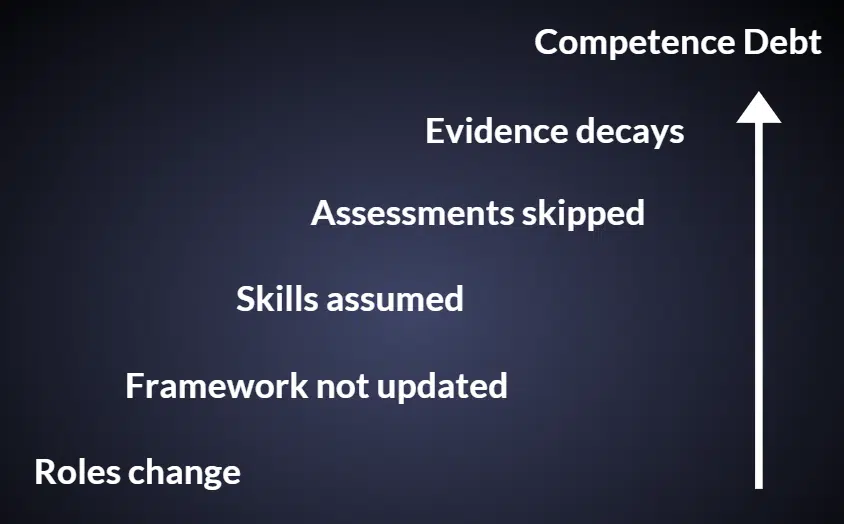
- roles change but capability requirements are not updated
- competency models remain static while work evolves
- skills are assumed rather than verified
- evidence of competence is incomplete or outdated
- assessments are inconsistent across teams or locations
- frameworks exist, but are not operationalized
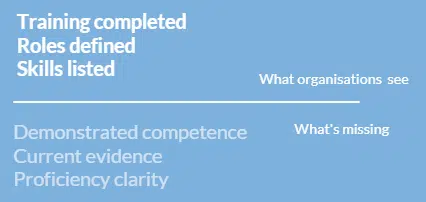
On paper, the organisation looks capable.
In practice, gaps emerge — often only when something goes wrong.
How Competence Debt Accumulates
Competence debt rarely results from poor intent. It usually builds through a series of reasonable shortcuts.
1. Frameworks frozen in time – Competency models created years ago are reused despite changes in technology, regulation, or service delivery.
2. Training completion substituted for competence – Attendance and completion data is treated as proof of capability, even when performance in real work varies.
3. Skills lists grow without validation – Skills inventories expand, but proficiency levels and evidence are not consistently checked.
4. Informal assessments replace structured ones – Managers rely on judgement rather than shared standards, creating variability.
5. Evidence decays – Competence was once demonstrated — but no longer refreshed or revalidated.
Individually, these seem minor. Collectively, they create a growing gap between assumed and actual competence.
Why Competence Debt Is Hard to See
Unlike performance issues, competence debt is often invisible day-to-day.
Common signs include:
- most staff rated “competent” or “advanced”
- few clearly defined proficiency thresholds
- limited differentiation between levels
- difficulty identifying who is genuinely ready for progression
- reliance on anecdotal knowledge of capability
- audit findings that contradict internal records
- succession plans that collapse under scrutiny
These are not people problems.
They are structural data problems.
The Cost of Competence Debt
Left unmanaged, competence debt has tangible consequences:
- Operational risk — staff deployed beyond verified capability
- Inconsistent performance — standards vary by manager or location
- Audit exposure — difficulty demonstrating competence over time
- Weak succession pipelines — readiness is assumed, not evidenced
- Ineffective development — learning disconnected from real gaps
- Pay and progression disputes — decisions hard to defend
The longer competence debt accumulates, the harder it becomes to unwind.
Competence Debt vs Skills Inflation
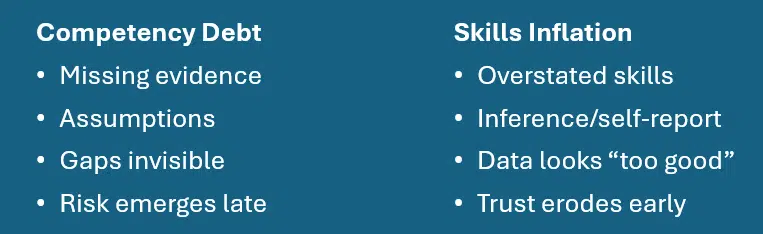
Competence debt is closely related to skills and capability inflation, but they are not the same.
Skills inflation describes over-stated or unverified skills claims.
Competence debt describes the organisational consequence of those claims persisting over time without correction.
Inflation is a signal.
Competence debt is the structural outcome.
When There Is Little or No Competence Data
When the Issue Isn’t Bad Data — It’s No Data
In many organisations, competence debt does not arise from outdated or inflated data.
It exists because reliable competence data was never established at all.
This is common where:
- competency frameworks are too high-level to assess
- roles are described only in broad responsibilities or behaviours
- frameworks exist as documents, not operational systems
- assessments were attempted once, then abandoned
- training completion is treated as proof of competence
- spreadsheets exist, but are not maintained or trusted
In these situations, organisations are not managing competence poorly —
they are managing it implicitly, through assumption, tenure or informal judgement.
The risk is the same.
 Without assessable competency definitions and consistent evidence, organisations cannot reliably answer basic questions such as:
- Who is genuinely competent to perform critical tasks?
- Who is ready for progression or additional responsibility?
- Where are the real development gaps?
This is still competence debt — just without the illusion of accuracy.
Why “No Data” Can Be Riskier Than Incomplete Data
When no structured competence data exists:
- gaps remain invisible until incidents occur
- readiness for progression or succession cannot be verified
- development planning is generic rather than targeted
- internal mobility depends on manager knowledge
- audits focus on documentation rather than demonstrated competence
Ironically, organisations with some flawed data often discover these issues sooner than organisations with none.
How Organisations Typically Exit This Starting Point
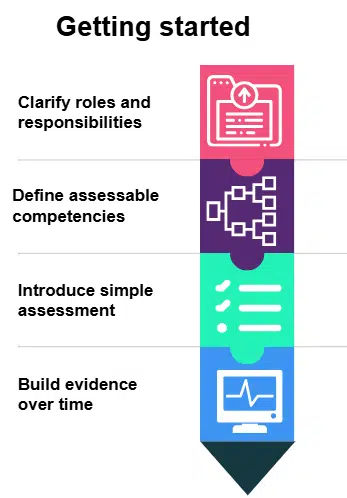
For organisations at this stage, reducing competence debt usually begins with:
Clarifying role responsibilities – Focus on what people actually do — not abstract behaviours.
Defining assessable competencies – Competencies must be specific enough to observe and rate.
Introducing light-touch assessment – Not everything needs to be assessed — start with critical roles or tasks.
Separating skills from competency – Use skills checklists only where detail is genuinely required.
Building evidence gradually – Competence data does not need to be perfect on day one — it needs to be defensible and improving.
This approach avoids overwhelming teams while creating a foundation for reliable workforce insight.
How Organisations Reduce Competence Debt
Reducing competence debt does not require excessive complexity. It requires discipline and clarity.
Effective organisations focus on:
1. Current role and capability definitions – Roles are reviewed and updated as work changes.
2. Competency models tied to real responsibilities – Competencies reflect actual work, not abstract behaviours.
3. Proficiency levels that distinguish readiness – Clear thresholds define what “competent”, “advanced” or “expert” mean.
4. Targeted skills verification –Only critical or high-risk skills require detailed assessment.
5. Evidence update cycles – Competence is demonstrated, recorded, and periodically revalidated.
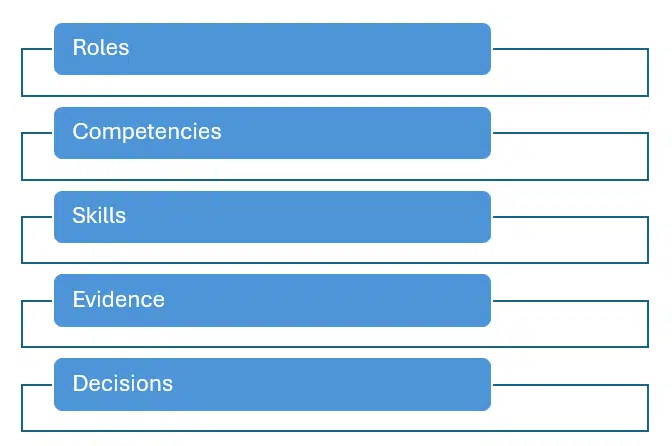
6. A single source of truth – Capability, competency, skills and evidence are managed in one consistent system.
Together, these practices prevent debt from accumulating — and gradually pay it down.
Why Competence Debt Matters Now
Competence debt becomes more dangerous as:

Roles become more complex.

Regulation and compliance needs increase

Technology changes faster and AI accelerates skill obsolescence

Organisations rely more on internal mobility and redeployment
In this context, assumed competence is no longer safe.
A Practical Starting Point
Whether your organisation has outdated competence data, inflated skills profiles, or no structured data at all, the challenge is the same:
understanding how far current frameworks support real decisions about performance, pay, mobility and succession.
- A simple diagnostic can help identify:
- whether roles are defined clearly enough to assess
- whether competencies are observable and measurable
- where evidence is missing or outdated
- which roles or skills should be prioritised first
This creates a baseline — not to judge maturity, but to decide where to focus effort.
How Centranum Helps Organisations Pay Down Competence Debt
If your organisation is reviewing workforce structures for 2026, it may be useful to ask:
- Where do we rely on assumed competence?
- Which roles or skills have not been reviewed recently?
- Where would audit or operational scrutiny expose gaps?
Competence debt is rarely eliminated in one step — but it can be reduced steadily with the right structure and data.
FAQ
What if we don’t really have competence data yet?
That is more common than most organisations admit. Many have frameworks or role documents but little assessable, current evidence of competence. This is still competence debt — and recognising it is the first step to reducing risk.
Does competence debt only apply if we already have a competency framework?
No. Competence debt exists whenever there is a gap between assumed capability and demonstrated competence — whether that gap comes from outdated frameworks, inflated skills data, or the absence of structured assessment altogether.
Is it risky to acknowledge we don’t have good competence data?
Ignoring the issue is riskier. Most regulators, auditors and boards are more concerned with whether organisations have a defensible process to improve competence over time than whether data is perfect today.
Where should organisations start if they have no assessments in place?
Start small. Clarify role responsibilities, define assessable competencies for critical roles, and introduce light-touch assessment where risk is highest. Competence data can be built incrementally.
Can training records substitute for competence evidence?
Training completion indicates exposure, not competence. It can support capability, but it does not demonstrate performance in real work conditions. Treating training records as proof of competence is a common source of competence debt.
How long does it take to reduce competence debt?
Reducing competence debt is a gradual process. Organisations typically see meaningful improvement within 6–12 months once role clarity, assessment structure and evidence refresh cycles are in place.
Related Reading
Capability, Competency & Skills — What’s the Difference?
Understand how competence fits alongside capability and skills in modern workforce frameworks.
How to Structure a Competency Model (10-Minute Diagnostic)
A quick way to assess whether your competency framework is fit for purpose.
Competency Assessment & Analytics
How organisations verify competence through observation, evidence and assessment.
Performance Management: What Effective Systems Really Measure
Why competence supports performance diagnostics and development — but shouldn’t replace role expectations.
Internal Mobility Is Broken — And How Capability Data Fixes It
How poor competence visibility blocks progression, succession and workforce planning.