
Skills & Capability Inflation — What It Is and How to Counteract It
Organisations are investing heavily in skills inventories, skills ontologies, and AI-generated skills profiles.
But another problem is quietly growing:
Skills and capability inflation.
Employees appear to have more skills on paper than they demonstrate in practice.
Critical tasks look “covered” in spreadsheets, but not in real operations.
Self-ratings trend upward even when performance is flat.
This page explains why this happens and how to counteract it with evidence, structure and clear role expectations.
What Skills & Capability Inflation Actually Means
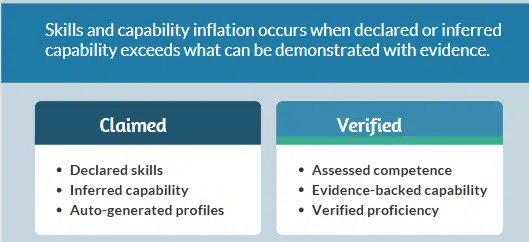
Skills or capability inflation occurs when:
- people claim higher skill levels than observed
- teams overstate their capability to appear compliant
- AI-generated profiles inflate proficiency
- self-assessed skills do not match manager or assessor ratings
- proficiency frameworks are applied inconsistently
- critical tasks are marked “competent” without evidence
- legacy competency models no longer reflect modern work
It creates the illusion of strength while hiding workforce risk.
Why It Happens (5 common causes)
1. Skills defined too vaguely
Broad, generic skills (“communication”, “leadership”, “problem solving”) encourage inflated claims because they aren’t tied to observable tasks or behaviours.

2. Self-assessment without calibration
Without structured observation or knowledge tests, employees over- or under-rate themselves, depending on confidence.
3.AI-generated profiles
Skills extracted from CVs or job descriptions often assume competencies that aren’t present.


4. Outdated competency models
Competency models built pre-2020 often omit new technologies, regulatory changes or emerging responsibilities.
5. Incentives that encourage inflation
When declarations drive eligibility for pay, promotion or project assignment, inflation naturally rises unless evidence gates it.

How to Spot Skills/Capability Inflation (practical indicators)
You can often detect inflation using simple diagnostic patterns:
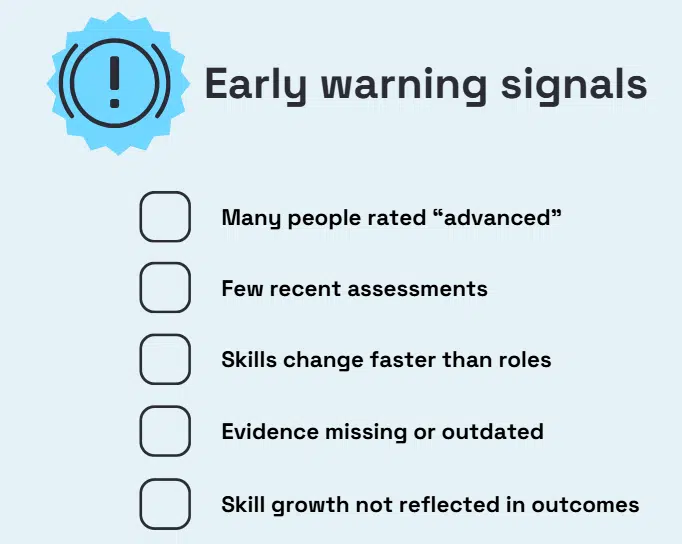
- Everyone is “advanced” — very few foundational ratings
- Self- and manager ratings rarely match
- High-skill claims with no linked evidence files
- Skills lists that grow but don’t map to competency
- Audit/compliance reviews show gaps not visible in the LMS or HRIS
- Critical tasks marked “competent” but not observed in 12+ months
- Teams across locations rate proficiency very differently
These patterns almost always signal un-validated skills and unclear expectations.
How to Counteract Skills & Capability Inflation (evidence-based steps)
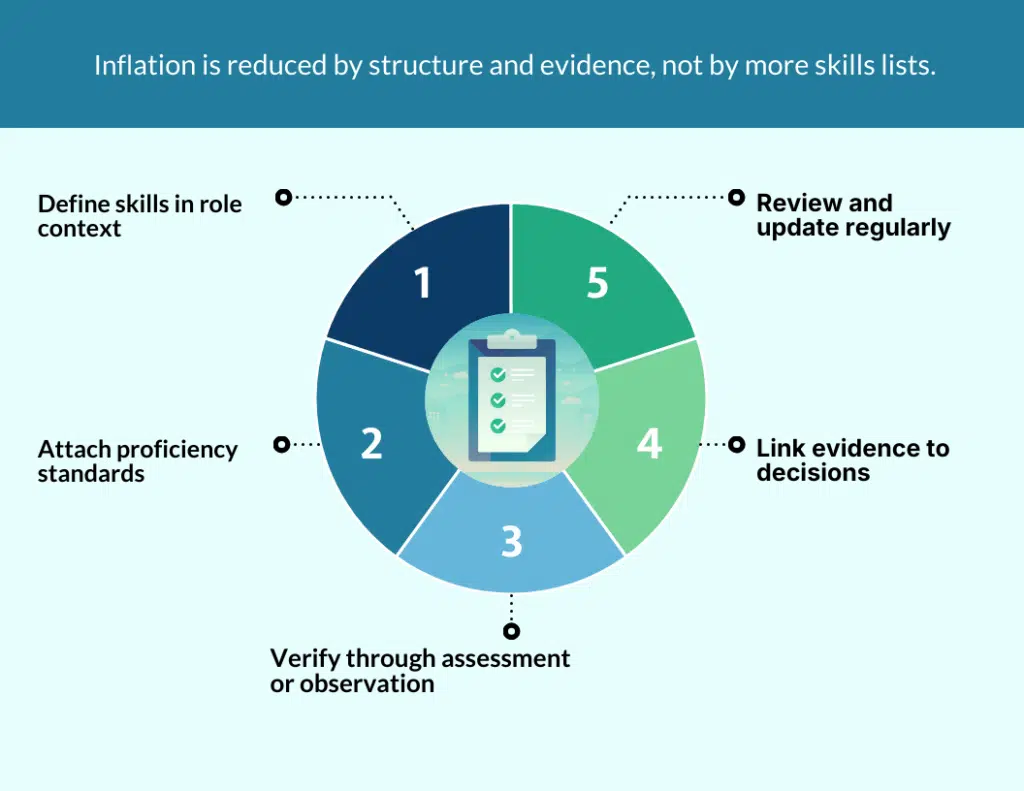
✓ 1. Define skills at task level
Skills should describe what a person actually does: steps, tools, conditions, correctness, safety.
✓ 2. Connect skills to competency indicators
Skills sit inside competency. Competency provides the behavioral and judgement standards that prevent inflation.
✓ 3. Calibrate ratings using observation, knowledge tests & evidence
Not everything needs assessment — only the skills that are:
- safety-critical
- high-risk
- high-value
- prone to error
✓ 4. Anchor every skill to a rating scale
Needs Development – Competent with Guidance – Fully Competent – Role Model
This prevents “yes/no” thinking.
✓ 5. Use proficiency levels to differentiate seniority or complexity progression
Foundation → Intermediate → Advanced
✓ 6. Use role responsibilities as the reference point
Capabilities, competencies and skills only make sense when tied to the actual work of the role.
✓ 7. Introduce evidence gates
For progression: “Show the evidence”, not “trust the declaration.” Works exceptionally well in healthcare, engineering and utilities.
✓ 8. Maintain a current job, capability and competency architecture
If the model is outdated, inflation is inevitable.
How This Connects to Skills-Based Pay
Skills inflation is one of the main reasons why skills-based pay schemes fail.
If skills data is not:
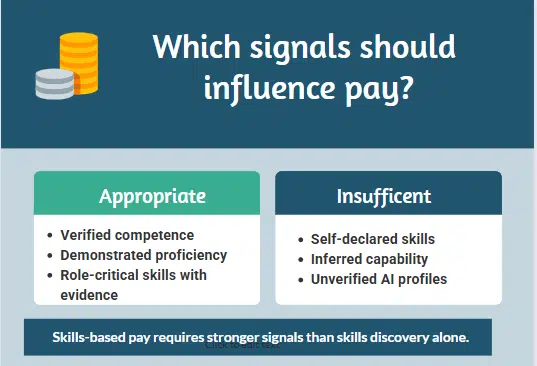
- defined clearly
- validated with assessment
- calibrated
- connected to role capability
- linked to proficiency level
…then any pay system built on it will be unfair and vulnerable to challenge.
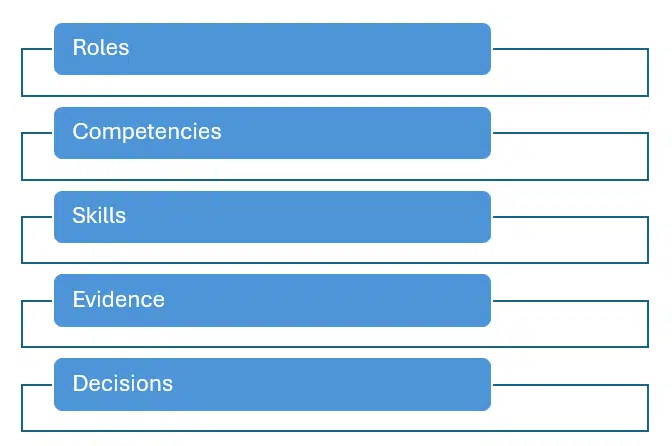
This is why capability → competency → skills → proficiency must form a validated chain.

How Centranum Helps Reduce Inflation and Make Data Reliable
The Centranum platform supports:
- clear role and capability definitions
- validated competency indicators
- structured skill/task checklists
- observation-based assessment
- linked evidence files
- calibrated proficiency ratings
- automated reminders to update evidence
- dashboards that highlight unverified competence
This creates defensible, audit-ready data for mobility, pay, progression and succession.
Common Myths About Skills & Capability Inflation
Myth 1: “This only happens in non-regulated industries.”
Clinical and safety-critical environments often have some skills checking in place. Inflation usually appears in areas with less formal verification — advanced practice, specialist roles, leadership, and cross-functional capability.
Myth 2: “Self-assessment is good enough if managers review it.”
Manager review alone rarely provides consistent calibration across teams. Without shared standards, proficiency scales and evidence expectations, ratings drift quickly.
Myth 3: “If someone has the qualification, they are competent.”
Qualifications and certifications indicate readiness, not ongoing competence. Competence must be demonstrated and maintained in real work contexts.
Myth 4: “AI skills extraction solves this problem.”
AI can identify potential skills from CVs or job descriptions, but it cannot verify proficiency, judgement or real-world application. Without validation, AI often amplifies inflation rather than reducing it.
Myth 5: “We only need to verify skills once.”
Skills and competence decay over time, especially for infrequently used or high-risk tasks. Without refresh cycles and evidence updates, inflation re-emerges.
Myth 6: “More skills detail automatically improves accuracy.”
Detail without structure increases noise. Accuracy comes from clear role context, competency linkage, proficiency definitions and selective verification — not longer skills lists.
FAQ
What is skills or capability inflation?
Skills or capability inflation occurs when employees appear more skilled on paper than they are in practice. It typically results from vague skill definitions, self-assessment without validation, inconsistent proficiency standards, or outdated competency models.
What causes skills inflation in organisations?
Common causes include generic skills lists, uncalibrated self-reporting, AI-generated skill profiles, inconsistent rating practices between teams, and incentives that reward “declared” rather than demonstrated skill.
How is capability inflation different from skills inflation?
Skills inflation usually refers to overstating task-level abilities.
Capability inflation refers to overstating broader role readiness — such as qualifications, certifications, or experience being assumed rather than verified. Both reduce the reliability of workforce data.
How can we tell if our organisation has skills inflation?
Typical indicators include:
• most staff rated “advanced” or “expert”;
• self-ratings that don’t match manager assessments;
• critical tasks marked competent with no recent evidence;
• inconsistent proficiency ratings across teams;
• audit findings that contradict the skills data.
What are the risks of skills or capability inflation?
Risks include incorrect deployment of staff, reduced productivity, inconsistency in pay or progression decisions, increased compliance exposure, unreliable succession data, and a loss of trust in workforce analytics.
How do we prevent skills and capability inflation?
Use task-level skill definitions, link skills to competency indicators, calibrate proficiency ratings through observation or testing, and maintain a current role and capability architecture. Evidence-based verification is critical for accuracy.
Does skills inflation affect skills-based pay?
Yes. Skills-based pay relies on accurate, validated skills data. If skills are inflated or unverified, the pay model becomes inconsistent and can create inequity, appeal risk, and manager resistance. This is one of the primary reasons skills-based pay initiatives fail.
How does Centranum help reduce skills and capability inflation?
Centranum links capability requirements, competency indicators, and skills to evidence.
Features include structured assessments, proficiency-based ratings, observation methods, linked evidence files, and dashboards that highlight unverified competence — making data consistent, accurate and audit-ready.