

Workforce Capability & Competency Management Framework
The capability and competency model behind Centranum
This page explains the structured capability and competency framework that underpins all Centranum solutions — including competency management, performance management, career development, and talent management.
It clarifies how roles, capability inputs, and demonstrated competence work together to support credible assessment, development, and workforce decisions.
From role expectations to demonstrated competence
At the core of the framework is a simple but critical distinction:
- Role expectations define what the job requires
- Capability represents the inputs a person brings — qualifications, training, and experience
- Competency is demonstrated performance in context, assessed against defined indicators
This distinction ensures workforce decisions are grounded in clear expectations, verified preparation, and observable performance — rather than assumptions or disconnected processes.
How role expectations and capability alignment work in practice
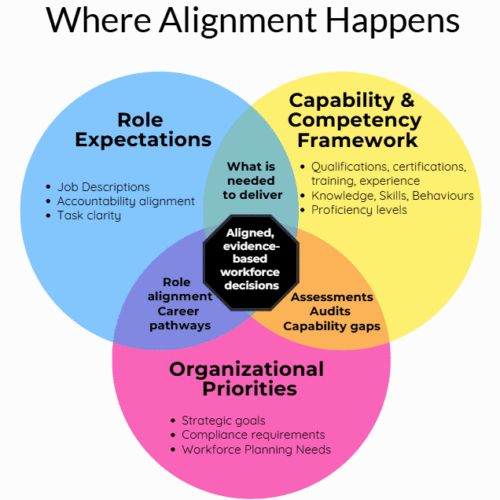
The Power of Alignment
Once role expectations, capability inputs, and competency requirements are clearly defined, the value comes from keeping them aligned over time.
Alignment means:
- People are assessed against the same role expectations and defined indicators
- Development plans target verified, role-specific gaps
- Performance conversations are grounded in evidence, not interpretation
When alignment breaks down, organisations see inconsistent standards, duplicated effort, and development activity that doesn’t translate into performance.
When alignment is maintained, organisations gain:
- Consistent standards across teams and locations
- Stronger risk and compliance control through role-based evidence
- Clear visibility of strengths, gaps, and development priorities
By centralizing role definitions and mapped capabilities, Centranum replaces fragmented spreadsheets and disconnected tools with decision-grade workforce insight.
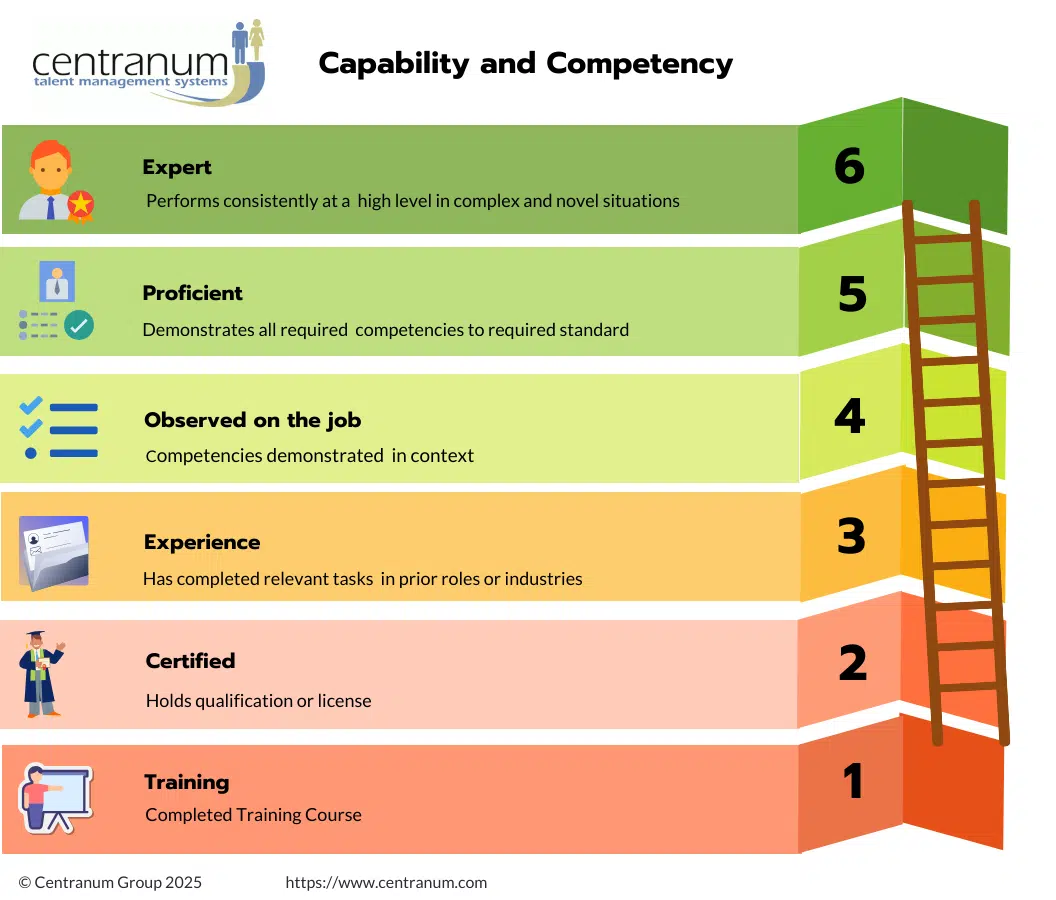
Levels 1–3 = Capability (Inferred) Levels 4–6 = Competency (Demonstrated)
Capability versus Competency- what’s the difference?
Many systems stop at training records and qualifications. But holding a certificate does not guarantee the ability to perform to the required standard in the workplace.
Centranum distinguishes clearly between:
- Capability —qualifications, training, and experience that indicate preparation and potential
- Competency — demonstrated performance on the job, assessed against relevant defined standards
This distinction allows organisations to:
- Identify workforce performance risk early
- Design development plans that address verified, role-specific gaps
- Demonstrate workforce readiness in practice — not just on paper
Capability prepares a person for performance.
Competency confirms that performance meets defined standards.
Both must be visible within a structured framework to support credible workforce decisions.
Centranum applies this distinction through a unified role-based architecture, creating a single source of truth for workforce capability and competency data.
Addressing common capability and competency challenges

Without a structured connection between role expectations, capability inputs, and demonstrated competence, organisations often face:
- Inconsistent standards across teams and locations
- Development activity that is not clearly tied to role requirements
- Fragmented workforce data stored across multiple systems
- Limited visibility into emerging capability risk
A coherent workforce framework must unify role architecture, capability mapping, competency standards, and organisational priorities within a single structured model.
Centranum applies this framework to provide leaders with consistent visibility into strengths, gaps, and workforce risk across the organisation.
Adoption Pathways Within the Framework
Not every organisation begins with the same level of role definition or competency maturity.
A structured capability and competency framework can be adopted from different entry points while maintaining a single, coherent data model.
Competency Framework First
Organisations that already have defined role-based competencies may begin with structured assessment and proficiency tracking, expanding later into development planning and workforce analytics.
Job Role + Training First
Organisations that already have defined role-based competencies may begin with structured assessment and proficiency tracking, expanding later into development planning and workforce analytics.
Growth & Mobility Focused
Organisations prioritizing career development and internal mobility can build structured progression pathways grounded in defined role expectations and demonstrated competence.
Whichever entry point is chosen, the underlying framework ensures data consistency across roles, capability inputs, assessment, and development.
How the Framework Connects Roles, Capability, and Competency
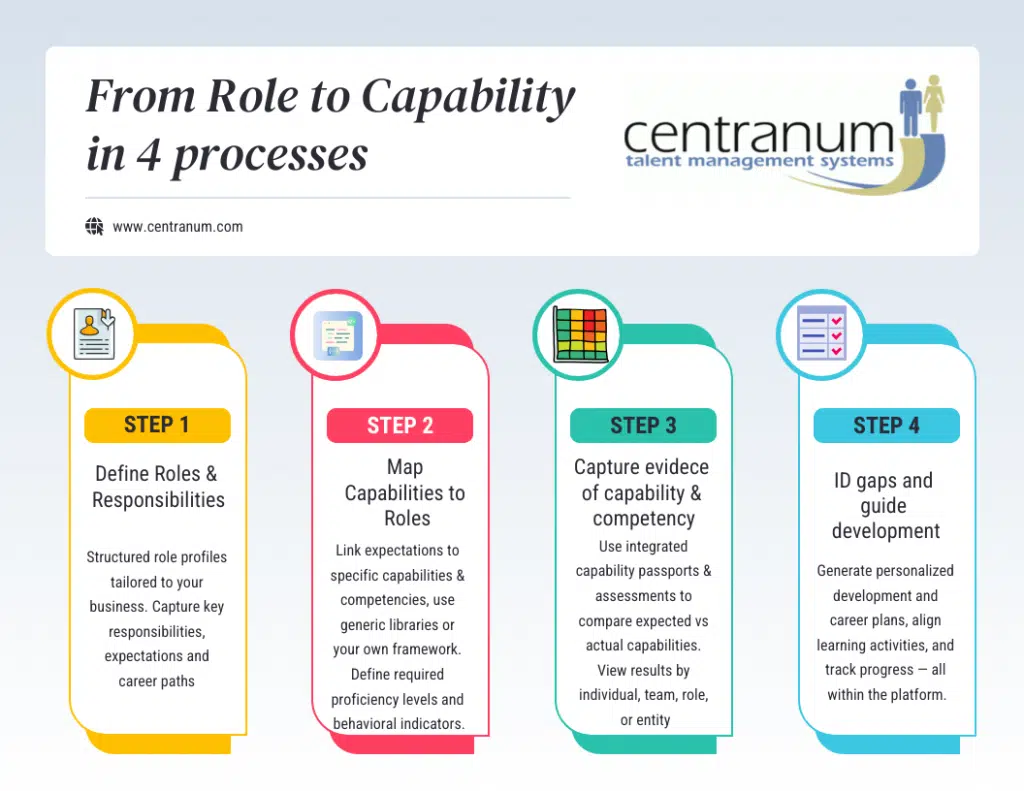
The framework connects role clarity, capability inputs, and demonstrated competence through four structured processes:
1. Define Role Expectations
Clarify responsibilities, required capabilities, and progression pathways.
2. Map Capability and Competency Requirements
Link roles to qualifications, training, experience, and defined competency standards with proficiency levels.
3. Capture and Validate Evidence
Record credentials and assess demonstrated performance against defined indicators.
4. Identify Gaps and Guide Development
Use structured assessment data to prioritise development and inform career and succession planning.
This structured cycle ensures that role expectations, preparation, and demonstrated performance remain aligned over time.
This model can be applied incrementally or in full, depending on organisational maturity — while maintaining a coherent, role-based structure.
To see how this framework is applied in practice, explore the related solution areas:
Why a Structured Capability and Competency Framework Matters
Many systems focus only on recording training or listing skills. A structured workforce framework must connect role expectations, preparation, demonstrated performance, and development in a coherent way.
This framework works because it:
- Supports flexible adoption from different starting points while maintaining structural consistency
- Distinguishes clearly between capability (credentials and preparation) and competency (demonstrated performance)
- Embeds assessment within defined role expectations rather than treating it as a separate activity
- Maintains auditability through structured documentation and version control
- Links identified gaps directly to role-based development pathways
- Aligns access and visibility to organisational roles and responsibilities
Who the Framework Serves
This capability and competency framework supports different needs across the organisation:
- Staff gain clarity on role expectations and development pathways grounded in demonstrated competence
- Managers gain structured visibility into team capability and readiness
- Leaders and HR gain consistent standards and workforce insight to support planning, assurance, and development
The same underlying structure supports all groups — without duplicating data or fragmenting systems.
Centranum applies this framework across healthcare, engineering, government, manufacturing, technology, and professional services environments.
Security, auditability, and enterprise deployment capabilities support organisations operating in regulated or high-assurance contexts. The platform is independently audited against SOC 2 Type II.
With over 20 years of experience supporting capability frameworks and competency-based systems, Centranum is used across healthcare, engineering, government, technology, manufacturing and professional services organizations.
The platform supports enterprise-scale deployment, auditability, localization, with dedicated onboarding and long-term client support.
Centranum is independently audited against SOC 2 Type II, supporting secure, auditable operation in enterprise and compliance-driven environments.


Related insights
If you’d like to explore this capability and competency model further, you can review the summaries below or see it in action.
FAQs
The questions below address common considerations when implementing a capability and competency-based approach.
What is the difference between capability and competency?
Capability refers to qualifications, training, and experience that indicate preparation for a role. Competency refers to demonstrated performance against defined standards in context. A structured workforce framework distinguishes between the two to ensure readiness is based on evidence, not assumption.
Why is role clarity important in competency management?
Clear role expectations define what performance should look like. Without defined responsibilities and required capabilities, assessments and development plans lack a consistent reference point.
Can organisations adopt a capability and competency framework incrementally?
Yes. A structured framework can be implemented from different starting points — such as existing role definitions, competency frameworks, or training records — while maintaining a coherent underlying model.
Why does alignment between roles, capability, and competency matter?
Alignment ensures that development, assessment, and performance standards are consistently applied across the organisation. Without alignment, organisations risk inconsistent standards and fragmented workforce data.
Is this framework suitable for regulated or high-assurance environments?
Yes. A structured capability and competency model supports auditability, documentation, and defensible workforce decisions — particularly where readiness and compliance are critical.