
Meritocracy and Better Talent Decisions
Why “Merit-Based” Often Means Guesswork — and How Evidence Improves Outcomes
Meritocracy tends to resurface during periods of uncertainty:
- economic disruption
- technological change (including AI)
- labour market volatility
- pressure on leadership pipelines
Key definitions
Merit-Based Decision Principles
Meritocracy – Decisions made against defined standards rather than informal preference or influence.
Fairness – Consistent application of standards across individuals and groups.
Transparency – Clear articulation of criteria and decision processes.
Governance – Controls ensuring standards, measurement, and approvals are documented and reviewable.
The concept of Meritocracy
At its core, meritocracy is the idea that:
- people should advance based on ability and merit
- opportunity should be earned rather than inherited
- decisions should be defensible rather than arbitrary
The Merrill Webster dictionary describes meritocracy as: ‘ a system, organization, or society in which people are chosen and moved into positions of success, power, and influence on the basis of their demonstrated abilities and merit.’
The appeal is straightforward:
- it promises better decisions
- it implies equal opportunity
- it offers justification for outcomes
The problem is not the idea — it’s how merit is interpreted and applied in practice.
What Do We Actually Mean by “Merit”?

The word merit is doing too much work.
Common definitions include:
- superior quality or worth
- a quality deserving praise or approval
- demonstrated ability or achievement
In organizations, these meanings are often blended together:
- performance
- capability
- effort
- potential
- perceived value
When one word stands in for many concepts:
- clarity disappears
- assumptions increase
- judgement fills the gaps
A Brief History: From Social Critique to Organizational Virtue
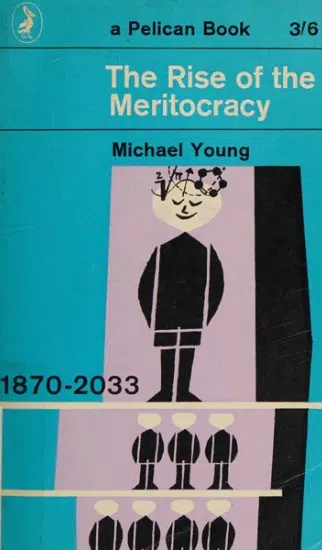
The term meritocracy entered modern discourse through Michael Young’s 1958 book The Rise of the Meritocracy, written in post-war Britain against a backdrop of hereditary privilege and class stratification. Young’s work was;
- written as satire, not endorsement
- warned of new elites formed through narrow definitions of merit
- highlighted how disadvantage can be obscured rather than removed
Later reinterpretations, for example the 2018 publication Meritocracy in Perspective with his son, Toby as one of the authors, reframed meritocracy as:
- a positive driver of effort and ambition
- a justification for market-based outcomes
- a mechanism for securing acceptance of inequality
Critics have since pointed out that meritocracy can:
- obscure structural advantage
- conflate education with capability
- legitimize unequal outcomes without examining inputs
This unresolved tension carries directly into organizational decision-making.
Meritocracy and Talent Decisions Today

Despite its contested history, meritocracy attractive in organizations because
- it promises better outcomes
- it feels practical, not ideological
Most organizations describe their people decisions as merit-based. Meritocracy is rarely a philosophical position. It functions as a decision model for answering practical questions:
- Who should be promoted?
- Who is ready for more responsibility?
- Who should be invested in?
- Who should be part of the succession pipeline?
The risk is that meritocracy morphs into a form of cultural shorthand:
- “We reward performance.”
- “We promote the best people.”
- “Opportunities are earned.”
What is often lost is measurement discipline. Merit is something felt rather than demonstrated.
- inferred rather than defined
- assumed rather than evidenced
The Decision-Quality Problem at the Heart of Meritocracy
Several recurring patterns explain why merit-based decision-making breaks down in practice.
Merit is inferred, not defined
Organizations rarely distinguish clearly between:
- competence and performance
- capability and outcomes
- potential and readiness
As a result:
- people use the same words differently
- alignment is assumed where it doesn’t exist

Proxies replace evidence
In most organizations, talent decisions are not driven by clear, comparable evidence. They rely instead on proxies. Common proxies include:
- job title or level
- overall performance ratings
- tenure
- track record
- manager confidence
- visibility or reputation
These signals feel efficient because they are readily available. They also feel reasonable — until decisions need to be compared, defended, or scaled. At that point, their limitations become visible.
Importantly, these are not wrong inputs. They are incomplete inputs. The result is not intentional unfairness, but inconsistent decision quality.
Judgement varies by manager
Two managers reviewing the same individual often reach different conclusions, not because of bad intent, but because the evidence base is thin
This variability:
- undermines consistency
- makes decisions harder to scale
- weakens defensibility
In fact research shows that manager assessments often are more reflective of their relationship with the staff member, than actual performance or competence.
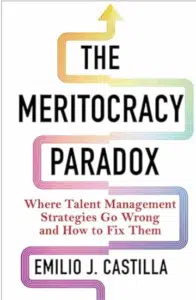
The Meritocracy Paradox (Confidence Without Evidence)
Research by Emilio Castilla highlights a critical risk.
Findings show that:
- emphasizing meritocratic values does not eliminate bias
- it can increase reliance on subjective judgement
- decision-makers assume the system itself ensures fairness
This finding does not argue against merit as a basis for decisions. It underscores a more practical point: aspirational meritocracy without strong decision inputs can reduce scrutiny, not improve outcomes.
From inferred “Merit” to Decision Evidence

The real question is not whether merit should matter. It is how merit is evidenced. Higher-quality decisions follow a sequence:
- Role expectations
- Capability evidence
- Performance outcomes
- Readiness signals
- Decision
Where many organizations fail:
- jumping from role → decision
- or performance → decision
Where better organizations differ:
- they insert evidence layers
- they reduce reliance on inference
What High-Quality Decisions Have in Common
1. Merit is decomposed
Merit is not treated as a single attribute.
Decisions separate:
- role requirements
- demonstrated competence
- performance outcomes
- readiness signals (e.g. progression, stretch performance, assessed gaps)
2. Capability is explicit
Capabilities are:
- defined at role level
- have evidence requirements
- observable in context
- assessable independently of title or tenure
This reduces guesswork.
3. Multiple evidence streams
Better decisions draw from:
- competency assessments
- performance history
- feedback and observation
- development activity and progression
- validated capability records
No single data source carries the full burden.
4. Decisions are explainable
If a promotion or succession decision cannot be explained later:
- the evidence was insufficient at the time
Auditability is:
- a decision-quality signal
- not a compliance exercise
Why This Matters More Now
The cost of weak decision inputs is rising because:
- skills-based operating models require finer-grained evidence
- AI amplifies existing data — good or bad
- leadership benches are thinner
- scrutiny of talent decisions is increasing
Meritocracy without evidence:
- produces sub-optimal talent allocation
- scales poorly when automated
What Better Decision-Making Looks Like — and How Leaders Can Start
Organizations that make better talent decisions do not rely on different values. They rely on better inputs. Across sectors, stronger decision quality shows up in consistent ways:
What better looks like in practice
- Organizations with higher decision confidence typically:
- define capability at the role level rather than inferring it from titles
- distinguish clearly between competence, performance, and readiness
- gather evidence over time rather than at decision points only
- reduce reliance on proxies such as tenure, visibility, or confidence
- can explain promotion and succession decisions calmly and consistently
These organizations are not more bureaucratic. They are more explicit.
How leaders can move toward better decisions
Improving decision quality does not require wholesale change. It starts with tightening inputs around the decisions that already matter most. Practical first steps include:
- Clarify decision criteria for one critical role family
(What actually constitutes readiness for advancement in this role?) - Identify proxy reliance
(Where are titles, tenure, or ratings standing in for evidence?) - Separate outcomes from capability assumptions
(Strong results are one input — not proof of readiness.) - Introduce at least one explicit competence assessment
(Something observable, role-specific, and repeatable.) - Require decisions to be explainable in plain language
(If it can’t be explained later, the evidence wasn’t sufficient.)
None of this requires culture change. It requires clearer inputs into existing decisions.
Where to go next
Decision quality improves when evidence replaces assumption.
Explore the areas below to strengthen the inputs behind your most important talent decisions.
Decision Criteria, Measurement and Evidence
Explore Decision criteria for Talent Decisions
Explore Measurement & Evidence in Talent Systems
Capability & Competence
Define what roles actually require — and how competence is evidenced.
Clarify capability expectations, distinguish competence from credentials, and reduce reliance on inferred skill.
Performance Evidence
Understand what performance data can — and cannot — support in talent decisions.
Separate outcomes from capability assumptions and use performance evidence appropriately.
Career & Succession Readiness
Assess readiness for advancement using evidence rather than inference.
Move beyond confidence and tenure toward explainable promotion and succession decisions.
Explore career & succession resources
Each of these strengthens decision quality independently — and together.
FAQs
What does meritocracy mean in talent decisions?
Meritocracy means decisions are made against defined standards rather than informal preference, influence, or inconsistent judgement.
Why do organisations struggle to achieve merit-based decisions?
Because criteria are often implicit and ambiguous, measurement is inconsistent, and evidence requirements are unclear—creating room for bias and variability.
Is meritocracy the same as fairness?
Meritocracy requires consistent standards. Fairness also depends on access, transparency, and how standards are applied in practice.
How do you make talent decisions fairer, more transparent and defensible?
Define criteria that are observable, separate criteria from measurement, set evidence requirements, and implement governance (version control, audit trail, approvals).
What is the link between meritocracy and bias?
When criteria are vague, decisions rely on interpretation. Bias results through different interpretations, preconceptions and application across assessors and decision makers.
What role does measurement design play in merit-based decisions?
Poor measurement design increases rater variability and weakens comparability. Strong measurement supports consistency but cannot compensate for unclear criteria.