
Defining Decision Criteria in Talent Systems
Talent systems frequently focus on scoring, rating, or evaluation methods.
Less attention is given to a more fundamental question:
What exactly are we judging against?
Before selecting a rating scale, introducing AI, or comparing individuals, organisations must define the criteria that underpin talent decisions.
Without defined criteria, measurement becomes opinion.
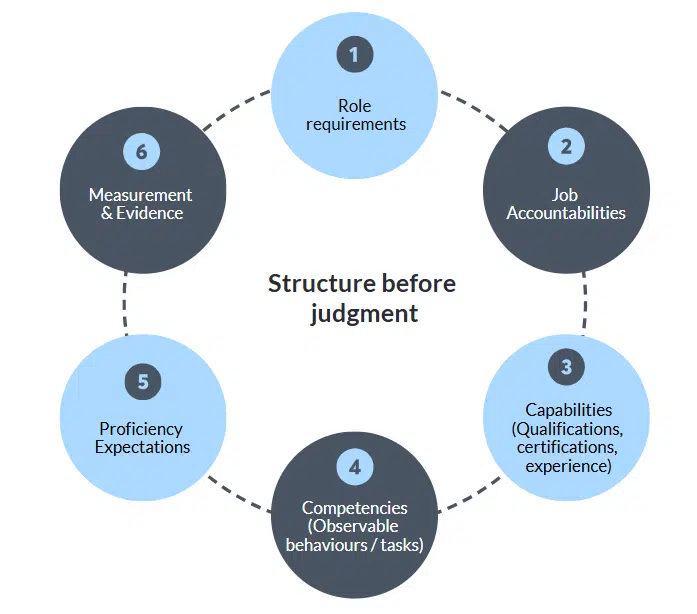
What Is a Decision Criterion?
A decision criterion is a defined standard used to evaluate whether an individual meets the requirements of a role.
In structured talent systems, criteria may include:
- Job accountabilities — the core responsibilities of a role
- Expected results — measurable outcomes or performance standards
- Capabilities — qualifications, certifications, training, experience, or professional registrations
- Competencies — knowledge and skills demonstrated in context
Criteria describe what must be achieved. They are distinct from ratings, scores, or narrative assessments.
Key Definitions
Decision Criterion – A defined, observable standard used to determine whether role requirements are met.
Job Accountability – A required responsibility or output attached to a role.
Capability – Qualifications, certifications, training, experience, or memberships indicating preparedness to perform.
Competency – Knowledge and skills demonstrated through observable behaviour or task execution on the job
Proficiency Level – Defined expectations that distinguish degree or scope of performance.

Observability as a Structural Requirement
For a criterion to be defensible, it must be:
- Observable (a task performed, behaviour demonstrated, or result achieved)
- Verifiable (supported by evidence)
- Linked to a defined role requirement
If a requirement cannot be observed, it cannot be measured.
If it cannot be measured, it cannot be validated.
Non-observable standards introduce subjectivity at the point of judgement in merit based talent decisions.
Criteria vs Measurement
A common structural error in talent systems is the conflation of criteria and measurement.
A rating scale (e.g., 1–5) is not a criterion. It is a measurement mechanism.
For example, consider the defined criterion:
Produces a monthly report summarizing interactions with key account customers, reconciled to CRM records, with documented agreed follow-up actions.
Verification may involve:
- Confirming the report was produced within the required period
- Checking reconciliation against CRM records
- Confirming follow-up actions are documented
The measurement mechanism may be:
- Supervisor review
- Structured checklist
- Random audit
- System-based validation
The criterion defines the requirement. The measurement verifies compliance with that requirement. Criteria must be separated from measurement and rating design.
Approaches to Proficiency Definition
Proficiency structures vary depending on how roles are designed. Two common architectural models exist.
Single Criterion, Measured by Degree
In some procedural or entrusted professional activity (EPA) frameworks, the observable task remains constant across levels.
Proficiency reflects degree of performance of the same task.
For example:
- Performs financial reconciliation with guidance
- Performs financial reconciliation independently.
- Performs financial reconciliation in complex or high-risk contexts.
The core task remains stable.
The distinction lies in supervision, complexity, or judgement boundary.
Measurement reflects degree of execution against the same criterion.
Distinct Criteria at Different Levels
In structured capability frameworks (for example, technical frameworks such as SFIA), levels represent defined bands of responsibility.
Proficiency levels are characterized by changes in:
- Accountability
- Autonomy
- Influence
- Complexity
- Business impact
While a skill category may appear across multiple levels, the expected behaviours and scope of responsibility differ structurally.
Criteria by Proficiency level example:
- New individual contributor — Executes defined operational tasks within established processes.
- Competent operator — Performs operational tasks independently and resolves routine issues within defined parameters.
- First-line supervisor or specialist — Allocates work, oversees task execution, and makes defined operational judgments.
- Manager or senior specialist — Designs or improves processes, manages risk, and makes cross-functional decisions.
- Senior manager or domain expert — Defines strategy, sets standards, and determines system-level direction.
Each proficiency level introduces different tasks, responsibilities, and judgement boundaries. The criteria differ structurally by level. Measurement then assesses whether the individual performs the tasks defined at that level.
Where levels represent materially different scopes of responsibility, criteria must be defined separately for each level rather than inferred through a rating scale.
Governance Implications
Decision criteria should be:
- Explicit
- Observable
- Role-linked
- Version-controlled
- Separated from measurement mechanisms
- Linked to defined evidence requirements
In regulated or safety-critical environments, absence of observable criteria introduces material risk.

Implications for AI
AI systems operate on observable inputs and recorded data. They depend on clearly defined criteria to support decision quality.
If criteria are abstract or inconsistently defined, AI will infer patterns from ambiguous signals.
It may advance confident and apparently precise measurement, when in fact objectivity is missing
AI may assist in drafting or summarizing decision criteria but not autonomously. Observable explicit criteria must precede any decision automation.
System Building Sequence
Defensible systems follow an ordered sequence and structure for managing talent decision criteria;
- Define job accountabilities and expected results.
- Define minimum qualifications, training, experience and competencies needed to deliver
- Translate competencies into observable behaviours or tasks.
- Define proficiency expectations.
- Define measurement instruments.
- Define acceptable evidence.
- Define decision criteria approval and governance controls.
Criteria must be observable before they can be measured. Measurement must precede judgement.
FAQs
What are decision criteria in talent systems?
Decision criteria are the defined standards used to determine whether role requirements are met. They may include job accountabilities, expected results, required capabilities, and demonstrated competencies. Criteria must be observable or verifiable.
What is the difference between a job accountability and a competency?
Job accountabilities define required outputs or responsibilities. Competencies define the knowledge and skills required to deliver those outputs. Both can be part of the decision criteria for a role.
What is a capability (as distinct from a competency)?
Capabilities refer to qualifications, certifications, training, experience, and memberships that indicate preparedness to perform. Competencies refer to knowledge and skills actually demonstrated on the job.
Why must decision criteria be observable?
If a requirement cannot be observed or verified, it cannot be measured consistently. Non-observable criteria increase interpretive variation between assessors and teams, reducing fairness and defensibility.
Are proficiency levels decision criteria or measurement?
Proficiency levels are part of decision criteria when they define different expectations by level. Ratings are measurement instruments used to record achievement against those expectations. A rating scale can also be used to indicate proficiency level – i.e. degree of independence – where the decision criteria are the same for all levels.
When do proficiency levels require different criteria rather than different scores?
When levels represent different scope of responsibility (tasks, decision authority, accountability), criteria must be defined separately for each level rather than inferred through a numeric scale.
How do criteria relate to defensible decisions?
Defensibility depends on clear standards that can be applied consistently, verified through evidence, and where history can be reviewed.