

Internal Mobility Is Broken — And How Capability Data Fixes It
Most organisations want to promote from within — but internal mobility rarely works the way it should.
Employees often can’t see a future in the organisation. Managers struggle to identify who is actually ready for progression. HR teams try to support career development but are limited by unclear role expectations, inconsistent competency profiles, or outdated capability data.
The result is predictable:
- talented people leave because they can’t see a path
- high-potential employees stay stuck in roles they’ve outgrown
- succession pipelines collapse when a key role becomes vacant
- development plans feel generic rather than role-specific
- mobility becomes a negotiation, not a structured process
What’s missing is clarity — and clarity starts with capability.
Why Internal Mobility (and Career Ladders) Fail
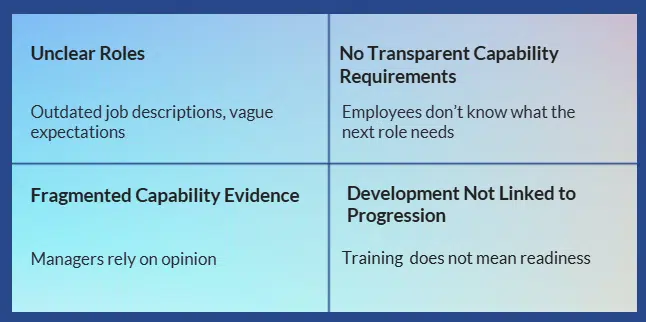
Across industries, four structural gaps undermine talent mobility:
1. Roles are unclear or outdated
Job descriptions are often responsibility-heavy, competency-light, or written as broad behavioral lists. Employees can’t see how one role leads to another — or what a modern career ladder looks like.
2. Capability and competency requirements lack transparency
Employees don’t know:
- what capabilities the next role demands
- how proficiency thresholds rise across levels
- which competencies matter most for progression
- what “ready for promotion” means in practice
Without clear progression criteria, mobility stalls.
3. Development isn’t aligned to progression
Training is usually consumption-based (courses completed), not capability-driven. Employees complete learning but don’t know how it supports their career development pathway
4. Evidence of readiness is fragmented
Managers rely on subjective judgement rather than capability evidence. High-potential employees stay hidden because:
- assessment methods differ
- capability records are inconsistent
- no common view of readiness exists
These problems can’t be solved with ad-hoc career conversations.
They need structured capability data.
How Capability Data Fixes Talent Mobility
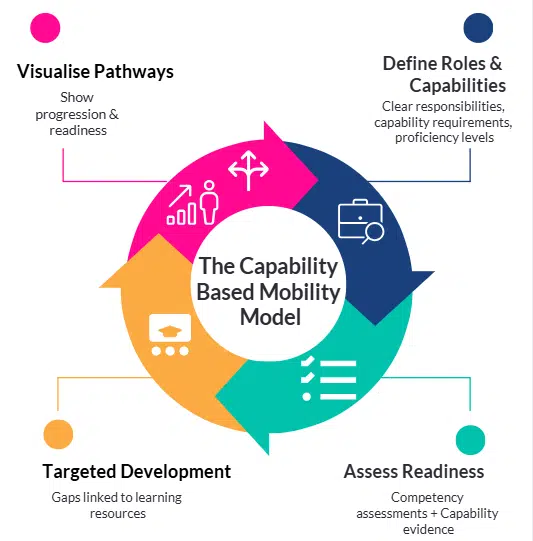
When organisations define roles through responsibilities, capability requirements, competencies and proficiency expectations, mobility becomes fair, transparent and repeatable.
1. Clear role-to-role pathways
Capability profiles define:
- the capability requirements to meet requirements of each role
- how expectations increase across levels
- vertical and lateral career pathways
- the structure of career ladders and ladders by function
- what constitutes readiness for the next step
This gives employees visibility and removes ambiguity.
2. Objective assessment of progression readiness
Consistent capability data enables:
- valid, repeatable competency assessments
- clear identification of strengths and gaps
- role-specific development planning
- fair and evidence-based readiness decisions
This strengthens the leadership pipeline and succession plans.
3. Personalized development aligned to progression
Employees and managers can see:
- exactly which capabilities to build
- which skills require verification
- what proficiency looks like
- which learning resources support each capability gap
- how progress contributes to career progression
Development becomes targeted and motivating.
4. Mobility becomes a scalable, data-driven system
Using capability data, employees gain visibility into:
- all viable roles they can move into
- career development pathways across functions
- capability gaps for each role
- proficiency levels required for progression
- real-time readiness indicators
Mobility becomes systematic — not subjective or political.
The Role of Career Path Visualization
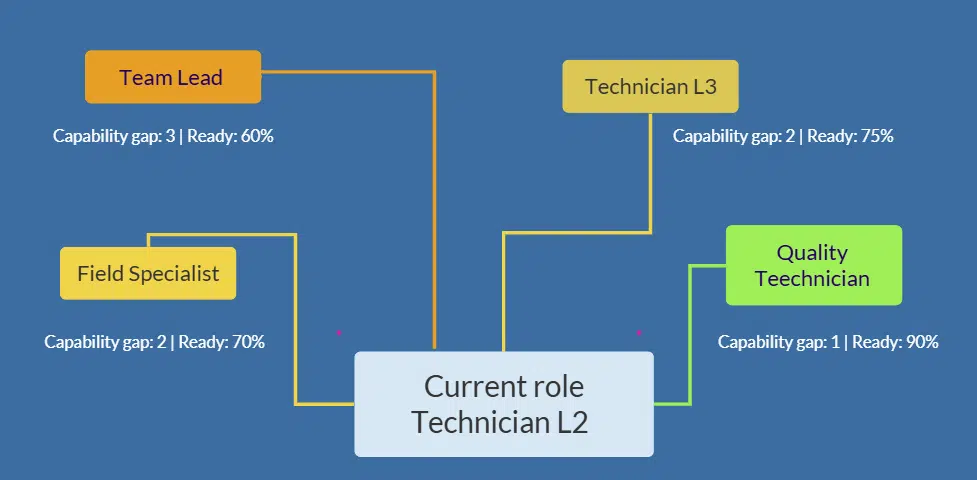
Visualisation converts capability data into something employees can understand and act on.
Rather than text-heavy tables, employees see:
- their current role
- adjacent roles and next-step roles
- lateral options
- vertical and cross-functional career ladders
- gaps in capability, competence or proficiency
- recommended development actions
- readiness for progression in real time
This shifts ownership of development from HR → to employees and their managers.
Linear. Single route. Limited options.

Multiple routes. Lateral opportunities. Capability-driven.

How Centranum Enables Effective Talent Mobility
Centranum supports consistent, capability-driven mobility across technical, clinical and professional roles by integrating:
✔ Role & Capability Architecture – Clear job families, levels, career pathways and capability requirements.
✔ Competency Profiles & Proficiency Mapping – Consistent competencies with role-specific proficiency thresholds.
✔ Assessments & Evidence Tracking – Self, manager, multi-source and knowledge-based assessment options — with evidence captured and linked.
✔ Gap-Based Development Planning – Development plans automatically aligned to capability gaps.
✔ Career Path Visualizer -Displays career ladders, lateral moves, capability gaps and readiness indicators.
✔ Succession Planning & Talent Assessment – Unified readiness, risk, potential and capability insights that strengthen the leadership pipeline.
Together, these capabilities make internal mobility a reliable organisational system — not an annual exercise.
When This Approach Is Most Useful
Use capability-driven mobility when you are:
- redesigning career pathways or career ladders
- addressing turnover or low internal promotion rates
- building a stronger succession pipeline
- modernising capability frameworks for 2026
- improving onboarding or development pathways
- supporting progression in clinical, technical or professional roles
- implementing job architecture or capability frameworks
Related Resources
Career Path Visualisation — Why It Matters
How capability clarity transforms progression pathways and internal mobility.
Succession Planning: How to Build a Ready Leadership Pipeline
A structured, evidence-based approach to succession across technical, clinical and professional roles.
Role & Capability Architecture — Foundations for Workforce Clarity
Why job families, role levels and capability profiles are essential for internal mobility and career progression.
Workforce Capability Growth & Careers
How integrated capability data supports role progression, mobility, development planning and talent retention.
FAQ
Why does internal mobility break down even in mature organisations?
Because capability expectations are unclear. Most organisations rely on outdated job descriptions, inconsistent competency profiles or subjective assessments of readiness. Without transparent capability and proficiency requirements, mobility becomes dependent on manager opinion rather than evidence.
What’s the difference between internal mobility and talent mobility?
The terms are often used interchangeably, but:
- Internal mobility focuses on movement within the organisation (lateral or vertical).
- Talent mobility emphasizes movement of capability — deploying skills and competence where they create the most value.
A capability-based approach supports both.
How do career pathways differ from career ladders?
Career ladders are linear — moving “up” in one function.
Career pathways are dynamic — showing lateral moves, cross-functional options, and multiple routes to progression depending on capability growth.
Modern workforce strategies use pathways, not ladders alone.
How does capability data improve fairness and effectiveness in progression decisions?
Capability profiles and proficiency thresholds give every employee the same transparent criteria for readiness. Assessments are based on consistent evidence, not personal preference or manager familiarity. This reduces bias and strengthens equity in progression.
What capability elements matter most for career progression?
The most important elements are:
- role responsibilities (the “what”)
- key capabilities and competencies
- proficiency thresholds
- evidence from assessments or real work
This combination provides a clear, defensible view of readiness.
How does this support succession planning?
Capability clarity allows organisations to monitor readiness levels, identify progression gaps and create targeted development plans. It builds a reliable leadership pipeline by ensuring mobility and succession decisions are based on evidence, not intuition.
What is the role of career path visualization?
Visualization makes possibilities visible. Employees can see next-step roles, capability gaps, lateral opportunities, and recommended development actions. This increases engagement, supports retention and reduces the ambiguity that normally blocks mobility.
How does Centranum support career progression for clinical and technical roles?
Technical and clinical roles require precise capability and proficiency definitions. Centranum supports:
- role/level structures
- knowledge and competency requirements
- proficiency thresholds
- evidence capture
- learning resources linked to capability gaps
This ensures consistent, defensible progression in regulated environments.