
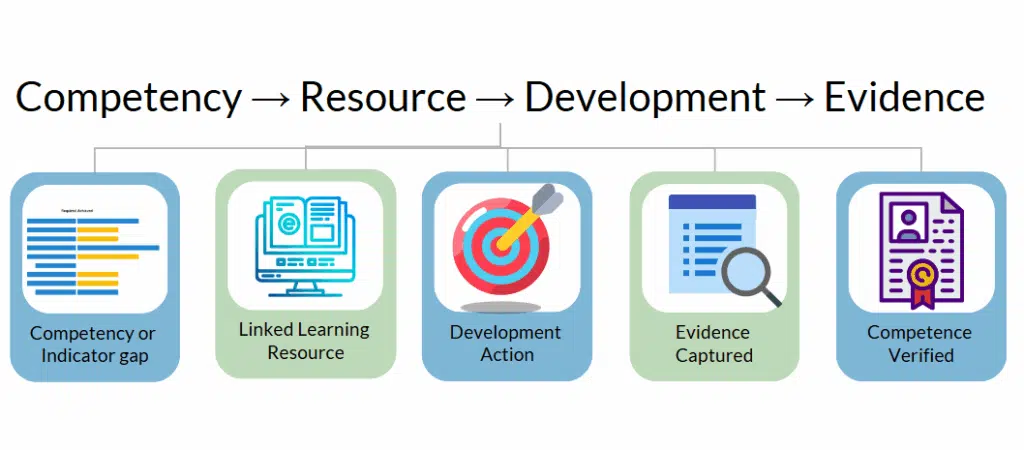
Link Learning Resources to Competencies and Skills
Most organisations already have large volumes of learning content — policies, protocols, SOPs, guides, videos, external courses, e-learning — but very little of it is directly connected to demonstrated competence.
As a result:
- learning is assigned generically rather than targeted
- training completion is mistaken for capability
- development plans are manual and inconsistent
- orientation and transition programmes are difficult to standardize
Centranum addresses this by linking learning resources directly to competencies — and down to skill and knowledge indicators — so development actions are precise, role-relevant, and auditable.
The Core Problem: Learning Exists, but It Isn’t Connected to Competence
In most organisations:
- competencies are defined in one system
- assessments happen elsewhere (or informally)
- learning resources sit in shared drives, LMS platforms, or external sites
- development plans rely on free text and manager discretion
This disconnect means:
- gaps identified in assessments do not reliably translate into learning actions
- staff complete courses that don’t address their actual performance needs
- auditors see training records, but not evidence of competence improvement
The issue is not a lack of learning content — it is a lack of structured linkage.
What “Competency-Linked Learning Resources” Actually Means
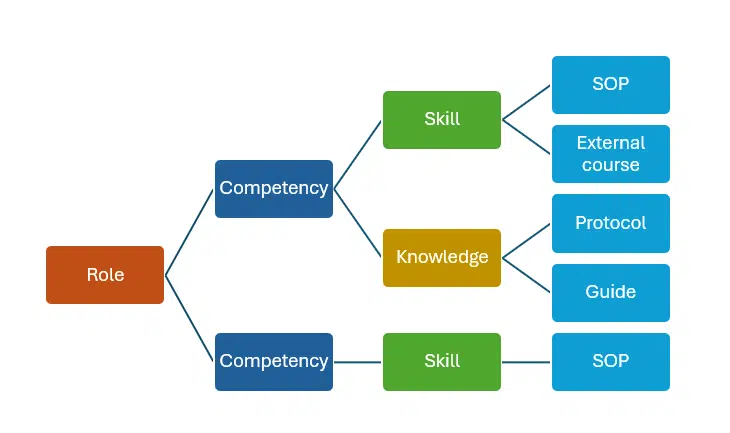
Competency-linked learning goes beyond tagging courses to roles. In practice, it means learning resources can be linked at multiple levels:
- Role level – Resources relevant to a specific job, scope, or programme.
- Competency level – Resources that support the overall performance expectation.
- Indicator / skill / knowledge level – Highly targeted materials linked to specific tasks, skills, or knowledge requirements.
This structure allows learning to be prescribed based on what is missing, not what is generally available.
How Learning Resources Are Managed in Centranum
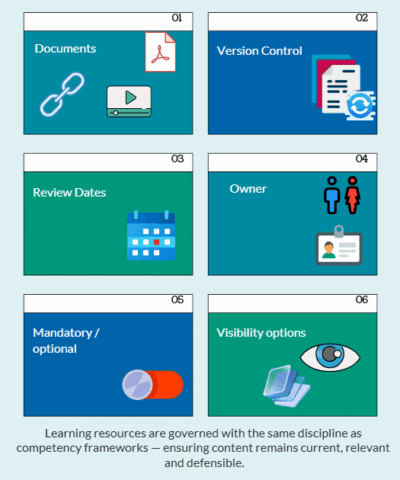
Centranum includes a configurable learning resource library that supports:
- internal documents (guides, protocols, SOPs)
- externally hosted content (URLs, LMS links, vendor platforms)
- different resource types (reference, mandatory, e-learning, hybrid course materials)
- version control, ownership, and review dates
- visibility rules by audience – unit, role, programme, or cohort
Resources can be linked directly to:
- competencies
- sub-competencies
- skill or knowledge indicators
This ensures learning materials are available to view alongside expectations, in assessment results and at the point of development planning, not buried in separate systems.
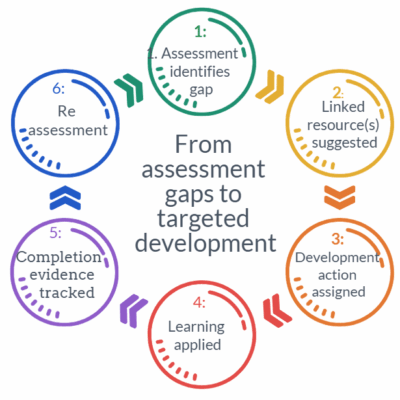
From Assessment Gaps to Targeted Development (The Closed Loop)
A key differentiator of Centranum is the closed loop between assessment, development, and re-assessment.
In practice:
- A competency or indicator gap is identified during assessment
- Linked learning resources are already available
- A development plan is created with targeted actions
- Evidence of learning and application is captured
- Competence is re-assessed and verified
This replaces generic “training required” actions with specific, evidence-based development.
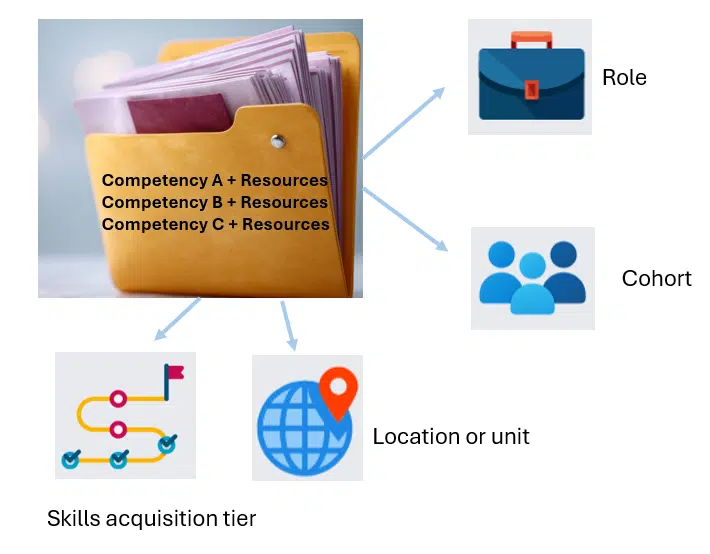
Development Programmes and Orientation Bundles
For onboarding, transition-to-practice, and re-skilling, organisations often need more than individual development plans.
Centranum supports structured development programmes, where:
- a programme is defined as a bundle of learning objectives (competencies and indicators)
- learning resources are pre-linked
- assessment requirements are clearly specified via requirement profiles
- including evidence expectations for consistency
These programmes can be:
- assigned en masse to cohorts (e.g. new starters, interns, graduates)
- automatically assigned based on:
- role assignment
- programme stage – requirement profile
- TSAM tier or progression rules
- identified competence gaps
This is particularly valuable for:
- clinical orientation
- regulated roles
- safety-critical environments
- large or distributed workforces
Why Indicator-Level Linking Matters
Many platforms stop at the competency level. In practice, this is often insufficient — especially where:
- competencies are broad
- skills are safety-critical
- knowledge must be applied correctly in context
By linking learning resources at the indicator, skill, or knowledge level, organisations can:
- target remediation precisely
- avoid over-training
- support supervised practice where needed
- document readiness for independent work
This approach aligns naturally with TSAM Tiered Skills Acquisition Model) -style tiered development and EPA (Entrusted Professional Activities) -based assessment.
Practical Examples
Clinical orientation
A protocol, skills guide, and observation checklist are linked to a specific indicator within a competency. Evidence is uploaded as part of assessment after or during supervised practice and reviewed before sign off.
Pharmacy professional activities
Knowledge resources and practice guidelines are linked to task-level indicators within a Professional Activity, supporting staged entrustment decisions.
Technical or operational roles
SOPs and safety documents are linked to critical skills. Development actions may be triggered when gaps are identified.
Why This Matters
Linking learning resources to competencies and indicators delivers measurable benefits:
- faster, more consistent onboarding
- reduced reliance on generic training
- clearer expectations for staff and supervisors
- defensible development decisions
- a single audit trail connecting learning, assessment, and competence
Most importantly, it ensures learning activity contributes directly to demonstrated capability, not just training completion.
How This Fits with the Centranum Platform
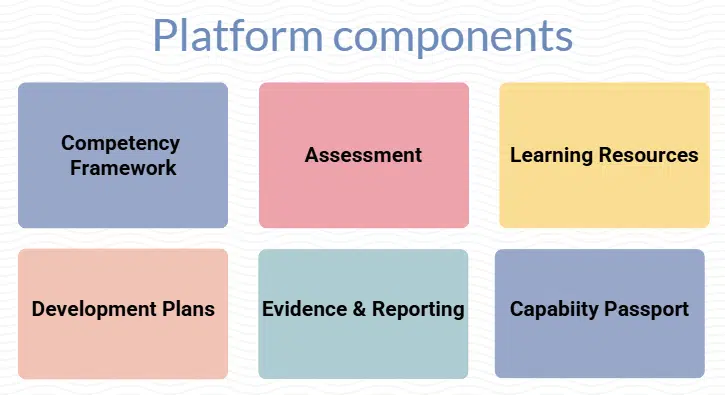
Competency-linked learning resources integrate with:
- competency assessments
- TSAM-style tiered development
- EPA-based models
- development plans
- journals and performance conversations
- capability passports and reporting
All components operate within a single data model, ensuring consistency across assessment, development, and assurance.
Related Reading
Capability & Competency Resources – Resources on competency concepts, examples, best practices, systems implementation, research and business case
Clinical Competency Management Resources – Resources specific to competency management in clinical settings.
FAQ
Can learning resources be linked below the competency level?
Yes. Learning resources can be linked not only to competencies, but also to skill and knowledge indicators within a competency. This allows development actions to be targeted to specific gaps rather than assigning generic training.
Does this replace our LMS?
No. Centranum complements LMS platforms by structuring and prescribing learning based on competence needs. Learning resources may be hosted internally, linked from an LMS, or referenced externally.
How does this support orientation and transition programmes?
Orientation programmes can be built as bundles of competencies and indicators, with learning resources and assessment requirements pre-linked. These programmes can be assigned in bulk or automatically to cohorts, roles, or progression stages.
Can learning be triggered automatically after an assessment?
Yes. Development plans can be informed directly by assessment outcomes, ensuring learning actions are relevant to the identified gaps rather than generic recommendations.
How is learning evidence captured?
Evidence such as completed activities, uploaded documents, observed practice, or case-based discussions can be attached to development actions and assessments to support audit-ready verification of competence.
Is this suitable for clinical and non-clinical roles?
Yes. The same approach is used across clinical, technical, operational and professional roles, with resource depth and evidence requirements adjusted based on risk and governance needs.